 |
CUGL 4.0
Cornell University Game Library
|
Loading...
Searching...
No Matches
|
CUGL 4.0
Cornell University Game Library
|
#include <CUScene3.h>
Public Member Functions | |
| Scene3 () | |
| ~Scene3 () | |
| virtual void | dispose () override |
| virtual bool | init () override |
| bool | initWithViewport (const Size &size) |
| bool | initWithViewport (float width, float height) |
| bool | initWithViewport (const Rect &rect) |
| bool | initWithViewport (const Vec2 &origin, const Size &size) |
| bool | initWithViewport (float x, float y, float width, float height) |
| bool | initWithFOV (float fov) |
| virtual std::string | toString (bool verbose=false) const override |
| operator std::string () const | |
| size_t | getChildCount () const |
| std::shared_ptr< SceneNode > & | getChild (unsigned int pos) |
| const std::shared_ptr< SceneNode > & | getChild (unsigned int pos) const |
| template<typename T > | |
| std::shared_ptr< T > | getChild (unsigned int pos) const |
| std::shared_ptr< SceneNode > | getChildByTag (unsigned int tag) const |
| template<typename T > | |
| std::shared_ptr< T > | getChildByTag (unsigned int tag) const |
| std::shared_ptr< SceneNode > | getChildByName (const std::string name) const |
| template<typename T > | |
| std::shared_ptr< T > | getChildByName (const std::string name) const |
| std::vector< std::shared_ptr< SceneNode > > & | getChildren () |
| const std::vector< std::shared_ptr< SceneNode > > & | getChildren () const |
| virtual void | addChild (const std::shared_ptr< SceneNode > &child) |
| void | addChildWithTag (const std::shared_ptr< SceneNode > &child, unsigned int tag) |
| void | addChildWithName (const std::shared_ptr< SceneNode > &child, const std::string name) |
| void | swapChild (const std::shared_ptr< SceneNode > &child1, const std::shared_ptr< SceneNode > &child2, bool inherit=false) |
| virtual void | removeChild (unsigned int pos) |
| void | removeChild (const std::shared_ptr< SceneNode > &child) |
| void | removeChildByTag (unsigned int tag) |
| void | removeChildByName (const std::string name) |
| virtual void | removeAllChildren () |
| std::shared_ptr< Scene3Pipeline > | getPipeline () const |
| void | setPipeline (const std::shared_ptr< Scene3Pipeline > &pipeline) |
| const std::shared_ptr< graphics::FrameBuffer > & | getFrameBuffer () const |
| void | setFrameBuffer (const std::shared_ptr< graphics::FrameBuffer > &buffer) |
| virtual void | render () override |
 Public Member Functions inherited from cugl::Scene Public Member Functions inherited from cugl::Scene | |
| Scene () | |
| ~Scene () | |
| virtual void | dispose () |
| virtual bool | init () |
| const std::string & | getName () const |
| void | setName (const std::string name) |
| std::shared_ptr< Camera > & | getCamera () |
| const std::shared_ptr< Camera > & | getCamera () const |
| virtual std::string | toString (bool verbose=false) const |
| operator std::string () const | |
| const Size & | getSize () const |
| const Rect | getBounds () const |
| Vec3 | screenToWorldCoords (const Vec2 &screenCoords) const |
| Vec2 | worldToScreenCoords (const Vec3 &worldCoords) const |
| bool | isActive () const |
| virtual void | setActive (bool value) |
| virtual void | update (float dt) |
| virtual void | reset () |
| virtual void | render () |
Static Public Member Functions | |
| static std::shared_ptr< Scene3 > | alloc () |
| static std::shared_ptr< Scene3 > | allocWithViewport (const Size &size) |
| static std::shared_ptr< Scene3 > | allocWithViewport (float width, float height) |
| static std::shared_ptr< Scene3 > | allocWithViewport (const Rect &rect) |
| static std::shared_ptr< Scene3 > | allocWithViewport (const Vec2 &origin, const Size &size) |
| static std::shared_ptr< Scene3 > | allocWithViewport (float x, float y, float width, float height) |
| static std::shared_ptr< Scene3 > | allocWithFOV (float fov) |
Protected Attributes | |
| std::shared_ptr< Scene3Pipeline > | _pipeline |
| std::vector< std::shared_ptr< SceneNode > > | _children |
| std::shared_ptr< graphics::FrameBuffer > | _framebuffer |
| Protected Attributes inherited from cugl::Scene | |
| std::shared_ptr< Camera > | _camera |
| std::string | _name |
| Size | _size |
| bool | _active |
Friends | |
| class | SceneNode |
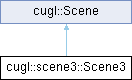
This class provides the root node of a three-dimensional scene graph.
The Scene2 class is very similar to scene3::SceneNode and shares some methods in common. The major difference is that it has no parent and it has no position (so it cannot be transformed). Instead, the Scene2 is defined by an attached PerspectiveCamera.
Rendering a scene graph happens via a Scene3Pipeline. That pipeline uses depth testing to properly render the scene, but may perform sorting in order to preserve transparency and similar such affects.
| cugl::scene3::Scene3::Scene3 | ( | ) |
Creates a new degenerate scene on the stack.
The scene has no camera and must be initialized.
NEVER USE A CONSTRUCTOR WITH NEW. If you want to allocate an object on the heap, use one of the static constructors instead.
|
inline |
Deletes this scene, disposing all resources
|
virtual |
Adds a child to this scene.
Children are not necessarily enumerated in the order that they are added. Hence you should generally attempt to retrieve a child by tag or by name instead.
| child | A child node. |
|
inline |
Adds a child to this scene with the given name.
Children are not necessarily enumerated in the order that they are added. Hence you should generally attempt to retrieve a child by tag or by name instead.
| child | A child node. |
| name | A string to identify the node. |
|
inline |
Adds a child to this scene with the given tag.
Children are not necessarily enumerated in the order that they are added. Hence you should generally attempt to retrieve a child by tag or by name instead.
| child | A child node. |
| tag | An integer to identify the node easily. |
|
inlinestatic |
Returns a newly allocated scene with the default FOV.
This scene will have a viewport that matches the display and a perspective camera with a FOV of 67 degrees. The camera will be pointed at the origin.
The scene will not have an attached pipeline. You must add one with setPipeline.
|
inlinestatic |
Returns a newly allocated scene with the given field of view.
The viewport will match the size of the display. The field of view given is for the height, and is measured in degrees.
The scene will not have an attached pipeline. You must add one with setPipeline.
| fov | The field of view |
|
inlinestatic |
Returns a newly allocated scene for the given viewport.
The viewport is used to define a perspective camera on the display. The camera will be pointed at the origin with a FOV of 67 degrees.
The viewport origin only affects the coordinate conversion methods Camera#project() and Camera#unproject() which are used to convert from the scene graph to a display. It is intended to represent the offset of the viewport in a larger canvas.
The scene will not have an attached pipeline. You must add one with setPipeline.
| rect | The viewport bounding box |
|
inlinestatic |
Returns a newly allocated scene for the given viewport.
The viewport is used to define a perspective camera on the display. The camera will be pointed at the origin with a FOV of 67 degrees.
The scene will not have an attached pipeline. You must add one with setPipeline.
| size | The viewport size |
|
inlinestatic |
Returns a newly allocated scene for the given viewport.
The viewport is used to define a perspective camera on the display. The camera will be pointed at the origin with a FOV of 67 degrees.
The viewport origin only affects the coordinate conversion methods Camera#project() and Camera#unproject() which are used to convert from the scene graph to a display. It is intended to represent the offset of the viewport in a larger canvas.
The scene will not have an attached pipeline. You must add one with setPipeline.
| origin | The viewport offset |
| size | The viewport size |
|
inlinestatic |
Returns a newly allocated scene for the given viewport.
The viewport is used to define a perspective camera on the display. The camera will be pointed at the origin with a FOV of 67 degrees.
The scene will not have an attached pipeline. You must add one with setPipeline.
| width | The viewport width |
| height | The viewport height |
|
inlinestatic |
Returns a newly allocated scene for the given viewport.
The viewport is used to define a perspective camera on the display. The camera will be pointed at the origin with a FOV of 67 degrees.
The viewport origin only affects the coordinate conversion methods Camera#project() and Camera#unproject() which are used to convert from the scene graph to a display. It is intended to represent the offset of the viewport in a larger canvas.
The scene will not have an attached pipeline. You must add one with setPipeline.
| x | The viewport x offset |
| y | The viewport y offset |
| width | The viewport width |
| height | The viewport height |
|
overridevirtual |
Disposes all of the resources used by this scene.
A disposed scene can be safely reinitialized. Any children owned by this scene will be released. They will be deleted if no other object owns them.
Reimplemented from cugl::Scene.
| std::shared_ptr< SceneNode > & cugl::scene3::Scene3::getChild | ( | unsigned int | pos | ) |
Returns the child at the given position.
Children are not necessarily enumerated in the order that they are added. For example, they may be resorted by their z-order. Hence you should generally attempt to retrieve a child by tag or by name instead.
| pos | The child position. |
| const std::shared_ptr< SceneNode > & cugl::scene3::Scene3::getChild | ( | unsigned int | pos | ) | const |
Returns the child at the given position.
Children are not necessarily enumerated in the order that they are added. Hence you should generally attempt to retrieve a child by tag or by name instead.
| pos | The child position. |
|
inline |
Returns the child at the given position, typecast to a shared T pointer.
This method is provided to simplify the polymorphism of a scene graph. While all children are a subclass of type Node, you may want to access them by their specific subclass. If the child is not an instance of type T (or a subclass), this method returns nullptr.
Children are not necessarily enumerated in the order that they are added. Hence you should generally attempt to retrieve a child by tag or by name instead.
| pos | The child position. |
| std::shared_ptr< SceneNode > cugl::scene3::Scene3::getChildByName | ( | const std::string | name | ) | const |
Returns the (first) child with the given name.
If there is more than one child of the given name, it returns the first one that is found. Children are not necessarily enumerated in the order that they are added. Hence it is very important that names be unique.
| name | An identifier to find the child node. |
|
inline |
Returns the (first) child with the given name, typecast to a shared T pointer.
This method is provided to simplify the polymorphism of a scene graph. While all children are a subclass of type Node, you may want to access them by their specific subclass. If the child is not an instance of type T (or a subclass), this method returns nullptr.
If there is more than one child of the given name, it returns the first one that is found. Children are not necessarily enumerated in the order that they are added. Hence it is very important that names be unique.
| name | An identifier to find the child node. |
| std::shared_ptr< SceneNode > cugl::scene3::Scene3::getChildByTag | ( | unsigned int | tag | ) | const |
Returns the (first) child with the given tag.
If there is more than one child of the given tag, it returns the first one that is found. Children are not necessarily enumerated in the order that they are added. Hence it is very important that tags be unique.
| tag | An identifier to find the child node. |
|
inline |
Returns the (first) child with the given tag, typecast to a shared T pointer.
This method is provided to simplify the polymorphism of a scene graph. While all children are a subclass of type Node, you may want to access them by their specific subclass. If the child is not an instance of type T (or a subclass), this method returns nullptr.
If there is more than one child of the given tag, it returns the first one that is found. Children are not necessarily enumerated in the order that they are added. Hence it is very important that tags be unique.
| tag | An identifier to find the child node. |
|
inline |
Returns the number of immediate children of this scene.
|
inline |
Returns the list of the scene's immediate children.
|
inline |
Returns the list of the scene's immediate children.
|
inline |
Returns the offscreen framebuffer associated with this scene.
If this value is nullptr (the default), then this scene will be rendered to the primary display. Otherwise, it will be rendered to the given framebuffer. The framebuffer must be compatible with a sprite batch. However, we do not require that the framebuffer be the same size as the display.
|
inline |
Returns the pipeline for rendering this scene.
Scene3 nodes are typically rendered with a Scene3Pipeline object. In particular the method render traverses the scene graph and sends those nodes to pipeline (though this behavior can be overridden).
As graphics pipelines are fairly heavy-weight pipelines, we do not construct a pipeline for each scene. Instead a pipeline has to be assigned to the scene. If no pipeline is assigned, nothing is drawn.
|
overridevirtual |
Initializes a Scene with the default FOV.
This scene will have a viewport that matches the display and a perspective camera with a FOV of 67 degrees. The camera will be pointed at the origin.
The scene will not have an attached pipeline. You must add one with setPipeline.
Reimplemented from cugl::Scene.
| bool cugl::scene3::Scene3::initWithFOV | ( | float | fov | ) |
Initializes a scene with the given field of view.
The viewport will match the size of the display. The field of view given is for the height, and is measured in degrees.
The scene will not have an attached pipeline. You must add one with setPipeline.
| fov | The field of view |
|
inline |
Initializes a scene with the given viewport.
The viewport is used to define a perspective camera on the display. The camera will be pointed at the origin with a FOV of 67 degrees.
The viewport origin only affects the coordinate conversion methods Camera#project() and Camera#unproject() which are used to convert from the scene graph to a display. It is intended to represent the offset of the viewport in a larger canvas.
The scene will not have an attached pipeline. You must add one with setPipeline.
| rect | The viewport bounding box |
|
inline |
Initializes a scene with the given viewport.
The viewport is used to define a perspective camera on the display. The camera will be pointed at the origin with a FOV of 67 degrees.
The scene will not have an attached pipeline. You must add one with setPipeline.
| size | The viewport size |
Initializes a scene with the given viewport.
The viewport is used to define a perspective camera on the display. The camera will be pointed at the origin with a FOV of 67 degrees.
The viewport origin only affects the coordinate conversion methods Camera#project() and Camera#unproject() which are used to convert from the scene graph to a display. It is intended to represent the offset of the viewport in a larger canvas.
The scene will not have an attached pipeline. You must add one with setPipeline.
| origin | The viewport offset |
| size | The viewport size |
|
inline |
Initializes a scene with the given viewport.
The viewport is used to define a perspective camera on the display. The camera will be pointed at the origin with a FOV of 67 degrees.
The scene will not have an attached pipeline. You must add one with setPipeline.
| width | The viewport width |
| height | The viewport height |
| bool cugl::scene3::Scene3::initWithViewport | ( | float | x, |
| float | y, | ||
| float | width, | ||
| float | height | ||
| ) |
Initializes a scene with the given viewport.
The viewport is used to define a perspective camera on the display. The camera will be pointed at the origin with a FOV of 67 degrees.
The viewport origin only affects the coordinate conversion methods Camera#project() and Camera#unproject() which are used to convert from the scene graph to a display. It is intended to represent the offset of the viewport in a larger canvas.
The scene will not have an attached pipeline. You must add one with setPipeline.
| x | The viewport x offset |
| y | The viewport y offset |
| width | The viewport width |
| height | The viewport height |
|
inline |
Cast from a Scene to a string.
|
virtual |
Removes all children from this Node.
| void cugl::scene3::Scene3::removeChild | ( | const std::shared_ptr< SceneNode > & | child | ) |
Removes a child from this Scene.
Removing a child alters the position of every child after it. Hence it is unsafe to cache child positions.
If the child is not in this node, nothing happens.
| child | The child node which will be removed. |
|
virtual |
Removes the child at the given position from this Scene.
Removing a child alters the position of every child after it. Hence it is unsafe to cache child positions.
| pos | The position of the child node which will be removed. |
| void cugl::scene3::Scene3::removeChildByName | ( | const std::string | name | ) |
Removes a child from the Scene by name.
If there is more than one child of the given name, it removes the first one that is found. Children are not necessarily enumerated in the order that they are added. Hence it is very important that names be unique.
| name | A string to identify the node. |
| void cugl::scene3::Scene3::removeChildByTag | ( | unsigned int | tag | ) |
Removes a child from the Scene by tag value.
If there is more than one child of the given tag, it removes the first one that is found. Children are not necessarily enumerated in the order that they are added. Hence it is very important that tags be unique.
| tag | An integer to identify the node easily. |
|
overridevirtual |
Draws all of the children in this scene with the given pipeline.
Rendering happens by traversing the the scene graph using an "Pre-Order" tree traversal algorithm ( https://en.wikipedia.org/wiki/Tree_traversal#Pre-order ). That means that parents are always draw before children.
Reimplemented from cugl::Scene.
|
inline |
Sets the offscreen framebuffer associated with this scene.
If this value is nullptr (the default), then this scene will be rendered to the primary display. Otherwise, it will be rendered to the given framebuffer. The framebuffer must be compatible with a sprite batch. However, we do not require that the framebuffer be the same size as the display.
| buffer | The offscreen framebuffer for this scene (or nullptr) |
|
inline |
Sets the pipeline for rendering this scene.
Scene3 nodes are typically rendered with a Scene3Pipeline object. In particular the method render traverses the scene graph and sends those nodes to pipeline (though this behavior can be overridden).
As graphics pipelines are fairly heavy-weight pipelines, we do not construct a pipeline for each scene. Instead a pipeline has to be assigned to the scene. If no pipeline is assigned, nothing is drawn.
| pipeline | The pipeline for rendering this scene. |
| void cugl::scene3::Scene3::swapChild | ( | const std::shared_ptr< SceneNode > & | child1, |
| const std::shared_ptr< SceneNode > & | child2, | ||
| bool | inherit = false |
||
| ) |
Swaps the current child child1 with the new child child2.
If inherit is true, the children of child1 are assigned to child2 after the swap; this value is false by default. The purpose of this value is to allow transitions in the scene graph.
This method is undefined if child1 is not a child of this scene.
| child1 | The current child of this node |
| child2 | The child to swap it with. |
| inherit | Whether the new child should inherit the children of child1. |
|
overridevirtual |
Returns a string representation of this scene for debugging purposes.
If verbose is true, the string will include class information. This allows us to unambiguously identify the class.
| verbose | Whether to include class information |
Reimplemented from cugl::Scene.
|
protected |
The array of internal nodes
|
protected |
An (optional) offscreen buffer for rendering the scene.
|
protected |
The camera for this scene
 1.9.7
1.9.7