I have been working on an efficient toolkit for pangenomics, called FlatGFA. Relative to other pangenomics tools like odgi, FlatGFA has only one trick: a zero-copy data format. The in-memory data format is identical to the on-disk format, so FlatGFA can skip all serialization and deserialization costs; opening a file consists of an mmap(2). For unfairly cherry-picked workloads, FlatGFA can be thousands of times faster than odgi.
Now comes the hard part: I want my genomicist colleagues to actually use FlatGFA. I want to write an inventory of high-performance operations and let the real scientists compose them into complete workflows.
To let them do that kind of composition, there were two simple options: we could either (1) make a command-line interface that exposes all the operators and let the scientists write shell scripts to compose them, or (2) design a Rust API and have the scientists write Rust code. Neither option is very compelling:
- The CLI approach limits the kind of composition you can do. All intermediates need to be either files or pipes, which can get awkward and surely comes with some overhead.
- Our internal Rust API uses, because of all the data-structure tricks we play, an endearingly idiosyncratic style. Even though our biologist collaborators are great Rust hackers, I can’t in good conscience say that we have a good API that they’d be happy to use.
This post is about the very silly alternative that we recently built: a fake shell that pretends to offer option 1 but approximates the performance of option 2.
On Ousterhout Dichotomies
For a long time, I thought that the right way to “package” a performance-oriented library like FlatGFA might be with a standard Ousterhout dichotomy. The performance-sensitive routines stay in Rust, but we build bindings to a higher-level language for composing those routines into whole workflows. The result would look a lot like PyTorch: it doesn’t matter to ML engineers that Python isn’t very fast because more than 99% of the time is spent in optimized kernel routines written in C++ and CUDA.
Python is the natural choice for the “glue language” part of an Ousterhout dichotomy in the modern era.1 So we started building Python bindings for FlatGFA using the excellent PyO3 project. We got the basics working reasonably well—for example, try this to see it in action:
$ curl -LO https://raw.githubusercontent.com/pangenome/odgi/refs/heads/master/test/LPA.gfa
$ uv run --with flatgfa python
>>> import flatgfa
>>> graph = flatgfa.parse("LPA.gfa")
>>> [path.name for path in graph.paths]
However, Python bindings had a few serious downsides:
- Even with PyO3, the bindings are hard to write efficiently. The problem is the fundamental complexity in the mismatch between Rust’s static lifetimes and Python’s dynamically managed heap. FlatGFA’s performance advantages come from eliminating copies, allocations, and pointer-chasing—all things that want to creep back in at the Rust/Python boundary.
- We don’t get a whole-program view of the workload. Straightforward Python bindings mean that our only opportunity to go fast is within each call to the library, and we can’t do much across multiple calls. For example, the moment that the user writes a Python
forloop that iterates over a FlatGFA data structure, we almost certainly lose the performance game. This is the same underlying reason that PyTorch has a separate, optional compiled mode, for example. - It turns out that our biologist collaborators aren’t exactly enamored with Python anyway! The traditional, familiar way to compose pangenomic pipelines is via the Unix shell. Personally, I have become too accustomed to Python being the default choice for approachability. Naturally, preferences among domain experts are contextual and varied.
It made sense to reconsider the CLI-oriented approach that odgi and friends all use.
Reconsidering the Shell
Let’s look at an example of shell-based composition in this domain. One tutorial from the odgi documentation shows how to find repetitive sequences in human chromosome 8 by composing operators from odgi itself and bedtools:
odgi depth -i chr8.pan.og -r chm13#chr8 | \
    bedtools makewindows -b /dev/stdin -w 5000 > chm13.chr8.w5kbps.bed

odgi depth -i chr8.pan.og -b chm13.chr8.w5kbps.bed --threads 2 | \
    bedtools sort > chr8.pan.depth.w5kbps.bed
It might seem odd to prefer shell scripting over a full-featured dynamic scripting language, but shell scripts like this have some material advantages over Python:
- Streaming I/O via pipes can be great for large datasets, in the right situation.
- Simple pipeline parallelism is easy to express.
- It’s straightforward to persist intermediate results in files.
- The shell is kinda the ultimate glue language: you can compose components developed separately, written in different languages, with no special effort on bindings. (The only “bindings” are the Unix userland APIs.)
This example workflow uses four operators from two different packages, two Unix pipes, and one intermediate file. I don’t think it matters much in this example, but it’s nice that the shell pipelines let the two pairs of commands run concurrently. To borrow a phrase from Greenberg et al., the shell is actually good.2
There is, however, one gigantic downside: the only ways to exchange data between operations are files and pipes. Files can entail writing stuff to the disk unnecessarily, even when all the bytes fit comfortably in memory. Pipes can avoid disk I/O and can be a great fit for streaming operators, but they generally entail serializing everything to text, and not every producer–consumer relationship naturally supports streaming. For example, if one command generates a new variation graph (a new GFA file), the next command probably needs to read the whole thing before it can start its work.
In our weekly meeting for a grant about pangenomics, the group got into a slightly heated discussion about these fundamental limits of shell-based composition.
Maybe the OS’s disk cache can mostly mitigate the file I/O cost?
Could you force it by putting the files in a RAM disk?
(What even happens when you mmap a file that’s on a RAM disk?)
Maybe none of that is practical anyway when datasets grow large enough to overflow main memory?
What happens to all these trade-offs if we change all the underlying commands to use zero-copy binary file formats instead of text-based streaming?
Would that approach make scripts messier and sacrifice all the benefits of pipelining?
In that discussion, I realized that there was a ridiculous, impractical, but very fun alternative that could sidestep all these downsides.
Digression: Vectorized Interpreters

In 2023, Graydon Hoare gave a talk at UCSC about “vectorized interpreters” that made a big impression on me.3 He makes the point that native-code compilers (especially JITs) are an extremely complicated way to extract performance from code. The idea that stuck with me was that, with suitable cooperation from the programming model, interpreters that operate in bulk can be a simple and fast alternative. If every instruction in your bytecode represents a big computation on a lot of data (instead of, say, a single scalar integer addition), then straightforwardly interpreting that bytecode is plenty efficient. There’s no need to worry about the cost of bytecode instruction dispatch, for example, when 99.99% of the time goes to running the implementation of those chunky instructions.
In Graydon’s presentation, PyTorch and NumPy are both examples of vectorized interpreters. But as I touched on above, they reuse Python’s program representation and interpreter—so their addressable “instruction window” is limited.
I had been thinking that there must be a way to do better with a bespoke vectorized interpreter for pangenomics operations. And the problems with shell-script workflows provided an excuse to try doing something about it.
A Fake Shell
The idea is to build a fake shell: something that supports a tiny fraction of POSIX shell syntax and “cheats” when running pangenomic operators. The goal is to run unmodified shell scripts that use traditional CLI tools, like odgi and bedtools, and communicate through pipes and files. We’ll make the same biologist-authored shell scripts go faster by opportunistically switching to faster implementations and avoiding I/O.
The shell is called Flash (the FlatGFA shell), and if you want to play along, you can find it in our pangenomics monorepo.
Use cargo run to get an interactive prompt.
Shell Basics
The first thing Flash can do is run ordinary commands, just like a real shell would. This works, for example:
echo llenroc | rev > message.txt ; cat message.txt
To make this work, I borrowed an existing shell syntax parser from a “rewrite it in Rust” shell project.
But instead of interpreting the shell AST directly, Flash first translates it into an instruction-based intermediate representation.
That little script above translates into three instructions, one for each command it runs.
Flash can pretty-print the IR if you give it a --pretend (-p) flag:
$ flash -p -c 'echo llenroc | rev > message.txt ; cat message.txt'
shell("echo", ["llenroc"], input=stdin) -> pipe-0
shell("rev", [], input=pipe-0) -> "message.txt"
shell("cat", ["message.txt"], input=stdin) -> stdout
So far, we’re only using the shell instruction, which actually forks a subprocess (like a real shell would).
Flash’s IR is built around resources: the things that can be inputs and outputs to instructions.
This program uses the stdin and stdout resources, a Unix pipe, and a file.
Flash’s IR evaluator takes care of setting up pipes and opening files on behalf of each instruction.
Faking It
The thing that makes Flash a fake shell is that it special-cases a baked-in set of known pangenomic CLI tools. Let’s borrow one part of the script we saw above, for example:
$ flash -p -c 'odgi depth -i chr8.pan.gfa -r chm13#chr8'
parse-gfa("chr8.pan.gfa") -> gfa-store-0
path-depth(gfa-store-0, path="chm13#chr8") -> stdout
Flash has recognized our odgi depth invocation and, in place of a shell instruction, has generated some specialized instructions it can run internally.
The path-depth instruction works by directly calling a Rust function in the FlatGFA library, and it never forks a subprocess.
The shell instructions saw above used input and output resources.
These get names like pipe-0 and "message.txt" in the IR listings above.
For shell, the only kinds of resources allowed are byte streams (i.e., pipes and files).
The parse-gfa instruction, however, produces a new type of resource:
a GFA store, which is an efficient in-memory representation of a pangenomic variation graph.
This is a plain Rust value stored in the Flash interpreter’s environment.
When it eventually evaluates the path-depth instruction, the Flash interpreter retrieves the value and feeds it into the relevant library function.
This is the whole reason for inventing a fake shell: so it can cheat. Flash opportunistically avoids running real commands in favor of an elaborate library of builtins.
A Complete Example
Let’s see the IR representation of a more complete workflow.
I’ll put this script in a file called wdepth.sh:
#!/bin/sh
odgi depth -i chr8.pan.gfa -r chm13#chr8 \
    | bedtools makewindows -b /dev/stdin -w 5000 > chm13.chr8.w5kbps.bed
odgi depth -i chr8.pan.gfa -b chm13.chr8.w5kbps.bed
rm -f chm13.chr8.w5kbps.bed
Here’s the IR listing:
$ flash -p wdepth.sh
parse-gfa("chr8.pan.gfa") -> gfa-store-0
path-depth(gfa-store-0, path="chm13#chr8") -> pipe-0
parse-bed(pipe-0) -> bed-store-0
make-windows(bed-store-0, size=5000) -> "chm13.chr8.w5kbps.bed"
parse-gfa("chr8.pan.gfa") -> gfa-store-1
parse-bed("chm13.chr8.w5kbps.bed") -> bed-store-1
interval-depth(gfa-store-1, bed-store-1) -> stdout
shell("rm", ["-f", "chm13.chr8.w5kbps.bed"], input=stdin) -> stdout
The thing I like about Flash’s design is that it naturally supports mixing and matching different resource types. Some instructions interact with the external world through the filesystem or Unix pipes; others interact with Flash’s internal data structures. Both kinds of instructions can coexist and exchange data.
This example script can run both under plain ol’ sh and with Flash.
Let’s compare the performance:4
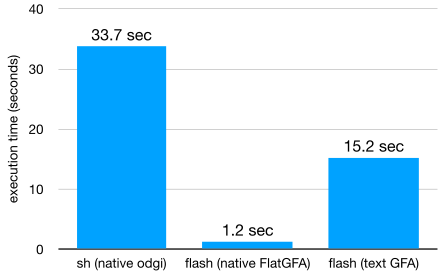
The first two bars are the important comparison:
both odgi (via plain sh) and FlatGFA (via Flash)
read the input graph in their respective efficient binary file format.
The last bar shows how Flash performs when it also has to parse the standard text GFA format for its input.
This particular little shell script runs 28× faster on Flash than when using a “real” shell and odgi underneath. I find this to be a satisfying speedup already! It’s also fun to see that Flash can outperform odgi even with the disadvantage of starting from the text GFA format. (I’ve omitted the bar for odgi reading a text GFA because it takes more than 7 minutes. I believe, without evidence, that FlatGFA has the world’s fastest GFA parser.)
Optimizations
This all makes for a fun language-implementation pastime, but the real reason for all this setup is to do optimizations. Flash’s instruction-based IR makes optimizations feasible (I can’t imagine how I’d implement them directly on the shell AST). Here are the optimizations I’ve implemented so far:
- When the program produces a BED file and then loads it again with a
parse-bedinstruction, avoid the round trip through bytes. Just produce an in-memory BED resource and use that directly. - Recognize uses of
path-depththat actually only need the number of base pairs, and replace them with the cheaperpath-lengthinstruction. (This one’s cheesy: it just so happens thatodgi depth -ris a convenient CLI way to get path length, even though it also needlessly computes depth.) - Find identical
map-fileinstructions that load the same file twice and deduplicate them. (If I were a better man, this would be a general CSE.) - The cheesiest one of all: when the program uses
parse-gfa("foo.gfa")and a file namedfoo.flatgfahappens to exist, replace it withmap-file("foo.flatgfa"). In other words, assuming that we’ve already converted the text GFA format to our efficient binary format, use that. (This ridiculous optimization mainly just helps with writing shell scripts that remain 100% compatible with a real POSIX shell.)
Here’s the result of optimizing our little script above:
$ flash -O -p wdepth.sh
map-file("chr8.pan.flatgfa") -> mmap-0
path-length(mmap-0, path="chm13#chr8") -> bed-store-0
make-windows(bed-store-0, size=5000) -> bed-store-1
interval-depth(mmap-0, bed-store-1) -> stdout
shell("rm", ["-f", "chm13.chr8.w5kbps.bed"], input=stdin) -> stdout
We’ve cleaned up the code substantially: we use an efficient FlatGFA file directly (and we only open it once), and we skip all the pipes and intermediate files. Let’s see how it performs:5
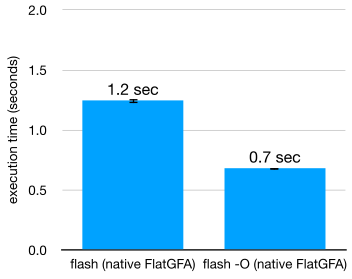
An additional 1.7× speedup seems respectable. Please keep in mind that the optimizations I’ve implemented so far are tragically overfit to this specific workload, which has been my “hello world” demo while working on Flash.
Is This an Elaborate Prank?
Flash is a little domain-specific language that’s wearing a ridiculous shell-syntax Halloween costume. I’m pretty excited about the underlying DSL, the vectorized interpreter, and the coarse-grained optimizations that it enables—I think all this machinery could be the way to make FlatGFA practical to use. The fact that the surface syntax happens to look like a shell is, in the end, not that important, even if it is kinda funny. But it does mean that we can run existing shell scripts that the biologists have already written and transparently make them go faster.
For now, Flash’s syntax is shell syntax. It’s a good starting point, it’s familiar, and it lets us do head-to-head comparisons against existing combinations of command-line tools. We’ll stick with the “fake shell” input language until we outgrow it.
Many thanks to Kevin Laeufer, Ernest Ng, Michael Xing, and Ayaka Yorihiro for their feedback on a draft of this post.
-
For broader thoughts on the essential goodness of shell scripts as a programming model, I strongly recommend “Unix Shell Programming: The Next 50 Years” in HotOS 2021. It’s a very fun read. In particular, PaSh also accelerates shell scripts by first compiling them into a dataflow IR; I would love to adopt its approach to parallelization in Flash. ↩
-
If you’re reading this, Graydon, sorry that I’m probably about to oversimplify your point here. ↩
-
I ran these experiments on a server with dual Xeon Gold 6230 processors (2.10 GHz), 512 GB of RAM, and Ubuntu 22.04. I used Hyperfine to compare end-to-end execution time, configured with 3 runs and 1 warmup per configuration (
hyperfine -w1 -r3 -N). The warmup means that the input files are cached, so I don’t think we’re measuring much actual disk I/O. Odgi reports its version asv0.6.3-9-ge1940cd, and I used Flash from commit 2421a7f. ↩ -
Error bars show the standard deviation. I didn’t include error bars in the other plot because they are so tiny. ↩