 |
CUGL 4.0
Cornell University Game Library
|
Loading...
Searching...
No Matches
|
CUGL 4.0
Cornell University Game Library
|
#include <CUComputeShader.h>
Public Member Functions | |
| ComputeShader () | |
| ~ComputeShader () | |
| virtual void | dispose () |
| virtual bool | init (const ShaderSource &source) |
| IVec3 | getDimension () const |
| void | setDimension (const IVec3 dimension) |
| void | setDimension (Uint32 x, Uint32 y, Uint32 z) |
| bool | declareUniform (const std::string name, const UniformDef &def) |
| const UniformDef * | getUniformDef (const std::string name) const |
| void | setConstant (const std::string name, const GLSLConstant &spec) |
| const GLSLConstant * | getConstant (const std::string name) const |
| bool | declareInput (const std::string name, const ResourceDef &def) |
| bool | declareOutput (const std::string name, const ResourceDef &def) |
| const ResourceDef * | getResourceDef (const std::string name) const |
| bool | isWriteable (const std::string name) const |
| bool | compile () |
| bool | isReady () const |
| void | setUniformBuffer (const std::string name, const std::shared_ptr< UniformBuffer > &buffer) |
| void | setUniformBuffers (const std::string name, const std::vector< std::shared_ptr< UniformBuffer > > &buffers) |
| const std::shared_ptr< UniformBuffer > | getUniformBuffer (const std::string name) const |
| const std::vector< std::shared_ptr< UniformBuffer > > | getUniformBuffers (const std::string name) const |
| void | setStorageBuffer (const std::string name, const std::shared_ptr< StorageBuffer > &buffer) |
| void | setStorageBuffers (const std::string name, const std::vector< std::shared_ptr< StorageBuffer > > &buffers) |
| const std::shared_ptr< StorageBuffer > | getStorageBuffer (const std::string name) const |
| const std::vector< std::shared_ptr< StorageBuffer > > | getStorageBuffers (const std::string name) const |
| void | setBlock (const std::string name, Uint32 block) |
| Uint32 | getBlock (const std::string name) const |
| void | setVertexBuffer (const std::string name, const std::shared_ptr< VertexBuffer > &buffer) |
| const std::shared_ptr< VertexBuffer > | getVertexBuffer (const std::string name) const |
| void | setIndexBuffer (const std::string name, const std::shared_ptr< IndexBuffer > &buffer) |
| const std::shared_ptr< IndexBuffer > | getIndexBuffer (const std::string name) const |
| void | setTexture (const std::string name, const std::shared_ptr< Texture > &texture) |
| void | setTextures (const std::string name, const std::vector< std::shared_ptr< Texture > > &textures) |
| const std::shared_ptr< Texture > | getTexture (const std::string name) const |
| const std::vector< std::shared_ptr< Texture > > | getTextures (const std::string name) const |
| void | setTextureArray (const std::string name, const std::shared_ptr< TextureArray > &array) |
| void | setTextureArrays (const std::string name, const std::vector< std::shared_ptr< TextureArray > > &arrays) |
| const std::shared_ptr< TextureArray > | getTextureArray (const std::string name) const |
| const std::vector< std::shared_ptr< TextureArray > > | getTextureArrays (const std::string name) const |
| void | setImage (const std::string name, const std::shared_ptr< Image > &image) |
| void | setImages (const std::string name, const std::vector< std::shared_ptr< Image > > &images) |
| const std::shared_ptr< Image > | getImage (const std::string name) |
| const std::vector< std::shared_ptr< Image > > | getImages (const std::string name) const |
| void | setImageArray (const std::string name, const std::shared_ptr< ImageArray > &array) |
| void | setImageArrays (const std::string name, const std::vector< std::shared_ptr< ImageArray > > &arrays) |
| const std::shared_ptr< ImageArray > | getImageArray (const std::string name) const |
| const std::vector< std::shared_ptr< ImageArray > > | getImageArrays (const std::string name) const |
| void | setSampler (const std::string name, const std::shared_ptr< Sampler > &sampler) |
| void | setSamplers (const std::string name, const std::vector< std::shared_ptr< Sampler > > &samplers) |
| const std::shared_ptr< Sampler > | getSampler (const std::string name) |
| const std::vector< std::shared_ptr< Sampler > > | getSamplers (const std::string name) const |
| void | pushInt (const std::string name, Sint32 value) |
| void | pushUInt (const std::string name, Uint32 value) |
| void | pushFloat (const std::string name, float value) |
| void | pushVec2 (const std::string name, const Vec2 &vec) |
| void | pushVec2 (const std::string name, float x, float y) |
| void | pushVec3 (const std::string name, const Vec3 &vec) |
| void | pushVec3 (const std::string name, float x, float y, float z) |
| void | pushVec4 (const std::string name, const Vec4 &vec) |
| void | pushVec4 (const std::string name, const Quaternion &quat) |
| void | pushVec4 (const std::string name, float x, float y, float z, float w) |
| void | pushIVec2 (const std::string name, Sint32 x, Sint32 y) |
| void | pushIVec3 (const std::string name, Sint32 x, Sint32 y, Sint32 z) |
| void | pushIVec4 (const std::string name, Sint32 x, Sint32 y, Sint32 z, Sint32 w) |
| void | pushUVec2 (const std::string name, Uint32 x, Uint32 y) |
| void | pushUVec3 (const std::string name, Uint32 x, Uint32 y, Uint32 z) |
| void | pushUVec4 (const std::string name, Uint32 x, Uint32 y, Uint32 z, Uint32 w) |
| void | pushColor4f (const std::string name, const Color4f &color) |
| void | pushColor4f (const std::string name, float red, float green, float blue, float alpha) |
| void | pushColor4 (const std::string name, const Color4 color) |
| void | pushColor4 (const std::string name, Uint8 red, Uint8 green, Uint8 blue, Uint8 alpha) |
| void | pushMat2 (const std::string name, const Affine2 &mat) |
| void | pushMat2 (const std::string name, const float *array) |
| void | pushMat3 (const std::string name, const Affine2 &mat) |
| void | pushMat3 (const std::string name, const float *array) |
| void | pushMat4 (const std::string name, const Mat4 &mat) |
| void | pushMat4 (const std::string name, const float *array) |
| void | push (const std::string name, Uint8 *data) |
| template<typename T > | |
| void | push (const std::string name, T value) |
| void | begin () |
| void | end () |
| void | dispatch (Uint32 x=1, Uint32 y=1, Uint32 z=1) |
Static Public Member Functions | |
| static std::shared_ptr< ComputeShader > | alloc (const ShaderSource &source) |
Protected Member Functions | |
| void | createInputs (const std::string name, ResourceDef def) |
| void | createOutputs (const std::string name, ResourceDef def) |
| void | flush () |
Protected Attributes | |
| ComputeShaderData * | _data |
| ShaderSource | _compModule |
| IVec3 | _dimension |
| std::unordered_map< std::string, GLSLConstant > | _constants |
| std::unordered_map< std::string, UniformDef > | _uniforms |
| std::unordered_map< std::string, ResourceDef > | _inputs |
| std::unordered_map< std::string, ResourceDef > | _outputs |
| std::vector< ImageData * > | _transitions |
| std::vector< uint8_t > | _constvalues |
| std::unordered_map< std::string, ResourceData * > | _invalues |
| std::unordered_map< std::string, ResourceData * > | _outvalues |
Static Protected Attributes | |
| static std::shared_ptr< ComputeShader > | g_shader |
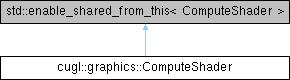
This class defines a GLSL compute shader.
VULKAN ONLY: This class compiles any well-defined GLSL compute shader. Note that CUGL only supports compute shaders in Vulkan (due to the OpenGL limitations of Apple platforms). Attempts to allocate an object of this type in OpenGL will fail.
Compute shaders only have a single shader module. For input, they support push constants, and any ResourceType. For output, we only support StorageBuffer, VertexBuffer, IndexBuffer and Image objects with compute access.
Note that it is never safe for input and output to be the same resources. If you need to update a data-set, such as a storage buffer containing particles, you should set up a ping-pong buffer to guarantee safety.
While Vulkan is multithreaded, CUGL shader objects can only be used on the main thread (due to synchronization constraints). Using them outside of the main application loop is undefined. In addition, compute shaders may not be used in the Application#draw method. They can only be used in one of the update methods such as Application#update, Application#preUpdate, Application#fixedUpdate or Application#postUpdate.
|
inline |
Creates an uninitialized compute shader with no source.
You must initialize the shader to add a source and compile it.
|
inline |
Deletes this shader, disposing all resources.
|
inlinestatic |
Returns a new compute shader with the given shader source.
This method will allocate resources for a shader, but it will not compile it. You must all the compile method to compile the shader.
| source | The source for the compute shader. |
| void cugl::graphics::ComputeShader::begin | ( | ) |
Begins a dispatch pass with this shader for the application.
Once this method is called, no other compute shader can perform a dispatch pass. You must complete this dispatch pass with end before starting a new pass.
Note that it is only safe to call this method within the scope of the Application#update method, or any of the deterministic update methods such as Application#preUpdate, Application#fixedUpdate, or Application#postUpdate. It is not safe to call this method during Application#draw. This is due to limitations on the implicit rendering queue in CUGL.
| bool cugl::graphics::ComputeShader::compile | ( | ) |
Compiles this compute shader for use
All variables (uniforms, input resources, and output resources) should be declared before compilation. Once compilation is successful, this shader should be ready for use.
If compilation fails, it will display error messages on the log.
|
protected |
Create the input data structures for the given definition
| name | The resource name |
| def | The resource definition |
|
protected |
Create the output data structures for the given definition
| name | The resource name |
| def | The resource definition |
| bool cugl::graphics::ComputeShader::declareInput | ( | const std::string | name, |
| const ResourceDef & | def | ||
| ) |
Declares an shader input uniform.
Input uniforms include resources such as uniform buffers, storage buffers, and images. In order to be used, each resource must be declared before the compute shader is compiled via compile. The declaration links a name to a resource definition. We can use this name to load data via methods such as setUniformBuffer and setImage.
Input uniforms are always read-only. This method can fail if the resource has already been declared.
| name | The resource name |
| def | The resource type, size, and location |
| bool cugl::graphics::ComputeShader::declareOutput | ( | const std::string | name, |
| const ResourceDef & | def | ||
| ) |
Declares an shader ouput uniform.
Output uniforms are resources that can be written to by a compute shader. Currently we only support Image, VertexBuffer, IndexBuffer and StorageBuffer objects with access type compute.
In order to be used, each resource must be declared before the compute shader is compiled via compile. The declaration links a name to a resource definition. We can use this name to load data via methods such as setUniformBuffer and setImage.
This method can fail if the resource has already been declared.
| name | The resource name |
| def | The resource type, size, and location |
| bool cugl::graphics::ComputeShader::declareUniform | ( | const std::string | name, |
| const UniformDef & | def | ||
| ) |
Declares a shader push-constant uniform.
In order to be used, each push-constant must be declared before the graphics shader is compiled via compile. The declaration links a name to a uniform definition. We can use this name to push data to the compute shader via any of the push methods.
This method can fail if the uniform has already been declared.
| name | The uniform name |
| def | The uniform type, size, and location |
| void cugl::graphics::ComputeShader::dispatch | ( | Uint32 | x = 1, |
| Uint32 | y = 1, |
||
| Uint32 | z = 1 |
||
| ) |
Dispatches a global workgroup on this compute shader
Each workgroup with have getDimension many local threads. The dimension must be non-zero along each axis
| x | Number of workgroups along the x dimension |
| y | Number of workgroups along the y dimension |
| z | Number of workgroups along the z dimension |
|
virtual |
Deletes the shader and resets all attributes.
You must reinitialize the shader to use it.
| void cugl::graphics::ComputeShader::end | ( | ) |
Ends the dispatch pass for this shader.
Once this method is called, it is safe to start a dispatch pass with another shader. This method has no effect if there is no active dispatch pass for this shader.
Note that once this method is called, it is not safe to make futher modifications to any output resources.
|
protected |
Updates all descriptors and buffers before computation.
| Uint32 cugl::graphics::ComputeShader::getBlock | ( | const std::string | name | ) | const |
Returns the active block of the associated resource buffer
If the type of the resource is not ResourceType#MULTI_BUFFER or ResourceType#MULTI_STORAGE, this method return 0. This block will be used in the next call to dispatch.
| name | The name of the resource |
| const GLSLConstant * cugl::graphics::ComputeShader::getConstant | ( | const std::string | name | ) | const |
Returns the information for a specialization constant
Specialization constants are assigned to the compute shader at compile time. This value can be reassigned any time before a call to compile, but cannot be changed once the compute shader is complete.
If there is no constant associated with the given name, this method returns nullptr.
| name | The constant name |
|
inline |
Returns the local group dimension of this compute shader
Setting this value has no effect on the compute shader. The dimension of a compute shader is entirely deteremined by its shader source. However, setting this value is useful for debugging.
| const std::shared_ptr< Image > cugl::graphics::ComputeShader::getImage | ( | const std::string | name | ) |
Returns the image for the given resource variable
If the variable does not refer to an image (a texture2D in GLSL), then this method will return nullptr. If more than one image is assigned to this attribute, then this method will return the first one.
Any image assigned to a name is stateful, in that it will persist compute passes. Note that an image can either be an input or an output resource. If name is an output variable, then the image must have compute access or this method will fail.
| name | The name of the resource |
| const std::shared_ptr< ImageArray > cugl::graphics::ComputeShader::getImageArray | ( | const std::string | name | ) | const |
Returns the image array for the given resource variable
If the variable does not refer to an image array (a texture2DArray in GLSL), then this method will return nullptr. If more than one image array is assigned to this attribute, then this method will return the first one.
Any image array assigned to a name is stateful, in that it will persist across compute passes. Note that image arrays (as opposed to images) are currently read-only in compute shaders.
| name | The name of the resource |
| const std::vector< std::shared_ptr< ImageArray > > cugl::graphics::ComputeShader::getImageArrays | ( | const std::string | name | ) | const |
Returns the image arrays for the given resource variable
If the variable does not refer to an image array (a texture2DArray in GLSL), then this method will return an empty vector.
Any image array assigned to a name is stateful, in that it will persist across compute passes. Note that image arrays (as opposed to images) are currently read-only in compute shaders.
| name | The name of the resource |
| const std::vector< std::shared_ptr< Image > > cugl::graphics::ComputeShader::getImages | ( | const std::string | name | ) | const |
Returns the images for the given resource variable
If the variable does not refer to an image (a texture2D in GLSL), then this method will return an empty vector.
Any image assigned to a name is stateful, in that it will persist compute passes. Note that an image can either be an input or an output resource. If name is an output variable, then the image must have compute access or this method will fail.
| name | The name of the resource |
| const std::shared_ptr< IndexBuffer > cugl::graphics::ComputeShader::getIndexBuffer | ( | const std::string | name | ) | const |
Returns the index buffer for the given resource variable
Compute shaders do not use index buffers as inputs, but they can use them as outputs. This is particularly useful for tesselation, where a compute shader is used to fill the contents of the index buffer.
Any IndexBuffer returned by this method must have compute access.
| name | The name of the resource |
| const ResourceDef * cugl::graphics::ComputeShader::getResourceDef | ( | const std::string | name | ) | const |
Returns the resource definition for the given variable name.
If there is no resource definition for the given name, or if it does not correspond to an input variable, this method returns nullptr.
This method does not distinguish input resources from output resources.
| name | The resource name |
| const std::shared_ptr< Sampler > cugl::graphics::ComputeShader::getSampler | ( | const std::string | name | ) |
Returns the sampler for the given resource variable
If the variable does not refer to a sampler (a sampler in GLSL), then this method will return nullptr. If more than one sampler is assigned to this attribute, then this method will return the first one.
Any sampler assigned to a name is stateful, in that it will persist across compute passes. Note that samplers are read-only in compute shaders.
| name | The name of the resource |
| const std::vector< std::shared_ptr< Sampler > > cugl::graphics::ComputeShader::getSamplers | ( | const std::string | name | ) | const |
Returns the samplers for the given resource variable
If the variable does not refer to a sampler (a sampler in GLSL), then this method will return an empty vector.
Any samplers assigned to a name are stateful, in that they will persist across compute passes. Note that samplers are read-only in compute shaders.
| name | The name of the resource |
| const std::shared_ptr< StorageBuffer > cugl::graphics::ComputeShader::getStorageBuffer | ( | const std::string | name | ) | const |
Returns the storage buffer for the given resource variable
If the variable does not refer to a storage buffer, then this method will return nullptr. If more than one buffer is assigned to this attribute, then this method will return the first one.
Storage buffers may be used either an input our output in a compute shader. Output buffers should have an access type that allows write access by the compute shader. Any buffer assigned to a name is stateful, in that it will persist across compute passes.
| name | The name of the resource |
| const std::vector< std::shared_ptr< StorageBuffer > > cugl::graphics::ComputeShader::getStorageBuffers | ( | const std::string | name | ) | const |
Returns the storage buffers for the given resource variable
If the variable does not refer to a storage buffer, then this method will return an empty vector.
Storage buffers may be used either an input our output in a compute shader. Output buffers should have an access type that allows write access by the compute shader. Any buffer assigned to a name is stateful, in that it will persist across compute passes.
| name | The name of the resource |
| const std::shared_ptr< Texture > cugl::graphics::ComputeShader::getTexture | ( | const std::string | name | ) | const |
Returns the texture for the given resource variable
If the variable does not refer to a texture (a sampler2d in GLSL), then this method will return nullptr. If more than one texture is assigned to this attribute, then this method will return the first one.
Any texture assigned to a name is stateful, in that it will persist across dispatch calls. Note that textures (which include both an image and a sampler) are read-only in compute shaders.
| name | The name of the resource |
| const std::shared_ptr< TextureArray > cugl::graphics::ComputeShader::getTextureArray | ( | const std::string | name | ) | const |
Returns the texture array for the given resource variable
If the variable does not refer to a texture array (a sampler2DArray in GLSL), then this method will return nullptr. If more than one texture array is assigned to this attribute, then this method will return the first one.
Any texture array assigned to a name is stateful, in that it will persist across compute passes. Note that texture arrays (which include both an image array and a sampler) are read-only in compute shaders.
| name | The name of the resource |
| const std::vector< std::shared_ptr< TextureArray > > cugl::graphics::ComputeShader::getTextureArrays | ( | const std::string | name | ) | const |
Returns the texture arrays for the given resource variable
If the variable does not refer to a texture array (a sampler2DArray in GLSL), then this method will return an empty vector.
Any texture arrays assigned to a name are stateful, in that they will persist across compute passes. Note that texture arrays (which include both an image array and a sampler) are read-only in compute shaders.
| name | The name of the resource |
| const std::vector< std::shared_ptr< Texture > > cugl::graphics::ComputeShader::getTextures | ( | const std::string | name | ) | const |
Returns the textures for the given resource variable
If the variable does not refer to a texture (a sampler2D in GLSL), then this method will return an empty vector.
Any textures assigned to a name are stateful, in that they will persist across dispatch calls. Note that textures (which include both an image and a sampler) are read-only in compute shaders.
| name | The name of the resource |
| const std::shared_ptr< UniformBuffer > cugl::graphics::ComputeShader::getUniformBuffer | ( | const std::string | name | ) | const |
Returns the uniform buffer for the given resource variable
If the variable does not refer to a uniform buffer then this method will return nullptr. If more than one buffer is assigned to this attribute, then this method will return the first one.
Any buffer assigned to a name is stateful, in that it will persist across compute passes. Note that uniform buffers are always read-only in CUGL compute shaders.
| name | The name of the resource |
| const std::vector< std::shared_ptr< UniformBuffer > > cugl::graphics::ComputeShader::getUniformBuffers | ( | const std::string | name | ) | const |
Returns the uniform buffers for the given resource variable
If the variable does not refer to a uniform buffer then this method will return an empty vector.
Any buffer assigned to a name is stateful, in that it will persist across compute passes. Note that uniform buffers are always read-only in CUGL compute shaders.
| name | The name of the resource |
| const UniformDef * cugl::graphics::ComputeShader::getUniformDef | ( | const std::string | name | ) | const |
Returns the uniform definition for the given variable name.
If there is no uniform definition for the given name, this method returns nullptr.
| name | The attribute name |
| const std::shared_ptr< VertexBuffer > cugl::graphics::ComputeShader::getVertexBuffer | ( | const std::string | name | ) | const |
Returns the vertex buffer for the given resource variable
Compute shaders do not use vertex buffers as inputs, but they can use them as outputs. This is particularly useful for particle systems, where a compute shader is used to fill the contents of the vertex buffer.
Any VertexBuffer returned by this method must have compute access.
| name | The name of the resource |
|
virtual |
Initializes this shader with the given shader source
This method will allocate resources for a shader, but it will not compile it. You must all the compile method to compile the shader.
| source | The source for the compute shader. |
| bool cugl::graphics::ComputeShader::isReady | ( | ) | const |
Returns true if this shader has been compiled and is ready for use.
| bool cugl::graphics::ComputeShader::isWriteable | ( | const std::string | name | ) | const |
Returns true if the resource variable is writeable
A writeable resource is one that has been declared by the method declareOutput. If the variable does not exist or was declared with another method, this method returns false.
| name | The resource name |
|
inline |
Sets the given uniform to the provided value.
The data type should match up with the size of the uniform previously declared. If not, the results of this method are undefined.
Note that this method does nothing if it is not invoked during an active begin/end pair. This method does not cache uniforms for later.
| name | The uniform name |
| value | The uniform value |
| void cugl::graphics::ComputeShader::push | ( | const std::string | name, |
| Uint8 * | data | ||
| ) |
Sets the given uniform to the provided array.
The array data should have the size of the uniform previously declared. If not, the results of this method are undefined.
Note that this method does nothing if it is not invoked during an active begin/end pair. This method does not cache uniforms for later.
| name | The uniform name |
| data | The uniform data |
| void cugl::graphics::ComputeShader::pushColor4 | ( | const std::string | name, |
| const Color4 | color | ||
| ) |
Sets the given uniform to a color value.
This will fail if the uniform is not a GLSL ucolor variable.
Note that this method does nothing if it is not invoked during an active begin/end pair. This method does not cache uniforms for later.
| name | The name of the uniform |
| color | The value for the uniform |
| void cugl::graphics::ComputeShader::pushColor4 | ( | const std::string | name, |
| Uint8 | red, | ||
| Uint8 | green, | ||
| Uint8 | blue, | ||
| Uint8 | alpha | ||
| ) |
Sets the given uniform to a color value.
This will fail if the uniform is not a GLSL ucolor variable.
Note that this method does nothing if it is not invoked during an active begin/end pair. This method does not cache uniforms for later.
| name | The name of the uniform |
| red | The uniform red value |
| green | The uniform green value |
| blue | The uniform blue value |
| alpha | The uniform alpha value |
| void cugl::graphics::ComputeShader::pushColor4f | ( | const std::string | name, |
| const Color4f & | color | ||
| ) |
Sets the given uniform to a color value.
This will fail if the uniform is not a GLSL color variable.
Note that this method does nothing if it is not invoked during an active begin/end pair. This method does not cache uniforms for later.
| name | The name of the uniform |
| color | The value for the uniform |
| void cugl::graphics::ComputeShader::pushColor4f | ( | const std::string | name, |
| float | red, | ||
| float | green, | ||
| float | blue, | ||
| float | alpha | ||
| ) |
Sets the given uniform to a color value.
This will fail if the uniform is not a GLSL color variable.
Note that this method does nothing if it is not invoked during an active begin/end pair. This method does not cache uniforms for later.
| name | The name of the uniform |
| red | The uniform red value |
| green | The uniform green value |
| blue | The uniform blue value |
| alpha | The uniform alpha value |
| void cugl::graphics::ComputeShader::pushFloat | ( | const std::string | name, |
| float | value | ||
| ) |
Sets the given uniform to a float value.
This will fail if the uniform is not a GLSL float variable.
Note that this method does nothing if it is not invoked during an active begin/end pair. This method does not cache uniforms for later.
| name | The name of the uniform |
| value | The value for the uniform |
| void cugl::graphics::ComputeShader::pushInt | ( | const std::string | name, |
| Sint32 | value | ||
| ) |
Sets the given uniform to a integer value.
This will fail if the uniform is not a GLSL int variable.
Note that this method does nothing if it is not invoked during an active begin/end pair. This method does not cache uniforms for later.
| name | The name of the uniform |
| value | The value for the uniform |
| void cugl::graphics::ComputeShader::pushIVec2 | ( | const std::string | name, |
| Sint32 | x, | ||
| Sint32 | y | ||
| ) |
Sets the given uniform to the given values
This will fail if the uniform is not a GLSL ivec2 variable.
Note that this method does nothing if it is not invoked during an active begin/end pair. This method does not cache uniforms for later.
| name | The name of the uniform |
| x | The x-value for the vector |
| y | The x-value for the vector |
| void cugl::graphics::ComputeShader::pushIVec3 | ( | const std::string | name, |
| Sint32 | x, | ||
| Sint32 | y, | ||
| Sint32 | z | ||
| ) |
Sets the given uniform to the given values
This will fail if the uniform is not a GLSL ivec3 variable.
Note that this method does nothing if it is not invoked during an active begin/end pair. This method does not cache uniforms for later.
| name | The name of the uniform |
| x | The x-value for the vector |
| y | The x-value for the vector |
| z | The z-value for the vector |
| void cugl::graphics::ComputeShader::pushIVec4 | ( | const std::string | name, |
| Sint32 | x, | ||
| Sint32 | y, | ||
| Sint32 | z, | ||
| Sint32 | w | ||
| ) |
Sets the given uniform to the given values
This will fail if the uniform is not a GLSL ivec4 variable.
Note that this method does nothing if it is not invoked during an active begin/end pair. This method does not cache uniforms for later.
| name | The name of the uniform |
| x | The x-value for the vector |
| y | The x-value for the vector |
| z | The z-value for the vector |
| w | The z-value for the vector |
| void cugl::graphics::ComputeShader::pushMat2 | ( | const std::string | name, |
| const Affine2 & | mat | ||
| ) |
Sets the given uniform to a 2x2 matrix.
The 2x2 matrix will be the non-translational part of the affine transform. This method will fail if the uniform is not a GLSL mat2 variable.
Note that this method does nothing if it is not invoked during an active begin/end pair. This method does not cache uniforms for later.
| name | The name of the uniform |
| mat | The value for the uniform |
| void cugl::graphics::ComputeShader::pushMat2 | ( | const std::string | name, |
| const float * | array | ||
| ) |
Sets the given uniform to a 2x2 matrix.
The matrix will be read from the array in column major order (not row major). This method will fail if the uniform is not a GLSL mat2 variable.
Note that uniforms can only be pushed during an active begin/end pair. This method does not cache uniforms for later.
| name | The name of the uniform |
| array | The values for the uniform |
| void cugl::graphics::ComputeShader::pushMat3 | ( | const std::string | name, |
| const Affine2 & | mat | ||
| ) |
Sets the given uniform to a 3x3 matrix.
The 3x3 matrix will be affine transform in homoegenous coordinates. This method will fail if the uniform is not a GLSL mat3 variable.
Note that this method does nothing if it is not invoked during an active begin/end pair. This method does not cache uniforms for later.
| name | The name of the uniform |
| mat | The value for the uniform |
| void cugl::graphics::ComputeShader::pushMat3 | ( | const std::string | name, |
| const float * | array | ||
| ) |
Sets the given uniform to a 3x3 matrix.
The matrix will be read from the array in column major order (not row major). This method will fail if the uniform is not a GLSL mat3 variable.
Note that this method does nothing if it is not invoked during an active begin/end pair. This method does not cache uniforms for later.
| name | The name of the uniform |
| array | The values for the uniform |
| void cugl::graphics::ComputeShader::pushMat4 | ( | const std::string | name, |
| const float * | array | ||
| ) |
Sets the given uniform to a 4x4 matrix.
The matrix will be read from the array in column major order (not row major). This method will fail if the uniform is not a GLSL mat4 variable.
Note that this method does nothing if it is not invoked during an active begin/end pair. This method does not cache uniforms for later.
| name | The name of the uniform |
| array | The values for the uniform |
| void cugl::graphics::ComputeShader::pushMat4 | ( | const std::string | name, |
| const Mat4 & | mat | ||
| ) |
Sets the given uniform to a 4x4 matrix
This will fail if the uniform is not a GLSL mat4 variable.
Note that this method does nothing if it is not invoked during an active begin/end pair. This method does not cache uniforms for later.
| name | The name of the uniform |
| mat | The value for the uniform |
| void cugl::graphics::ComputeShader::pushUInt | ( | const std::string | name, |
| Uint32 | value | ||
| ) |
Sets the given uniform to an unsigned integer value.
This will fail if the uniform is not a GLSL uint variable.
Note that this method does nothing if it is not invoked during an active begin/end pair. This method does not cache uniforms for later.
| name | The name of the uniform |
| value | The value for the uniform |
| void cugl::graphics::ComputeShader::pushUVec2 | ( | const std::string | name, |
| Uint32 | x, | ||
| Uint32 | y | ||
| ) |
Sets the given uniform to the given values
This will fail if the uniform is not a GLSL ivec2 variable.
Note that this method does nothing if it is not invoked during an active begin/end pair. This method does not cache uniforms for later.
| name | The name of the uniform |
| x | The x-value for the vector |
| y | The x-value for the vector |
| void cugl::graphics::ComputeShader::pushUVec3 | ( | const std::string | name, |
| Uint32 | x, | ||
| Uint32 | y, | ||
| Uint32 | z | ||
| ) |
Sets the given uniform to the given values
This will fail if the uniform is not a GLSL ivec3 variable.
Note that this method does nothing if it is not invoked during an active begin/end pair. This method does not cache uniforms for later.
| name | The name of the uniform |
| x | The x-value for the vector |
| y | The x-value for the vector |
| z | The z-value for the vector |
| void cugl::graphics::ComputeShader::pushUVec4 | ( | const std::string | name, |
| Uint32 | x, | ||
| Uint32 | y, | ||
| Uint32 | z, | ||
| Uint32 | w | ||
| ) |
Sets the given uniform to the given values
This will fail if the uniform is not a GLSL ivec4 variable.
Note that this method does nothing if it is not invoked during an active begin/end pair. This method does not cache uniforms for later.
| name | The name of the uniform |
| x | The x-value for the vector |
| y | The x-value for the vector |
| z | The z-value for the vector |
| w | The z-value for the vector |
| void cugl::graphics::ComputeShader::pushVec2 | ( | const std::string | name, |
| const Vec2 & | vec | ||
| ) |
Sets the given uniform to a Vector2 value.
This will fail if the uniform is not a GLSL vec2 variable.
Note that this method does nothing if it is not invoked during an active begin/end pair. This method does not cache uniforms for later.
| name | The name of the uniform |
| vec | The value for the uniform |
| void cugl::graphics::ComputeShader::pushVec2 | ( | const std::string | name, |
| float | x, | ||
| float | y | ||
| ) |
Sets the given uniform to the given values
This will fail if the uniform is not a GLSL vec2 variable.
Note that this method does nothing if it is not invoked during an active begin/end pair. This method does not cache uniforms for later.
| name | The name of the uniform |
| x | The x-value for the vector |
| y | The x-value for the vector |
| void cugl::graphics::ComputeShader::pushVec3 | ( | const std::string | name, |
| const Vec3 & | vec | ||
| ) |
Sets the given uniform to a Vector3 value.
This will fail if the uniform is not a GLSL vec3 variable.
Note that this method does nothing if it is not invoked during an active begin/end pair. This method does not cache uniforms for later.
| name | The name of the uniform |
| vec | The value for the uniform |
| void cugl::graphics::ComputeShader::pushVec3 | ( | const std::string | name, |
| float | x, | ||
| float | y, | ||
| float | z | ||
| ) |
Sets the given uniform to the given values
This will fail if the uniform is not a GLSL vec3 variable.
Note that this method does nothing if it is not invoked during an active begin/end pair. This method does not cache uniforms for later.
| name | The name of the uniform |
| x | The x-value for the vector |
| y | The x-value for the vector |
| z | The z-value for the vector |
| void cugl::graphics::ComputeShader::pushVec4 | ( | const std::string | name, |
| const Quaternion & | quat | ||
| ) |
Sets the given uniform to a quaternion.
This will fail if the uniform is not a GLSL vec4 variable.
Note that this method does nothing if it is not invoked during an active begin/end pair. This method does not cache uniforms for later.
| name | The name of the uniform |
| quat | The value for the uniform |
| void cugl::graphics::ComputeShader::pushVec4 | ( | const std::string | name, |
| const Vec4 & | vec | ||
| ) |
Sets the given uniform to a Vector4 value.
This will fail if the uniform is not a GLSL vec4 variable.
Note that this method does nothing if it is not invoked during an active begin/end pair. This method does not cache uniforms for later.
| name | The name of the uniform |
| vec | The value for the uniform |
| void cugl::graphics::ComputeShader::pushVec4 | ( | const std::string | name, |
| float | x, | ||
| float | y, | ||
| float | z, | ||
| float | w | ||
| ) |
Sets the given uniform to the given values
This will fail if the uniform is not a GLSL vec4 variable.
Note that this method does nothing if it is not invoked during an active begin/end pair. This method does not cache uniforms for later.
| name | The name of the uniform |
| x | The x-value for the vector |
| y | The x-value for the vector |
| z | The z-value for the vector |
| w | The z-value for the vector |
| void cugl::graphics::ComputeShader::setBlock | ( | const std::string | name, |
| Uint32 | block | ||
| ) |
Sets the active block of the associated resource buffer
If the type of the resource is not ResourceType#MULTI_BUFFER or ResourceType#MULTI_STORAGE, this method will fail. Otherwise, it will change the active block. That block will be used in the next call to dispatch.
| name | The name of the resource |
| block | The resource block to use |
| void cugl::graphics::ComputeShader::setConstant | ( | const std::string | name, |
| const GLSLConstant & | spec | ||
| ) |
Declares and sets a specialization constant
Specialization constants are assigned to the compute shader at compile time. This value can be reassigned any time before a call to compile, but cannot be changed once the compute shader is complete.
| name | The constant name |
| spec | The specialization constant |
|
inline |
Sets the local group dimension of this compute shader
Setting this value has no effect on the compute shader. The dimension of a compute shader is entirely deteremined by its shader source. However, setting this value is useful for debugging.
| dimension | The local group dimension |
|
inline |
Sets the local group dimension of this compute shader
Setting this value has no effect on the compute shader. The dimension of a compute shader is entirely deteremined by its shader source. However, setting this value is useful for debugging.
| x | The local group size in the x-dimension |
| y | The local group size in the y-dimension |
| z | The local group size in the z-dimension |
| void cugl::graphics::ComputeShader::setImage | ( | const std::string | name, |
| const std::shared_ptr< Image > & | image | ||
| ) |
Sets the image for the given resource variable
This method will fail is the variable does not refer to an image (a texture2D in GLSL), or if the value is nullptr. If the variable refers to an array of images, all slots will be assigned to this image.
Setting this value is stateful, in that it will persist across compute passes. Note that an image can either be an input or an output resource. If name is an output variable, then the image must have compute access or this method will fail.
| name | The name of the resource |
| image | The image for the resource |
| void cugl::graphics::ComputeShader::setImageArray | ( | const std::string | name, |
| const std::shared_ptr< ImageArray > & | array | ||
| ) |
Sets the image array for the given resource variable
This method will fail if the variable does not refer to an image array (a texture2DArray in GLSL), or if the value is nullptr. If the variable refers to an array of image arrays, all slots will be assigned to this image array.
Setting this value is stateful, in that it will persist across compute passes. Note that image arrays (as opposed to images) are currently read-only in compute shaders.
| name | The name of the resource |
| array | The image array for the resource |
| void cugl::graphics::ComputeShader::setImageArrays | ( | const std::string | name, |
| const std::vector< std::shared_ptr< ImageArray > > & | arrays | ||
| ) |
Sets the image arrays for the given resource variable
This method will fail if the variable does not refer to an image array (a texture2DArray in GLSL), or if the vector is empty. If the vector is larger than the number of images referenced by this variable, then the image arrays past the limit are ignored. If the vector is smaller, then the missing positions will be replaced by the last image array.
Setting this value is stateful, in that it will persist across compute passes. Note that image arrays (as opposed to images) are currently read-only in compute shaders.
| name | The name of the resource |
| arrays | The image arrays for the resource |
| void cugl::graphics::ComputeShader::setImages | ( | const std::string | name, |
| const std::vector< std::shared_ptr< Image > > & | images | ||
| ) |
Sets the images for the given resource variable
This method will fail is the variable does not refer to an image (a texture2D in GLSL), or if the value is nullptr. If the vector is larger than the number of images referenced by this variable, then the images past the limit are ignored. If the vector is smaller, then the missing positions will be replaced by nullptr (potentially causing the pipeline to crash).
Setting this value is stateful, in that it will persist across compute passes. Note that an image can either be an input or an output resource. If name is an output variable, then the image must have compute access or this method will fail.
| name | The name of the resource |
| images | The images for the resource |
| void cugl::graphics::ComputeShader::setIndexBuffer | ( | const std::string | name, |
| const std::shared_ptr< IndexBuffer > & | buffer | ||
| ) |
Sets the index buffer for the given resource variable
Compute shaders do not use index buffers as inputs, but they can use them as outputs. This is particularly useful for tesselation, where a compute shader is used to fill the contents of the index buffer.
Any IndexBuffer set by this method must have compute access.
| name | The name of the resource |
| buffer | The index buffer for the resource |
| void cugl::graphics::ComputeShader::setSampler | ( | const std::string | name, |
| const std::shared_ptr< Sampler > & | sampler | ||
| ) |
Sets the sampler for the given resource variable
This method will fail is the variable does not refer to a sampler (a sampler in GLSL), or if the value is nullptr. If the variable refers to an array of samplers, all slots will be assigned to this sampler.
Setting this value is stateful, in that it will persist across compute passes. Note that samplers are read-only in compute shaders.
| name | The name of the resource |
| sampler | The sampler for the resource |
| void cugl::graphics::ComputeShader::setSamplers | ( | const std::string | name, |
| const std::vector< std::shared_ptr< Sampler > > & | samplers | ||
| ) |
Sets the samplers for the given resource variable
This method will fail is the variable does not refer to a sampler (a sampler in GLSL), or if the value is nullptr. If the vector is larger than the number of samplers referenced by this variable, then the samplers past the limit are ignored. If the vector is smaller, then the missing positions will be replaced by nullptr (potentially causing the pipeline to crash).
Setting this value is stateful, in that it will persist across compute passes. Note that samplers are read-only in compute shaders.
| name | The name of the resource |
| samplers | The samplers for the resource |
| void cugl::graphics::ComputeShader::setStorageBuffer | ( | const std::string | name, |
| const std::shared_ptr< StorageBuffer > & | buffer | ||
| ) |
Sets the storage buffer for the given resource variable
If the variable does not refer to a storage buffer, then this method will fail. If the resource variable refers to an array of storage buffers, then this buffer will be assigned to all positions in the array.
If the storage buffer is composed of more than one block (e.g. it has type ResourceType#MULTI_STORAGE), the shader will initially start at block 0. To switch the block, use setBlock.
Storage buffers may be used either an input our output in a compute shader. Output buffers should have an access type that allows write access by the compute shader. Setting this value is stateful, in that it will persist across compute passes.
| name | The name of the resource |
| buffer | The uniform buffer for the resource |
| void cugl::graphics::ComputeShader::setStorageBuffers | ( | const std::string | name, |
| const std::vector< std::shared_ptr< StorageBuffer > > & | buffers | ||
| ) |
Sets the storage buffer array for the given resource variable
This method will fail if the variable does not refer to a storage buffer or if the vector is empty. If the vector is larger than the number of buffers referenced by this variable, then the buffers past the limit are ignored. If the vector is smaller, then the missing positions will be replaced by the last buffer.
If the storage buffers are composed of more than one block (e.g. they have type ResourceType#MULTI_STORAGE), the shader will initially start at block 0. To switch the block, use setBlock. Note that all storage buffers in an array must have the same block count.
Storage buffers may be used either an input our output in a compute shader. Output buffers should have an access type that allows write access by the compute shader. Setting this value is stateful, in that it will persist across compute passes.
| name | The name of the resource |
| buffers | The storage buffers for the resource |
| void cugl::graphics::ComputeShader::setTexture | ( | const std::string | name, |
| const std::shared_ptr< Texture > & | texture | ||
| ) |
Sets the texture for the given resource variable
This method will fail if the variable does not refer to a texture (a sampler2D in GLSL), or if the value is nullptr. If the variable refers to an array of textures, all slots will be assigned to this texture.
Setting this value is stateful, in that it will persist across compute passes. Note that textures (which include both an image and a sampler) are read-only in compute shaders.
| name | The name of the resource |
| texture | The texture for the resource |
| void cugl::graphics::ComputeShader::setTextureArray | ( | const std::string | name, |
| const std::shared_ptr< TextureArray > & | array | ||
| ) |
Sets the texture array for the given resource variable
This method will fail if the variable does not refer to a texture array (a sampler2DArray in GLSL), or if the value is nullptr. If the variable refers to an array of texture arrays, all slots will be assigned to this texture array.
Setting this value is stateful, in that it will persist across compute passes. Note that texture arrays (which include both an image array and a sampler) are read-only in compute shaders.
| name | The name of the resource |
| array | The texture array for the resource |
| void cugl::graphics::ComputeShader::setTextureArrays | ( | const std::string | name, |
| const std::vector< std::shared_ptr< TextureArray > > & | arrays | ||
| ) |
Sets the texture arrays for the given resource variable
This method will fail if the variable does not refer to a texture array (a sampler2DArray in GLSL), or if the vector is empty. If the vector is larger than the number of texture arrays referenced by this variable, then the texture arrays past the limit are ignored. If the array is smaller, then the missing positions will be replaced by the last texture array.
Setting this value is stateful, in that it will persist across compute passes. Note that texture arrays (which include both an image array and a sampler) are read-only in compute shaders.
| name | The name of the resource |
| arrays | The texture arrays for the resource |
| void cugl::graphics::ComputeShader::setTextures | ( | const std::string | name, |
| const std::vector< std::shared_ptr< Texture > > & | textures | ||
| ) |
Sets the textures for the given resource variable
This method will fail if the variable does not refer to a texture (a sampler2D in GLSL), or if the vector is empty. If the vector is larger than the number of textures referenced by this variable, then the textures past the limit are ignored. If the vector is smaller, then the missing positions will be replaced by the last texture.
Setting this value is stateful, in that it will persist across compute passes. Note that textures (which include both an image and a sampler) are read-only in compute shaders.
| name | The name of the resource |
| textures | The textures for the resource |
| void cugl::graphics::ComputeShader::setUniformBuffer | ( | const std::string | name, |
| const std::shared_ptr< UniformBuffer > & | buffer | ||
| ) |
Sets the uniform buffer for the given resource variable
This method will fail if the variable does not refer to a uniform buffer or if the value is nullptr. If the resource variable refers to an array of uniform buffers, then this buffer will be assigned to all positions in the array.
If the uniform buffer is composed of more than one block (e.g. it has type ResourceType#MULTI_BUFFER), the shader will initially start at block 0. To switch the block, use setBlock.
Setting this value is stateful, in that it will persist across compute passes. Note that uniform buffers are always read-only in CUGL compute shaders.
| name | The name of the resource |
| buffer | The uniform buffer for the resource |
| void cugl::graphics::ComputeShader::setUniformBuffers | ( | const std::string | name, |
| const std::vector< std::shared_ptr< UniformBuffer > > & | buffers | ||
| ) |
Sets the uniform buffer array for the given resource variable
This method will fail if the variable does not refer to a uniform buffer or if the vector is empty. If the vector is larger than the number of buffers referenced by this variable, then the buffers past the limit are ignored. If the vector is smaller, then the missing positions will be replaced by the last buffer.
If the uniform buffers are composed of more than one block (e.g. they have type ResourceType#MULTI_BUFFER), the shader will initially start at block 0. To switch the block, use setBlock. Note that all buffers in an array must use the same block.
Setting this value is stateful, in that it will persist across compute passes. Note that uniform buffers are always read-only in CUGL compute shaders.
| name | The name of the resource |
| buffers | The uniform buffers for the resource |
| void cugl::graphics::ComputeShader::setVertexBuffer | ( | const std::string | name, |
| const std::shared_ptr< VertexBuffer > & | buffer | ||
| ) |
Sets the vertex buffer for the given resource variable
Compute shaders do not use vertex buffers as inputs, but they can use them as outputs. This is particularly useful for particle systems, where a compute shader is used to fill the contents of the vertex buffer.
Any VertexBuffer set by this method must have compute access.
| name | The name of the resource |
| buffer | The vertex buffer for the resource |
|
protected |
The source for the shader module
|
protected |
The specialization constant declarations
|
protected |
The specialization constant values
This is the data for the specialization constants. The offsets can be determined by the declarations, which are separate.
|
protected |
The graphics API implementation of this shader
|
protected |
The work group dimension
|
protected |
The resource input definitions of this shader
|
protected |
The currently attached input resources
|
protected |
The resource output definitions of this shader
|
protected |
The currently attached output resources
|
protected |
The images that need to be transitioned
|
protected |
The push-constant definitions of this shader
|
staticprotected |
The active shader (if any)
 1.9.7
1.9.7