 |
CUGL 4.0
Cornell University Game Library
|
Loading...
Searching...
No Matches
|
CUGL 4.0
Cornell University Game Library
|
#include <CUImage.h>
Public Member Functions | |
| Image () | |
| ~Image () | |
| void | dispose () |
| bool | init (Uint32 width, Uint32 height, TexelFormat format=TexelFormat::COLOR_RGBA, ImageAccess access=ImageAccess::READ_WRITE) |
| bool | initWithData (const std::byte *data, Uint32 width, Uint32 height, TexelFormat format=TexelFormat::COLOR_RGBA, ImageAccess access=ImageAccess::READ_WRITE, bool mipmaps=false) |
| bool | initWithFile (const std::string filename, ImageAccess access=ImageAccess::READ_WRITE, bool mipmaps=false) |
| ImageData * | getImplementation () |
| const Image & | operator= (const std::byte *data) |
| const Image & | set (const std::byte *data) |
| const Image & | set (const std::vector< std::byte > &data) |
| const size_t | get (std::vector< std::byte > &data) |
| bool | save (const std::string file) |
| void | setName (std::string name) |
| const std::string | getName () const |
| size_t | id () const |
| ImageAccess | getAccess () const |
| Uint32 | getWidth () const |
| Uint32 | getHeight () const |
| Size | getSize () |
| size_t | getByteSize () const |
| TexelFormat | getFormat () const |
| bool | isPremultiplied () const |
| void | setPremultiplied (bool value) |
| bool | hasMipMaps () const |
| std::string | toString (bool verbose=false) const |
| operator std::string () const | |
| const std::shared_ptr< Image > & | getParent () const |
| std::shared_ptr< Image > | getParent () |
| std::shared_ptr< Image > | getSubImage (Uint32 x, Uint32 y, Uint32 w, Uint32 h) |
| bool | isSubImage () const |
| Uint32 | getX () const |
| Uint32 | getY () const |
| Vec2 | getOrigin () const |
| float | getMinS () const |
| float | getMinT () const |
| float | getMaxS () const |
| float | getMaxT () const |
Static Public Member Functions | |
| static std::shared_ptr< Image > | alloc (Uint32 width, Uint32 height, TexelFormat format=TexelFormat::COLOR_RGBA, ImageAccess access=ImageAccess::READ_WRITE) |
| static std::shared_ptr< Image > | allocWithData (const std::byte *data, Uint32 width, Uint32 height, TexelFormat format=TexelFormat::COLOR_RGBA, ImageAccess access=ImageAccess::READ_WRITE, bool mipmaps=false) |
| static std::shared_ptr< Image > | allocWithFile (const std::string filename, ImageAccess access=ImageAccess::READ_WRITE, bool mipmaps=false) |
| static Uint32 | getMaximumSize () |
Protected Attributes | |
| std::string | _name |
| Uint32 | _originx |
| Uint32 | _originy |
| Uint32 | _width |
| Uint32 | _height |
| bool | _premult |
| ImageData * | _data |
| ImageAccess | _access |
| TexelFormat | _format |
| bool | _mipmaps |
| std::shared_ptr< Image > | _parent |
| Image atlas support. | |
| float | _minS |
| float | _maxS |
| float | _minT |
| float | _maxT |
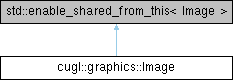
This is a class representing an image.
This class represents a single 2d image, which is a rectangular collection of texels. The color format for these texels is determined by the value TexelFormat.
Historically, many game engines treat images and textures as the same thing. However, this is not the case in Vulkan and modern graphics APIs, where a texture is actually an image plus a sampler. To maximize compatibility with Vulkan, we have split textures into this class and the class Sampler.
An image stores the pixel information for a texture, but does not specify how to resize it or how to handle texture coordinates that are out-of-bounds. Note that in Vulkan, a texture must explicitly specify the number of mipmap levels, while this value is implicit in OpenGL. Our interface assumes that all OpenGL textures with mipmap level > 0 are the same.
Because this class stores the image information for a Texture, this class is also where we provide support for atlases. An atlas allows us to carve an image up into smaller subimages. A subimage wraps the same image data (and so does not require a context switch in the rendering pipeline), but has different start and end boundaries, as defined by getMinS, getMaxS, getMinT, and getMaxT. See getSubImage for more information.
Note that we talk about texture coordinates in terms of S (horizontal) and T (vertical). This is different from other implementations that use UV instead.
Images can only be constructed on the main thread when using OpenGL. However, in Vulkan, images can be safely constructed on any thread.
| cugl::graphics::Image::Image | ( | ) |
Creates a new empty image with no size.
This method performs no allocations. You must call init to generate a proper image.
|
inline |
Deletes this image, disposing all resources
|
inlinestatic |
Returns a new empty image with the given dimensions.
The image will have all of its texels set to 0. It will not support mipmaps. You should use allocWithData for mipmap support.
| width | The image width in texels |
| height | The image height in texels |
| format | The image data format |
| access | The image access |
|
inlinestatic |
Returns a new image with the given data.
The data format must match the one specified by the format parameter. If the parameter mipmaps is true, the image will generate an appropriate number of mipmaps determined by its size.
This initializer assumes that alpha is not premultiplied. You should call setPremultiplied if this is not the case.
| data | The image data (size width*height*format) |
| width | The image width in pixels |
| height | The image height in pixels |
| format | The image data format |
| access | The image access |
| mipmaps | A flag to generate mipmaps |
|
inlinestatic |
Returns a new image with the data from the given file.
This method can load any file format supported by SDL_Image. This includes (but is not limited to) PNG, JPEG, GIF, TIFF, BMP and PCX. The image will be stored in RGBA format, even if it is a file format that does not support transparency (e.g. JPEG). Because of how SDL3 processes image files, any image loaded this way will have premultiplied alpha.
If the parameter mipmaps is true, the image will generate an appropriate number of mipmaps determined by its size.
If the file path is relative, it is assumed to be with respect to Application#getAssetDirectory. If you wish to load an image from somewhere else, you must use an absolute path.
| filename | The file supporting the texture file. |
| access | The image access |
| mipmaps | A flag to generate mipmaps |
| void cugl::graphics::Image::dispose | ( | ) |
Deletes the image and resets all attributes.
You must reinitialize the image to use it.
| const size_t cugl::graphics::Image::get | ( | std::vector< std::byte > & | data | ) |
Fills the given buffer with data from this texture.
This method will append the data to the given vector. This method will fail if the access does not support CPU-side reads.
| data | The buffer to store the texture data |
|
inline |
Returns the access policy of this image
| size_t cugl::graphics::Image::getByteSize | ( | ) | const |
Returns the number of bytes in a single texel of this image.
|
inline |
Returns the data format of this image.
The data format determines what type of data can be assigned to this image.
|
inline |
Returns the height of this image in texels.
|
inline |
Returns the platform-specific implementation for this image
The value returned is an opaque type encapsulating the information for either OpenGL or Vulkan.
|
static |
Returns the maximum image size (per dimension) for this platform
This value is useful for when we want to allocate an image buffer and want to make sure we do not exceed the platform limitations
|
inline |
Returns the maximum horizontal texture coordinate for this image.
When rescaling texture coordinates for a subimage, this value is used in place of 1.
|
inline |
Returns the maximum vertical texture coordinate for this image.
When rescaling texture coordinates for a subimage, this value is used in place of 1.
|
inline |
Returns the minimum horizontal texture coordinate for this image.
When rescaling texture coordinates for a subimage, this value is used in place of 0.
|
inline |
Returns the minimum vertical texture coordinate for this image.
When rescaling texture coordinates for a subimage, this value is used in place of 0.
|
inline |
Returns the name of this image.
A name is a user-defined way of identifying a image.
|
inline |
Returns the origin texel.
If this is not a subimage, this method returns the origin (0,0). Otherwise, this method returns the bottom left corner of the subimage region.
|
inline |
Returns the parent image of this subimage.
This method will return nullptr is this is not a subimage.
Returns the parent image of this subtexture.
|
inline |
Returns the parent image of this subimage.
This method will return nullptr is this is not a subimage.
Returns the parent image of this subtexture.
|
inline |
Returns the size of this image in texels.
| std::shared_ptr< Image > cugl::graphics::Image::getSubImage | ( | Uint32 | x, |
| Uint32 | y, | ||
| Uint32 | w, | ||
| Uint32 | h | ||
| ) |
Returns a subimage with the given dimensions.
The values x,y,w, and h must specify a subrectangle inside of the image. All values are in texels. In defining this rectangle, we put the origin in the bottom left corner. Positive y values go up the image from the bottom.
It is the responsibility of the user to rescale the texture coordinates of a mesh when using a subimage. Otherwise, the graphics pipeline will just use the original image instead. See the method internal method SpriteBatch#prepare for an example of how to scale texture coordinates.
It is possible to make a subimage of a subimage. However, in that case, the parent of the new subimage will be the original root image. So no tree of subtextures is more than one level deep.
| x | The x-coordinate of the bottom left in texels |
| y | The y-coordinate of the bottom left in texels |
| w | The region width in texels |
| h | The region height in texels |
|
inline |
Returns the width of this image in texels.
|
inline |
Returns the x-coordinate of the origin texel.
If this is not a subimage, this method returns 0. Otherwise, this method is defined by the origin of the subimage region.
|
inline |
Returns the y-coordinate of the origin texel.
If this is not a subimage, this method returns 0. Otherwise, this method is defined by the origin of the subimage region.
|
inline |
Returns whether this image has generated mipmaps.
This method will not indicate the number of mipmap levels in Vulkan. Instead, it treats mipmaps as all-or-nothing (like OpenGL).
| size_t cugl::graphics::Image::id | ( | ) | const |
Returns a unique identifier for this image
This value can be used in memory-based hashes.
|
inline |
Initializes an empty image with the given dimensions.
The image will have all of its texels set to 0. It will not support mipmaps. You should use initWithData for mipmap support.
| width | The image width in texels |
| height | The image height in texels |
| format | The image data format |
| access | The image access |
| bool cugl::graphics::Image::initWithData | ( | const std::byte * | data, |
| Uint32 | width, | ||
| Uint32 | height, | ||
| TexelFormat | format = TexelFormat::COLOR_RGBA, |
||
| ImageAccess | access = ImageAccess::READ_WRITE, |
||
| bool | mipmaps = false |
||
| ) |
Initializes an image with the given data and access.
The data format must match the one specified by the format parameter. If the parameter mipmaps is true, the image will generate an appropriate number of mipmaps determined by its size.
This initializer assumes that alpha is not premultiplied. You should call setPremultiplied if this is not the case.
| data | The image data (size width*height*format) |
| width | The image width in pixels |
| height | The image height in pixels |
| format | The image data format |
| access | The image access |
| mipmaps | A flag to generate mipmaps |
| bool cugl::graphics::Image::initWithFile | ( | const std::string | filename, |
| ImageAccess | access = ImageAccess::READ_WRITE, |
||
| bool | mipmaps = false |
||
| ) |
Initializes an image with the data from the given file.
This method can load any file format supported by SDL_Image. This includes (but is not limited to) PNG, JPEG, GIF, TIFF, BMP and PCX. The image will be stored in RGBA format, even if it is a file format that does not support transparency (e.g. JPEG). Because of how SDL3 processes image files, any image loaded this way will have premultiplied alpha.
If the parameter mipmaps is true, the image will generate an appropriate number of mipmaps determined by its size.
If the file path is relative, it is assumed to be with respect to Application#getAssetDirectory. If you wish to load an image from somewhere else, you must use an absolute path.
| filename | The file supporting the texture file. |
| access | The image access |
| mipmaps | A flag to generate mipmaps |
|
inline |
Returns true if this image uses premultiplied alpha.
Changing this value does not actually change the image data. It only changes how the image is interpretted by the graphics backend.
By default, this value is true if the image was read from a file (because of how SDL3 processes image files) and false otherwise.
|
inline |
Returns true if this image is a subimage.
This method is the same as checking if the parent is not nullptr.
|
inline |
Casts from Image to a string.
|
inline |
Sets this image to have the contents of the given buffer.
The buffer must have the correct data format. In addition, the buffer must be size width*height*bytesize. See getByteSize for a description of the latter.
Note that some images created by CUGL are read-only. For any such images, this method will fail.
| data | The buffer to read into the image |
| bool cugl::graphics::Image::save | ( | const std::string | file | ) |
Returns true if able to save the image to the given file.
The image will be saved as a PNG file. If the suffix of file is not a .png, then this suffix will be added.
This method will fail if the access does not support CPU-side reads.
IMPORTANT: In CUGL, relative path names always refer to the asset directory, which is a read-only directory. Therefore, the file must must be specified with an absolute path. Using a relative path for this method will cause this method to fail.
| file | The name of the file to write to |
| const Image & cugl::graphics::Image::set | ( | const std::byte * | data | ) |
Sets this image to have the contents of the given buffer.
The buffer must have the correct data format. In addition, the buffer must be size width*height*bytesize. See getByteSize for a description of the latter.
This method will fail if the access does not support CPU-side writes.
| data | The buffer to read into the image |
|
inline |
Sets this image to have the contents of the given buffer.
The buffer must have the correct data format. In addition, the buffer must be size width*height*bytesize. See getByteSize for a description of the latter.
This method will fail if the access does not support CPU-side writes.
| data | The buffer to read into the image |
|
inline |
Sets the name of this image.
A name is a user-defined way of identifying a image.
| name | The name of this image. |
|
inline |
Sets whether this image uses premultiplied alpha.
Changing this value does not actually change the image data. It only changes how the image is interpretted by the graphics backend.
By default, this value is true if the image was read from a file (because of how SDL3 processes image files) and false otherwise.
| value | Whether this image uses premultiplied alpha. |
| std::string cugl::graphics::Image::toString | ( | bool | verbose = false | ) | const |
Returns a string representation of this image for debugging purposes.
If verbose is true, the string will include class information. This allows us to unambiguously identify the class.
| verbose | Whether to include class information |
|
protected |
The access for this image
|
protected |
The graphics API image data
|
protected |
The pixel format of the image
|
protected |
The height in texels
|
protected |
The image max S (used for image atlases)
|
protected |
The image max T (used for image atlases)
|
protected |
The image min S (used for image atlases)
|
protected |
The image min T (used for image atlases)
|
protected |
Whether this image has associated mipmaps
|
protected |
The decriptive name of this image
|
protected |
The horizontal origin of the texture region
|
protected |
The vertical origin of the texture region
|
protected |
Image atlas support.
Our parent, who owns the image (or nullptr if we own it)
|
protected |
Whether the image uses premultiplied alpha
|
protected |
The width in texels
 1.9.7
1.9.7