• Research preview
Map any MS2 spectrum across the known structural space
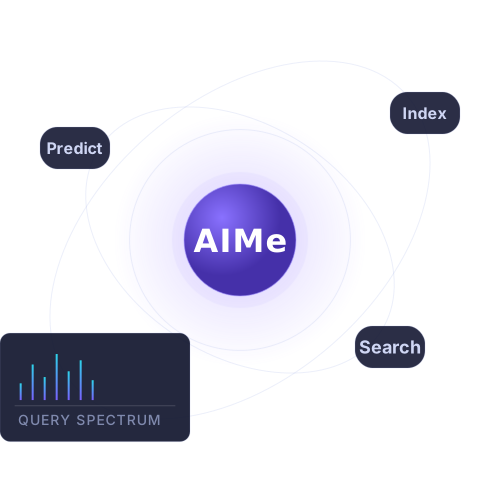
AI Molecule Explorer combines spectral prediction, molecular search, and interpretable fragmentation to contextualize experimental spectra across MS2KOSMOS.
Paste m/z–intensity pairs, import an .MGF or .MSP file, or begin with a preloaded example.
MS2KOSMOS
• A multi-agent framework
Three specialized agents
AIMe enables query-driven molecular contextualization across the Known Organic Small-Molecule Space through a modular neuro-symbolic workflow.
DeepMS2Reasoner
Predicts MS2 spectra and interpretable fragmentation pathways at experimental collision energies.
• Predict + explainMS2KOSMOSGenerator
Constructs and indexes a searchable space of predicted spectra for known small organic molecules.
• Construct + indexMS2KOSMOSMapper
Maps query spectra onto MS2KOSMOS for molecular search, comparison, and visualization.
• Search + map• Search MS2KOSMOS
Collision energy–matched search of the MS2KOSMOS
Match experimental spectra against predicted spectra of >105 million molecules at NCE 20%, 30%, 50%, and 80%, in both [M+H]+ and [M-H]- ionization modes.
Start spectrum searchCollision energy—matched spectra
Retrieves candidates, then predicts and reranks their spectra at the experimental collision energy in NCE or eV.
Precomputed spectra
Searches spectra calculated at the four indexed collision energies for a faster, coarse-grained result.
• Human-in-the-loop
Hypothesize–predict–compare AI-assisted loop
For any unknown spectrum, AIMe enables retrieval of potentially related molecules within MS2KOSMOS. Retrieval works over shared fragment formulas, and thus stays informative even if the true structure is not in PubChem, in that substructures of the retrieved candidates can serve as foundations for developing structural hypotheses. Retrieved candidates thus become priors for AI-assisted structure elucidation.
Hypothesize
Propose one or more possible structures, e.g., based on initial search results.
Predict
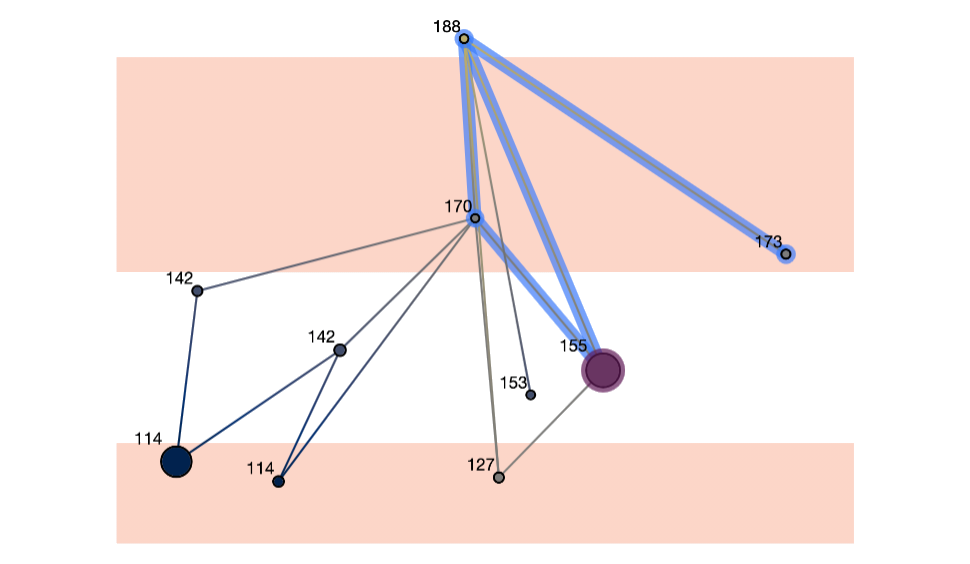
DeepMS2Reasoner predicts spectra and fragmentation DAGs for proposed structures.
Compare
Predicted spectra are compared and ranked against the experimental spectrum, enabling interpretation and refinement of structural hypotheses.
Each comparison guides the next hypothesis: an iterative, interpretable path to structure elucidation, with the scientist in control.
Try on search page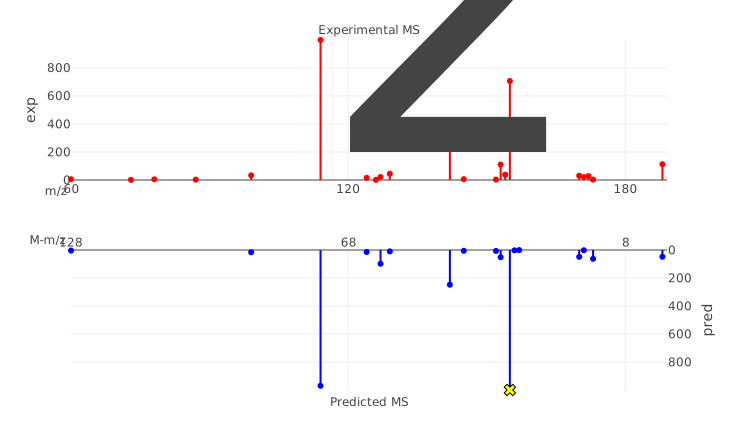
• Explore the result
Detailed fragmentation pathways for every spectrum
Inspect candidate molecules, mirror plots, matched fragments, and Fragmentation DAGs. Open results directly after a search or reload a saved .json file at any time.
• Research preview
Built for research, exploration, and discovery
For more details, see the accompanying paper:
Utku U. Acikalin, Dieqiao Feng, Aaron M. Ferber, Goncalo J. Gouveia, Tyler J. Schwertfeger, Di Chen, Delia Qu, Marissa A. Fontaine, Yingheng Wang, Richard A. Bernstein, Haofan Wang, Tae-Hyung Won, Christopher N. Parkhurst, Bart Selman, David Artis, Frank C. Schroeder, Carla P. Gomes. Charting the small-molecule universe from mass spectra with neuro-symbolic AI. bioRxiv (2026) doi:10.64898/2026.08.05.743095.
We thank the project's sponsors for their support: Schmidt Sciences, National Institutes of Health (NIH), National Institute of Food and Agriculture (USDA/NIFA), Air Force Office of Scientific Research (AFOSR), Biocodex Microbiota Foundation, and Brain and Behavior Research Foundation.