CS 6210: Matrix Computations
Introduction to least squares
Least squares basics
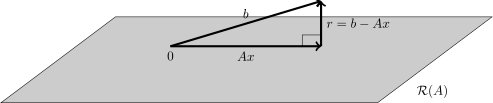
A least squares problem involves minimization of a (squared) Euclidean norm of some vector: \[ \mbox{minimize } \frac{1}{2} \|r\|^2 \mbox{ s.t. } r \in \Omega. \] In general, the derivative of the squared norm is given by \[ \delta \left( \frac{1}{2} \|r\|^2 \right) = \Re \langle \delta r, r \rangle; \] we will usually assume least squares problems over the real numbers, in which case we don’t have to worry about taking the real part. If we want to minimize the Euclidean norm of \(r\) (in the real case), we need \[ \langle \delta r, r \rangle = 0 \mbox{ for all admissible } \delta r; \] that is, \(r\) is orthogonal (or normal) to any admissible variation \(\delta r\) at the point. Here an “admissible” variation is just one that we could produce by changing the system in an allowed way.
For example, consider \(A \in \mathbb{R}^{m \times n}\) with \(m > n\) and let \(r(x) = A x - b\). This is a linear least squares problem. In this setting, the admissible variations are \(\delta r = A \delta x\), and the first-order condition for a minimizer is \[ \forall \delta x \in \mathbb{R}^n, \langle A \delta x, Ax - b \rangle = 0. \] Using the standard inner product, this gives us \[ A^T (Ax - b) = A^T A x - A^T b = 0, \] which is sometimes known as the normal equations because the residual is normal to all admissible variations (Figure 1).
The normal equations have a unique solution when \(A\) is full column rank. The solution to the normal equations is \[ (A^T A)^{-1} A^T b = A^\dagger b, \] where \(A^\dagger = (A^T A)^{-1} A\) is the Moore-Penrose pseudoinverse of \(A\). It is a pseudoinverse because \(A^\dagger A = I\), but \(P = A A^\dagger\) is not an identity. Instead, \(P\) is a projector, i.e. \(P^2 = P\). We say \(P\) is the orthogonal projector onto \(\mathcal{R}(A)\). Conceptually, it maps each point to the nearest point in the range space of \(A\). The projector \(I-P\) is the residual projector, for which \(\mathcal{R}(A)\) is the null space.
If you are not entirely happy with the variational calculus argument, there is a more algebraic approach. We note that for \(x = A^\dagger b + z\) we have \[\begin{aligned} \|Ax-b\|^2 &= \|Az-(I-P)b\|^2 \\ &= \|Az\|^2 + \|(I-P)b\|^2 \end{aligned}\] by the Pythagorean theorem (since \(Az \perp (I-AA^\dagger) b\) by the normal equations). When \(A\) is full rank, positive definiteness implies that \(\|Az\|^2 > 0\) for \(z \neq 0\); therefore, the minimizer happens at \(z = 0\).
An alternate formulation for the normal equations for the linear least squares problem is \[ \begin{bmatrix} I & A \\ A^T & 0 \end{bmatrix} \begin{bmatrix} r \\ x \end{bmatrix} = \begin{bmatrix} b \\ 0 \end{bmatrix} \] where the first row in the system defines \(r = b-Ax\) and the second row gives the normal condition \(A^T r = 0\). Partial Gaussian elimination on this alternative system gives the normal equations \(A^T A x = A^T b\) as a Schur complement subsystem.
Nothing we have said is specific to the standard inner product. If \(M\) is any symmetric positive definite matrix, there is an associated inner product \[ \langle x, y \rangle_M = y^T M x, \] and we can write the normal equations in terms of this inner product: \[ A^T M (Ax - b) = 0. \] Similarly, we can generalize the alternative form of the least squares problem to \[ \begin{bmatrix} M^{-1} & A \\ A^T & 0 \end{bmatrix} \begin{bmatrix} \tilde{r} \\ x \end{bmatrix} = \begin{bmatrix} b \\ 0 \end{bmatrix} \] where \(\tilde{r} = M r\) is the scaled residual.
Minimum norm problems
So far, we have considered overdetermined problems. But it is also interesting to consider minimum norm solutions to underdetermined problems: \[ \mbox{minimize } \frac{1}{2} \|x\|^2 \mbox{ s.t. } Ax = b \] where \(A \in \mathbb{R}^{m \times n}\) and now \(m < n\). In this case, using the method of Lagrange multipliers, we have \[ \mathcal{L}(x, \lambda) = \frac{1}{2} \|x\|^2 + \lambda^T (Ax - b) \] and the stationary equations are \[ 0 = \delta \mathcal{L} = \delta x^T (x + A^T \lambda) + \delta \lambda^T (Ax-b) \] for all \(\delta x\) and \(\delta \lambda\). Alternately, in matrix form, we have \[ \begin{bmatrix} I & A^T \\ A & 0 \end{bmatrix} \begin{bmatrix} x \\ \lambda \end{bmatrix} = \begin{bmatrix} 0 \\ b \end{bmatrix}. \] Eliminating the \(x\) variable gives us \((AA^T) \lambda = b\), and back-substitution yields \[ x = A^T (A A^T)^{-1} b. \] When \(A\) is short and wide rather than tall and skinny (and assuming it is full row rank), we say that \(A^\dagger = A^T (AA^T)^{-1}\) is the Moore-Penrose pseudo-inverse.
Why least squares?
Why is the ordinary least squares problem interesting? There are at least three natural responses.
Simplicity: The least squares problem is one of the simplest formulations around for fitting linear models. The quadratic loss model is easy to work with analytically; it is smooth; and it leads to a problem whose solution is linear in the observation data.
Statistics: The least squares problem is the optimal approach to parameter estimation among linear unbiased estimators, assuming independent Gaussian noise. The least squares problem is also the maximum likelihood estimator under these same hypotheses.
It’s a building block: Linear least squares are not the right formulation for all regression problems — for example, they tend to lack robustness in the face of heavy-tailed, non-Gaussian random errors. But even for these cases, ordinary least squares is a useful building block. Because least squares problems are linear in the observation vector, they are amenable to direct attack by linear algebra methods in a way that other estimation methods are not. The tools we have available for more complex fitting boil down to linear algebra subproblems at the end of the day, so it is useful to learn how to work effectively with linear least squares.
Least squares and statistical models
Consider the model \[ y_i = \sum_{j=1}^n c_j x_{ij} + \epsilon_i \] where the factors \(x_{ij}\) for example \(j\) are known, and the observations \(y_i\) are assumed to be an (unknown) combination of the factor values plus independent noise terms \(\epsilon_i\) with mean zero and variance \(\sigma^2\). In terms of a linear system, we have \[ y = X c + \epsilon. \]
Gauss-Markov
A linear unbiased estimator for \(c\) is a linear combination of the observations whose expected value is \(c\); that is, we need a matrix \(M \in \mathbb{R}^{n \times m}\) such that \[ \mathbb{E}[M y] = M X c = c. \] That is, \(M\) should be a pseudo-inverse of \(X\). Clearly one choice of linear unbiased estimator is \(\hat{c} = X^\dagger y\). According to the Gauss-Markov theorem, this is actually the best linear unbiased estimator, in the sense of miminizing the variance. To see this, consider any other linear unbiased estimator. We can always write such an estimator as \[ \tilde{c} = (X^\dagger + D) y \] where \(D \in \mathbb{R}^{n \times m}\) satisfies \(D X = 0\). Then \[\begin{aligned} \operatorname{Var}(\tilde{c}) &= \operatorname{Var}((X^\dagger + D) y) \\ &= (X^\dagger + D) (\sigma^2 I) (X^\dagger D) \\ &= \sigma^2 (X^\dagger + D) (X^\dagger + D)^T \\ &= \sigma^2 (X^T X)^{-1} + \sigma^2 D D^T &= \operatorname{Var}(\hat{c}) + \sigma^2 D D^T, \end{aligned}\] i.e. the variance of \(\tilde{c}\) exceeds that of \(\hat{c}\) by a positive definite matrix. And when the noise has covariance \(C\), the best linear unbiased estimator satisfies the generalized least squares problem \(X^T C^{-1} (Xc-y) = 0\) or, in alternate form \[ \begin{bmatrix} C & X \\ X^T & 0 \end{bmatrix} \begin{bmatrix} r \\ c \end{bmatrix} = \begin{bmatrix} y \\ 0 \end{bmatrix}. \]
Maximum likelihood
Another estimator for the parameters \(c\) in the model \(y = Xc + \epsilon\) comes from maximizing the (log) likelihood function. If \(\epsilon\) is a vector of multivariate Gaussian noise with mean zero and covariance \(C\), then the likelihood function is \[ \ell(y) = \frac{1}{\sqrt{\det(2\pi C)}} \exp\left( -\frac{1}{2} (y-Xc)^T C^{-1} (y-Xc) \right), \] and for a fixed \(C\), maximizing the likelihood corresponds to minimizing \(\|y-Xc\|_{C^{-1}}^2\).
Of course, Gaussian noise is not the only type of noise. More general noise models lead to more complex optimization problems. For example, if we assume the \(\epsilon_i\) are Laplacian random variables (with probability proportional to \(\exp(-|z|)\) rather than \(\exp(-z^2)\)), then maximizing the likelihood corresponds to maximimizing \(\|y-Xc\|_1\) instead of \(\|y-Xc\|_2\). This gives an estimator that is a nonlinear function of the data. However, least squares computations can be used as a building block for computing this type of estimators as well.
Reasoning about the residual
When we come to a least squares problem via a statistical model, it is natural to check whether the residual terms behave as one might expect:
Are there about the same number of positive and negative residuals?
If there is a natural “linear” structure to the data, is there evidence of significant auto-correlation between consecutive residuals?
Does the residual behave like white noise, or does it concentrate on certain frequencies?
Even when they are small, residuals that do not appear particularly noisy are a sign that the model may not describe the data particularly well.
A family of factorizations
Cholesky
If \(A\) is full rank, then \(A^T A\) is symmetric and positive definite matrix, and we can compute a Cholesky factorization of \(A^T A\): \[ A^T A = R^T R. \] The solution to the least squares problem is then \[ x = (A^T A)^{-1} A^T b = R^{-1} R^{-T} A^T b. \] Or, in Julia world
F = cholesky(A'*A);
x = F\(A'*b);
Economy QR
The Cholesky factor \(R\) appears in a different setting as well. Let us write \(A = QR\) where \(Q = AR^{-1}\); then \[ Q^T Q = R^{-T} A^T A R^{-1} = R^{-T} R^T R R^{-1} = I. \] That is, \(Q\) is a matrix with orthonormal columns. This “economy QR factorization” can be computed in several different ways, including one that you have seen before in a different guise (the Gram-Schmidt process).
Julia provides a numerically stable method to compute the QR factorization via
F = qr(A)and we can use the QR factorization directly to solve the least squares problem without forming \(A^T A\) by
F = qr(A)
x = F\b
Behind the scenes, this is what is used when we write A\b with a dense rectangular matrix \(A\).
Full QR
There is an alternate “full” QR decomposition where we write \[ A = QR, \mbox{ where } Q = \begin{bmatrix} Q_1 & Q_2 \end{bmatrix} \in \mathbb{R}^{n \times n}, R = \begin{bmatrix} R_{1} \\ 0 \end{bmatrix} \in \mathbb{R}^{m \times n}. \] To see how this connects to the least squares problem, recall that the Euclidean norm is invariant under orthogonal transformations, so \[ \|r\|^2 = \|Q^T r\|^2 = \left\| \begin{bmatrix} Q_1^T b \\ Q_2^T b \end{bmatrix} - \begin{bmatrix} R_1 \\ 0 \end{bmatrix} x \right\|^2 = \|Q_1^T b-R_1x\|^2 + \|Q_2^T b\|^2. \] We can set \(\|Q_1^T v-R_1 x\|^2\) to zero by setting \(x = R_1^{-1} Q_1^T b\); the result is \(\|r\|^2 = \|Q_2^T b\|^2\).
The QR factorization routine in Julia can be used to reconstruct either the full or the compact QR decomposition. Internally, it stores neither the smaller \(Q_1\) nor the full matrix \(Q\) explicitly; rather, it uses a compact representation of the matrix as a product of Householder reflectors, as we will discuss next time.
SVD
The full QR decomposition is useful because orthogonal transformations do not change lengths. Hence, the QR factorization lets us change to a coordinate system where the problem is simple without changing the problem in any fundamental way. The same is true of the SVD, which we write as \[\begin{aligned} A &= \begin{bmatrix} U_1 & U_2 \end{bmatrix} \begin{bmatrix} \Sigma \\ 0 \end{bmatrix} V^T & & \mbox{Full SVD} \\ &= U_1 \Sigma V^T & & \mbox{Economy SVD}. \end{aligned}\] As with the QR factorization, we can apply an orthogonal transformation involving the factor \(U\) that makes the least squares residual norm simple: \[ \|U^T r\|^2 = \left\| \begin{bmatrix} U_1^T b \\ U_2^T b \end{bmatrix} - \begin{bmatrix} \Sigma V^T \\ 0 \end{bmatrix} x \right\| = \|U_1^T b - \Sigma V^T x\|^2 + \|U_2^T b\|^2, \] and we can minimize by setting \(x = V \Sigma^{-1} U_1^T b\).