 |
CUGL 4.0
Cornell University Game Library
|
Loading...
Searching...
No Matches
|
CUGL 4.0
Cornell University Game Library
|
#include <CUFigmaLayout.h>
Classes | |
| class | Entry |
Public Member Functions | |
| FigmaLayout () | |
| ~FigmaLayout () | |
| virtual bool | initWithData (const std::shared_ptr< JsonValue > &data) override |
| virtual void | dispose () override |
| virtual bool | add (const std::string key, const std::shared_ptr< JsonValue > &data) override |
| bool | addMixed (const std::string key, Anchor anchor, float left, float right, float top, float bottom, bool x_absolute, bool y_absolute) |
| virtual bool | remove (const std::string key) override |
| virtual void | layout (scene2::SceneNode *node) override |
 Public Member Functions inherited from cugl::scene2::Layout Public Member Functions inherited from cugl::scene2::Layout | |
| Layout () | |
| ~Layout () | |
| virtual void | dispose () |
| virtual bool | init () |
| virtual bool | initWithData (const std::shared_ptr< JsonValue > &data) |
| virtual bool | add (const std::string key, const std::shared_ptr< JsonValue > &data) |
| virtual bool | remove (const std::string key) |
| virtual void | layout (SceneNode *node) |
Static Public Member Functions | |
| static std::shared_ptr< FigmaLayout > | alloc () |
| static std::shared_ptr< FigmaLayout > | allocWithData (const std::shared_ptr< JsonValue > &data) |
| static void | placeFigmaNode (SceneNode *node, Anchor anchor, const Rect &bounds, const Rect &offset) |
| Static Public Member Functions inherited from cugl::scene2::Layout | |
| static Anchor | getAnchor (const std::string x_anchor, const std::string y_anchor) |
| static void | placeNode (SceneNode *node, Anchor anchor, const Rect &bounds, const Vec2 &offset) |
| static void | placeNode (SceneNode *node, Anchor anchor, const Rect &bounds, const Vec2 &offbl, const Vec2 &offtr) |
| static void | reanchor (SceneNode *node, Anchor anchor) |
Protected Attributes | |
| std::unordered_map< std::string, Entry > | _entries |
Additional Inherited Members | |
| Public Types inherited from cugl::scene2::Layout | |
| enum class | Anchor : int { BOTTOM_LEFT = 0 , MIDDLE_LEFT = 1 , TOP_LEFT = 2 , BOTTOM_CENTER = 3 , CENTER = 4 , TOP_CENTER = 5 , BOTTOM_RIGHT = 6 , MIDDLE_RIGHT = 7 , TOP_RIGHT = 8 , BOTTOM_FILL = 9 , MIDDLE_FILL = 10 , TOP_FILL = 11 , LEFT_FILL = 12 , CENTER_FILL = 13 , RIGHT_FILL = 14 , TOTAL_FILL = 15 , NONE = 16 } |
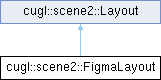
This class provides a Figma layout manager.
A Figma layout attaches a child node to one of nine "anchors" in the parent (corners, sides or middle), together with a percentage (or absolute) offset. As the parent grows or shinks, the child will move according to its anchor. For example, nodes in the center will stay centered, while nodes on the left side will move to keep the appropriate distance from the left side. In fact, the stretching behavior is very similar to that of a NinePatch.
Layout information is indexed by key. To look up the layout information of a scene graph node, we use the name of the node. This requires all nodes to have unique names. The Scene2Loader prefixes all child names by the parent name, so this is the case in any well-defined JSON file.
|
inline |
Creates a degenerate layout manager with no data.
NEVER USE A CONSTRUCTOR WITH NEW. If you want to allocate an object on the heap, use one of the static constructors instead.
|
inline |
Deletes this layout manager, disposing of all resources.
|
overridevirtual |
Assigns layout information for a given key.
The JSON object may contain any of the following attribute values:
 "x_anchor": One of 'left', 'center', 'right', or 'left+right'
 "y_anchor": One of 'bottom', 'middle', 'top', or 'top+bottom'
 "x_absolute": Whether to use absolute instead of relative (percentage) offsets in x
 "y_absolute": Whether to use absolute instead of relative (percentage) offsets in y
 "l_offset": A number indicating the left offset from the anchor.
             If "x_absolute" is true, this is the distance in coordinate space.
             Otherwise it is a percentage of the width.
 "r_offset": A number indicating the right offset from the anchor.
             If "x_absolute" is true, this is the distance in coordinate space.
             Otherwise it is a percentage of the width.
 "t_offset": A number indicating the top offset from the anchor.
             If "y_absolute" is true, this is the distance in coordinate space.
             Otherwise it is a percentage of the height.
 "b_offset": A number indicating the bottom offset from the anchor.
             If "y_absolute" is true, this is the distance in coordinate space.
             Otherwise it is a percentage of the height.
All attributes are optional. There are no required attributes.
To look up the layout information of a scene graph node, we use the name of the node. This requires all nodes to have unique names. The Scene2Loader prefixes all child names by the parent name, so this is the case in any well-defined JSON file. If the key is already in use, this method will fail.
| key | The key identifying the layout information |
| data | A JSON object with the layout information |
Reimplemented from cugl::scene2::Layout.
| bool cugl::scene2::FigmaLayout::addMixed | ( | const std::string | key, |
| Anchor | anchor, | ||
| float | left, | ||
| float | right, | ||
| float | top, | ||
| float | bottom, | ||
| bool | x_absolute, | ||
| bool | y_absolute | ||
| ) |
Assigns layout information for a given key.
This method allows for independent specification of absolute or relative offsets along the x and y axes. If an axis is marked as absolute, its offset is treated as a distance in Node coordinate space. Otherwise, the offset is interpreted as a percentage of the parent node's size in that dimension.
To look up the layout information of a scene graph node, we use the name of the node. This requires all nodes to have unique names. The Scene2Loader prefixes all child names by the parent name, so this is the case in any well-defined JSON file. If the key is already in use, this method will fail.
| key | The key identifying the layout information |
| anchor | The anchor point to use |
| left | The offset from the left edge |
| right | The offset from the right edge |
| top | The offset from the top edge |
| bottom | The offset from the bottom edge |
| x_absolute | Whether the x offset is absolute (in coordinate space) |
| y_absolute | Whether the y offset is absolute (in coordinate space) |
|
inlinestatic |
Returns a newly allocated layout manager.
The layout manager is initially empty. Before using it to perform a layout, layout information must be registered throught the add method interface.
|
inlinestatic |
Returns a newly allocated layout manager with the given JSON specificaton.
The JSON specification format is simple. It only supports one (required) attribute: 'type'. The type should specify "figma".
| data | The JSON object specifying the node |
|
inlineoverridevirtual |
Deletes the layout resources and resets all attributes.
A disposed layout manager can be safely reinitialized.
Reimplemented from cugl::scene2::Layout.
|
inlineoverridevirtual |
Initializes a new layout manager with the given JSON specificaton.
The JSON specification format is simple. It only supports one (required) attribute: 'type'. The type should specify "figma".
| data | The JSON object specifying the node |
Reimplemented from cugl::scene2::Layout.
|
overridevirtual |
Performs a layout on the given node.
This layout manager will searches for those children that are registered with it. For those children, it repositions and/or resizes them according to the layout information.
This manager attaches a child node to one of nine "anchors" in the parent (corners, sides or middle), together with a percentage (or absolute) offset. As the parent grows or shinks, the child will move according to its anchor. For example, nodes in the center will stay centered, while nodes on the left side will move to keep the appropriate distance from the left side. In fact, the stretching behavior is very similar to that of a NinePatch.
To look up the layout information of a scene graph node, this method uses the name of the node. This requires all nodes to have unique names. The Scene2Loader prefixes all child names by the parent name, so this is the case in any well-defined JSON file.
Children not registered with this layout manager are not affected.
| node | The scene graph node to rearrange |
Reimplemented from cugl::scene2::Layout.
|
static |
Repositions the given Figma node according the rules of its anchor.
The repositioning is done relative to bounds, not the parent node. This allows us to apply anchors to a subregion of the parent, like we do in GridLayout.
This function is different from Layout#placeNode in that it follows the conventions of Figma layouts. For Figma nodes, the offset is measured from the top-left corner of the parent. The size of the offset is the total distance from the edges. So the width is the sum of the distance from the left and right edges while the height is the sum of the distance from the top and bottom edges
| node | The node to reposition |
| anchor | The anchor rule for this node |
| bounds | The area to compute the position from |
| offset | The Figma specified offset from the parent |
|
overridevirtual |
Removes the layout information for a given key.
To look up the layout information of a scene graph node, we use the name of the node. This requires all nodes to have unique names. The Scene2Loader prefixes all child names by the parent name, so this is the case in any well-defined JSON file.
If the key is not in use, this method will fail.
| key | The key identifying the layout information |
Reimplemented from cugl::scene2::Layout.
|
protected |
The map of keys to layout information
 1.9.7
1.9.7