CS 4220: Numerical Analysis
Introduction to least squares
Least squares: the big idea
Least squares problems are a special sort of minimization problem. Suppose \(A \in \mathbb{R}^{m \times n}\) where \(m > n\). In general, we cannot solve the overdetermined system \(Ax = b\); the best we can do is minimize the residual \(r = b-Ax\). In the least squares problem, we minimize the two norm of the residual: \[ \mbox{Find } x \mbox{ to minimize } \|r\|_2^2 = \langle r, r \rangle. \] This is not the only way to approximately solve the system, but it is attractive for several reasons:
It’s mathematically attractive: the solution of the least squares problem is \(x = A^\dagger b\) where \(A^\dagger\) is the Moore-Penrose pseudoinverse of \(A\).
There’s a nice picture that goes with it — the least squares solution is the projection of \(b\) onto the range of \(A\), and the residual at the least squares solution is orthogonal to the range of \(A\).
It’s a mathematically reasonable choice in statistical settings when the data vector \(b\) is contaminated by Gaussian noise.
Cricket chirps: an example
Did you know that you can estimate the temperature by listening to the rate of chirps? The data shown in Figure 1 represents measurements of the number of chirps (over 15 seconds) of a striped ground cricket at different temperatures measured in degrees Farenheit1. The plot shows that the two are roughly correlated: the higher the temperature, the faster the crickets chirp. We can quantify this by attempting to fit a linear model \[
\mbox{temperature} = \alpha \cdot \mbox{chirps} + \beta +
\epsilon
\] where \(\epsilon\) is an error term. To solve this problem by linear regression, we minimize the residual \[
r = b-Ax
\] where \[\begin{aligned}
b_{i} &= \mbox{temperature in experiment } i \\
A_{i1} &= \mbox{chirps in experiment } i \\
A_{i2} &= 1 \\
x &= \begin{bmatrix} \alpha \\ \beta \end{bmatrix}
\end{aligned}\] Julia is capable of solving least squares problems using the backslash operator; that is, if chirps and temp are column vectors in Julia, we can solve this regression problem as
A = [chirps ones(ndata)]
x = A\temp
The algorithms underlying that backslash operation will make up most of the next lecture.
In more complex examples, we want to fit a model involving more than two variables. This still leads to a linear least squares problem, but one in which \(A\) may have more than one or two columns. As we will see later in the semester, we also use linear least squares problems as a building block for more complex fitting procedures, including fitting nonlinear models and models with more complicated objective functions.
Normal equations
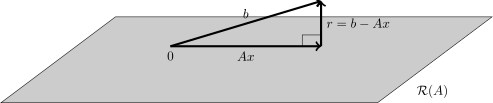
When we minimize the Euclidean norm of \(r = b-Ax\), we find that \(r\) is normal to everything in the range space of \(A\) (Figure 2): \[ b-Ax \perp \mathcal{R}(A), \] or, equivalently, for all \(z \in \mathbb{R}^n\) we have \[ 0 = (Az)^T (b-Ax) = z^T(A^T b - A^T A x). \] The statement that the residual is orthogonal to everything in \(\mathcal{R}(A)\) thus leads to the normal equations \[ A^T A x = A^T b. \] To see why this is the right system, suppose \(x\) satisfies the normal equations and let \(y \in \mathbb{R}^{n}\) be arbitrary. Using the fact that \(r \perp Ay\) and the Pythagorean theorem, we have \[ \|b-A(x+y)\|^2 = \|r-Ay\|^2 = \|r\|^2 + \|Ay\|^2 > 0. \] The inequality is strict if \(Ay \neq 0\); and if the columns of \(A\) are linearly independent, \(Ay = 0\) is equivalent to \(y = 0\).
We can also reach the normal equations by calculus. Define the least squares objective function: \[ F(x) = \|Ax-b\|^2 = (Ax-b)^T (Ax-b) = x^T A^TA x - 2x^T A^T b + b^T b. \] The minimum occurs at a stationary point; that is, for any perturbation \(\delta x\) to \(x\) we have \[ \delta F = 2 \delta x^T (A^T A x - A^T b) = 0; \] equivalently, \(\nabla F(x) = 2 (A^T A x - A^T b) = 0\) — the normal equations again!
A family of factorizations
Cholesky
If \(A\) is full rank, then \(A^T A\) is symmetric and positive definite matrix, and we can compute a Cholesky factorization of \(A^T A\): \[ A^T A = R^T R. \] The solution to the least squares problem is then \[ x = (A^T A)^{-1} A^T b = R^{-1} R^{-T} A^T b, \] or, in Julia world
AC = cholesky(A'*A)
x = AC\(A'*b)  # Using the factorization object, OR
x = AC.U\(AC.U'\(A'*b))
Economy QR
The Cholesky factor \(R\) appears in a different setting as well. Let us write \(A = QR\) where \(Q = AR^{-1}\); then \[ Q^T Q = R^{-T} A^T A R^{-1} = R^{-T} R^T R R^{-1} = I. \] That is, \(Q\) is a matrix with orthonormal columns. This “economy QR factorization” can be computed in several different ways, including one that you have seen before in a different guise (the Gram-Schmidt process). Julia provides a numerically stable method to compute the QR factorization via
AC = qr(A)and we can use the QR factorization directly to solve the least squares problem without forming \(A^T A\) by
AC = qr(A,0)
x = AC\b   # Using the factorization object, OR
x = AC.R\((AC.Q'*b)[1:m])
Full QR
There is an alternate “full” QR decomposition where we write \[ A = QR, \mbox{ where } Q = \begin{bmatrix} Q_1 & Q_2 \end{bmatrix} \in \mathbb{R}^{m \times m}, R = \begin{bmatrix} R_{1} \\ 0 \end{bmatrix} \in \mathbb{R}^{m \times n}. \] To see how this connects to the least squares problem, recall that the Euclidean norm is invariant under orthogonal transformations, so \[ \|r\|^2 = \|Q^T r\|^2 = \left\| \begin{bmatrix} Q_1^T b \\ Q_2^T b \end{bmatrix} - \begin{bmatrix} R_1 \\ 0 \end{bmatrix} x \right\|^2 = \|Q_1^T b-R_1x\|^2 + \|Q_2^T b\|^2. \] We can set \(\|Q_1^T v-R_1 x\|^2\) to zero by setting \(x = R_1^{-1} Q_1^T b\); the result is \(\|r\|^2 = \|Q_2^T b\|^2\).
The actual thing computed by Julia is a sort of hybrid of the full and economy decompositions. The data structure representing \(Q\) (in compressed form) can reconstruct the full orthogonal matrix; but the \(R\) factor is stored as in the economy form.
SVD
The full QR decomposition is useful because orthogonal transformations do not change lengths. Hence, the QR factorization lets us change to a coordinate system where the problem is simple without changing the problem in any fundamental way. The same is true of the SVD, which we write as \[\begin{aligned} A &= \begin{bmatrix} U_1 & U_2 \end{bmatrix} \begin{bmatrix} \Sigma \\ 0 \end{bmatrix} V^T & & \mbox{Full SVD} \\ &= U_1 \Sigma V^T & & \mbox{Economy SVD}. \end{aligned}\] As with the QR factorization, we can apply an orthogonal transformation involving the factor \(U\) that makes the least squares residual norm simple: \[ \|U^T r\|^2 = \left\| \begin{bmatrix} U_1^T b \\ U_2^T b \end{bmatrix} - \begin{bmatrix} \Sigma V^T \\ 0 \end{bmatrix} x \right\| = \|U_1^T b - \Sigma V^T x\|^2 + \|U_2^T b\|^2, \] and we can minimize by setting \(x = V \Sigma^{-1} U_1^T b\).
The Moore-Penrose pseudoinverse
If \(A\) is full rank, then \(A^T A\) is symmetric and positive definite matrix, and the normal equations have a unique solution \[x = A^{\dagger} b \mbox{ where } A^{\dagger} = (A^T A)^{-1} A^T.\] The matrix \(A^\dagger \in \mathbb{R}^{n \times m}\) is the Moore-Penrose pseudoinverse. We can also write \(A^\dagger\) via the economy QR and SVD factorizations as \[\begin{aligned} A^\dagger &= R^{-1} Q_1^T, \\ A^\dagger &= V \Sigma^{-1} U_1^T. \end{aligned}\] If \(m = n\), the pseudoinverse and the inverse are the same. For \(m > n\), the Moore-Penrose pseudoinverse has the property that \[ A^\dagger A = I; \] and \[ \Pi = A A^\dagger = Q_1 Q_1^T = U_1 U_1^T \] is the orthogonal projector that maps each vector to the closest vector (in the Euclidean norm) in the range space of \(A\).
The good, the bad, and the ugly
At a high level, there are two pieces to solving a least squares problem:
Project \(b\) onto the span of \(A\).
Solve a linear system so that \(Ax\) equals the projected \(b\).
Consequently, there are two ways we can get into trouble in solving least squares problems: either \(b\) may be nearly orthogonal to the span of \(A\), or the linear system might be ill conditioned.
Let’s first consider the issue of \(b\) nearly orthogonal to the range of \(A\) first. Suppose we have the trivial problem \[ A = \begin{bmatrix} 1 \\ 0 \end{bmatrix}, \quad b = \begin{bmatrix} \epsilon \\ 1 \end{bmatrix}. \] The solution to this problem is \(x = \epsilon\); but the solution for \[ A = \begin{bmatrix} 1 \\ 0 \end{bmatrix}, \quad \hat b = \begin{bmatrix} -\epsilon \\ 1 \end{bmatrix} \] is \(\hat x = -\epsilon\). Note that \(\|\hat b-b\|/\|b\| \approx 2 \epsilon\) is small, but \(|\hat x - x|/|x| = 2\) is huge. That is because the projection of \(b\) onto the span of \(A\) (i.e. the first component of \(b\)) is much smaller than \(b\) itself; so an error in \(b\) that is small relative to the overall size may not be small relative to the size of the projection onto the columns of \(A\).
Of course, the case when \(b\) is nearly orthogonal to \(A\) often corresponds to a rather silly regressions, like trying to fit a straight line to data distributed uniformly around a circle, or trying to find a meaningful signal when the signal to noise ratio is tiny. This is something to be aware of and to watch out for, but it isn’t exactly subtle: if \(\|r\|/\|b\|\) is near one, we have a numerical problem, but we also probably don’t have a very good model. A more subtle problem occurs when some columns of \(A\) are nearly linearly dependent (i.e. \(A\) is ill-conditioned).
The condition number of \(A\) for least squares is \[ \kappa(A) = \|A\| \|A^\dagger\| = \sigma_1/\sigma_n. \] If \(\kappa(A)\) is large, that means:
Small relative changes to \(A\) can cause large changes to the span of \(A\) (i.e. there are some vectors in the span of \(\hat A\) that form a large angle with all the vectors in the span of \(A\)).
The linear system to find \(x\) in terms of the projection onto \(A\) will be ill-conditioned.
If \(\theta\) is the angle between \(b\) and the range of \(A\), then the sensitivity to perturbations in \(b\) is \[\frac{\|\delta x\|}{\|x\|} \leq \frac{\kappa(A)}{\cos(\theta)}{\|\delta b\|}{\|b\|}\] while the sensitivity to perturbations in \(A\) is \[\frac{\|\delta x\|}{\|x\|} \leq \left( \kappa(A)^2 \tan(\theta) + \kappa(A) \right) \frac{\|\delta A\|}{\|A\|}\] Even if the residual is moderate, the sensitivity of the least squares problem to perturbations in \(A\) (either due to roundoff or due to measurement error) can quickly be dominated by \(\kappa(A)^2 \tan(\theta)\) if \(\kappa(A)\) is at all large.
In regression problems, the columns of \(A\) correspond to explanatory factors. For example, we might try to use height, weight, and age to explain the probability of some disease. In this setting, ill-conditioning happens when the explanatory factors are correlated — for example, perhaps weight might be well predicted by height and age in our sample population. This happens reasonably often. When there is a lot of correlation, we have an ill-posed problem; we will talk about this case in a couple lectures.