
Kenneth P. Birman
N. Rama Rao Emeritus Professor of Computer Science
435 Gates Hall, Cornell University
Ithaca, New York 14853
M: 607-227-0894
Email: ken@cs.cornell.edu
CV: Mar 2026
|
|
Kenneth P. Birman M: 607-227-0894 |
Breaking News.
I am now retired, with an emeritus professor title. I won't be bringing any new students into my group, although I am happy to talk about research related to what we did while I was active. In my post-Cornell life, I'm working at Microsoft in a product area, Frontier Tuning -- an exciting direction for Microsoft itself, and for me too. Unfortunately, because Frontier Tuning is a product, I cannot talk about my work or share details beyond what you can read in the public materials describing the technology and its many features.
Graduate Studies in Computer Science at Cornell
True, I'm no longer active at Cornell, but the department remains just as outstanding in systems, distributed systems, databases, embedded applications and a wide range of related topics. If systems research is your passion, Alex, Andrew, Hakim, Lorenzo, Rachee, Rachit and Robbert would all be fantastic advisors with active groups. I've put advice on applying to graduate school down at the bottom of this page.
Recent Research (full publications list).
Teaching:
Now that I have retired, I am no longer teaching and in fact the courses I was teaching in 2024 and 2025 are being revamped, so you will need to focus on their web sites to learn about the current versions.
Video links:
Cloud Computing Textbook (last revised in 2012):
|
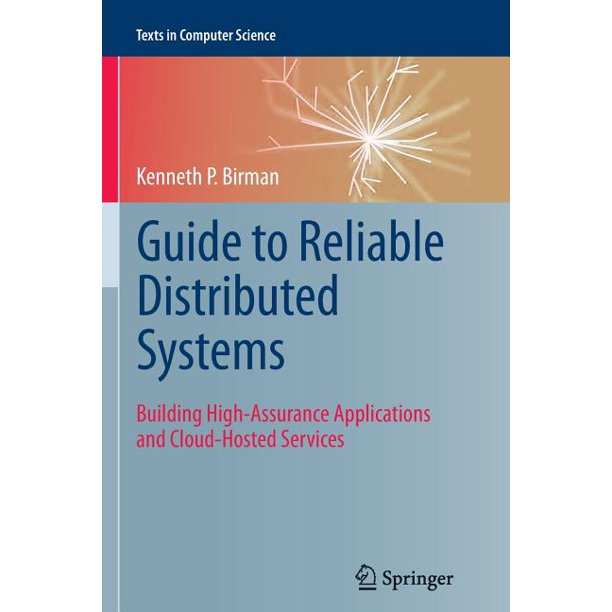
Guide to Reliable Distributed Systems: Building High-Assurance
Applications and Cloud-Hosted Services. Click here to get to slides from the last offering of my course on this topic. You can use any of those slides for your own classes without needing special permission from me. The bad news is that the material evolves at a breathtaking pace, which is why I keep revising the slides. Natually, this also means that the book is already out of date. I don't have the time to revise it, right now. |
 |
Older work. I've really worked in Cloud Computing for most of my career, although it obviously wasn't called cloud computing in the early days. As a result, our papers in this area date back to 1985.
Some examples of mission-critical systems on which my software was used in the past include the New York Stock Exchange and Swiss Exchange, the French Air Traffic Control system, the AEGIS warship and a wide range of applications in settings like factory process control and telephony. In fact, every stock quote or trade on the NYSE from 1995 until early 2006 was reported to the overhead trading consoles through software I personally implemented - a cool (but also scary) image, for me at least! During the ten years this system was running, many computers crashed during the trading day, and many network problems have occurred - but the design we developed and implemented has managed to reconfigure itself automatically and kept the overall system up, without exception. They didn't have a single trading disruption during the entire period. As far as I know, the other organizations listed above have similar stories to report.
Today, these kinds of ideas are gaining "mainstream" status. For example, IBM's Websphere 6.0 product includes a multicast layer used to replicate data and other runtime state for high-availability web service applications and web sites. Although IBM developed its own implementation of this technology, we've been told by the developers that the architecture was based on Cornell's Horus and Ensemble systems, described more fully below. The CORBA architecture includes a fault-tolerance mechanism based on some of the same ideas. And we've also worked with Microsoft on the technology at the core of the next generation of that company's clustering product. So, you'll find Cornell's research not just on these web pages, but also on web sites worldwide and in some of the world's most ambitious data centers and high availability computing systems.
In fact we still have very active dialogs with many of these companies: Cisco, IBM, Intel, Microsoft, Amazon, and others. An example of a more recent dialog is this: a few years ago worked with Cisco to invent a new continuous availability option for their core Internet routers, the CRS-1 series. You can read about this work here.
My group often works with vendors and industry researchers. We maintain a very active dialog with the US government and military on research challenges emerging from a future generation communication systems now being planned by organizations like the Air Force and the Navy. We've even worked on new ways of controlling the electric power grid, but not in time to head off the big blackout in 2003! Looking to the future, we are focused on needs arising in financial systems, large-scale military systems, and even health-care networks. (In this connection, I should perhaps mention that although we do get research support from the government and the US military, none of our research is classified or even sensitive, and all of it focuses on widely used commercial standards and platforms. Most of our software is released for free, under open source licenses.)
I'm just one of many members of a group in this area at Cornell. My closest colleagues and co-leaders of the group are Robbert van Renesse and Hakim Weatherspoon. But the systems group is very strong and broad right now, and the three of us have great relationships and collaborations with many other systems faculty here at Cornell (both in the systems area within CS, but also folks in ECE where we have great ties, MAE, IS, and down in New York City, where a few faculty are members of our fast-growing New York City Technology "outpost" on Roosveldt Island.
Four generations of reliable distributed systems research! Overall, our group has developed three generations of technology and is now working on a fourth generation system: The Isis Toolkit, developed mostly during 1987-1993, the Horus system, developed starting in 1990 until around 1995, the Ensemble system, 1995-1999. Right now we're developing a number of new systems including Isis2, Gradient, and the reliable TCP solution mentioned above, and working with others to integrate those solutions into settings where reliability, security, consistency and scalability are make-or-break requirements. Older Research web pages: Live Objects, Quicksilver, Maelstrom, Ricochet and Tempest projects Ensemble project Horus project Isis Toolkit (really old stuff! This is from the very first version of Isis). A collection of papers on Isis, edited by myself with Robbert van Renesse, may still be available -- it was called Reliable Distributed Computing with the Isis Toolkit and was in the IEEE Press Computer Science series.
Advice on applying to PhD programs: Ken's few bits of useful knowledge (based on running Cornell's PhD admissions in CS, many times over many years, though not since 2019).
At the MS and PhD level (and Cornell has very few MS students, so PhD is the larger program by far), you are hoping to get a full time, paid job working on cutting edge research questions. Like any job, you apply through a screening committee -- a company would do this, and graduate school does too. Then the screening committee shares your application to individual professors.
In fact despite dialog with potential advisors after being admitted and before deciding, Cornell assumes you could switch to someone else, or switch areas. To give you time, forming a graduate committee -- making your advisor official -- normally doesn't occur until you have been in the department for several months (and sometimes longer). So your application will be read by a group of faculty and students. Assume that not all will be in your areas of interest. After this it will be shown to many faculty who could become advisors, and you may have a zoom interview (or many) before any form of admissions decision is finalized. If you focus too narrowly because you really want to work with Professor X, you might miss out on a chance to work with Professor Y, who could be a fantastic advisor, with funding -- whereas Professor X might be going on sabbatical for one year and not taking new students.
Don't feel heartbroken if you talk to someone before deciding, but later it doesn't work out for them to be your main advisor. It often was a financial issue, not about you -- not some kind of negative judgement. And you won't know for sure, even if it was something as mundane as funding. Professors just don't explain their reasons so graduate students need that flexibility. Plus you could work with one person for a few years but then shift interests and switch to someone else. So unlike being an undergraduate, where everything is fairly predictable, graduate school is about becoming an independent professional who collaborates well with others -- about taking on the active management of your own research and future, collaboratively with your advisor and others but still ``owned'' by you.
There are no shortcuts. Unlike some academic models where the professor in a group decides admissions, it simply does not work that way at Cornell or at most other top-ranked schools. For addmissions, the committee decides, with input from professors who advocate for admitting you and have funding to support you if you do get admitted, accept the offer, and then the two of you decide to work together.
You must follow this standard process. If the cost of applying is a burden, request a fee waiver -- but follow that standard process no matter what. Reaching out to individual professors at an early stage won't help much, because the odds are that the individual you email to isn't even on the screening and admissions committee!
This means that beyond your statement of purpose and your CV and grades, you need this committee to understand the goals and general vision you bring to graduate studies -- not the actual topic you plan to work on (very few students arrive knowing that or even sure of who they will work with!), but a sort of path you hope to follow. Normally you would be able to identify three or four specific faculty you might work with, and your statement of purpose will not be so much about you personally but rather about the skills and experience you gained that qualify you to work with them, and how you would advance their current projects.
Make sure your letter writers are researchers themselves, or at least very plugged in and aware of what PhD research is like at a cutting edge program. They need to talk about you as a future researcher, which means helping define new topics, carrying out the work and bringing really innovative insights to it, and delivering great solutions that are also experimentally validated. The work is hard and you also have to juggle: taking some courses, doing some TA work. Everyone has that mix -- and these letters are supposed to convince the committee that you have what it takes.
Beyond all this is a question of funding. In the US the funding levels in computer systems have been variable but generally speaking, are down relative to AI areas or core AI. So money is tight and in a tight market, being the best qualified candidate isn't helpful if there are no actual jobs open. The admissions committee will have canvased the faculty to learn about needs: who has funding, what skills are needed, etc. So in this concept of applying for a job, you are applying for one of those specific jobs -- even though no job opening is really posted except for what you will find on the individual web sites of the faculty in your area. You won't be admitted even if you walk on water if the professors you are hoping to work with don't have any capacity for new students. So don't be overly narrow: your goal is to have the committee match you to two or three faculty who need new students, and for everyone in that process including those professors to feel that you sound like a great bet.
Having a fellowship and hence not needing funding is very helpful in many ways, but isn't a factor for those admissions decisions. They all center on merit. But being from a famous undergraduate program or having your name on a published paper isn't actually a requirement: we define merit in a more hollistic way that tries to think about the whole person, not a list of achievements. So don't feel that it is hopeless simply because you graduated from a smaller school and don't have any publications to brag about -- it really isn't hopeless at all! Just tell your story, in a suscinct and professional way (professional writing is drier than personal emails). And your intrinisic value will shine through and carry things along!
One last remark: Everyone in this process is getting really tired of AI
writing.
They will notice if you use AI to write your essays or if that undergraduate
paper was AI-assisted in some heavy sense. AI to fix grammar is fine.
AI as a research topic is excellent. But we do not admit AIs into our
graduate program. If you can't make your case without an AI writing the
materials, you won't be a success at Cornell, and we won't admit you. So
factor that into your planning!
Good luck! Perhaps we will meet when you apply to do an internship at
Microsoft in SYSML for Frontier Tuning!