Scheduling as a Constraint Satisfaction
Problem
Constructive Search
Partial
assignment
Consistent
assignment
Extension
Stack
architecture
Backtracking
mechanism
Completeness
Local Search
Full assignment
Inconsistent
assignment
Improvement
Parallel
architecture
Digression
mechanism
Incompleteness
Sport Scheduling
A
football League has 7 teams. Every team has to play every other team in a season of 7 weeks. Every team can play at most
once a week and no
team can play at home more than twice in a row.
Model: Every week each team has an opponent = one of the other 6 teams.
Complexity: Total of 7 teams * 7
weeks = 49 opponent variables. The number
of possible configurations are 649
CSP Framework
The CSP (Constraint
Satisfaction Problem) paradigm is good at modeling many real-life
problems: job scheduling, timetabling, vehicle routing, etc.
In CSPs the problem is
stated in terms of variables, possible values for them and constraints.
The problem difficulty
grows really fast (exponentially) with the number of variables to be scheduled.

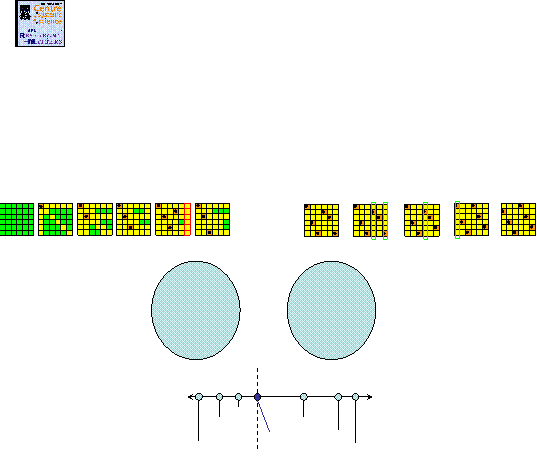
Start with an empty solution
Add a queen and apply constraints
Extend the partial solution
Extend the partial solution
Until some queen cannot be placed on the
board
Change the first possible previous
queen and continue…
Systematicity
Memory
Inference
Completeness Boundary
Chronological Backtracking
Dependency-directed Backjumping
Random Restart
Simulated Annealing
Tabu Search
CBJ
Systematic Local Search
Full assignment
Equality between solvers
Freedom to move
heuristically
A feasible solution
is found
3
2
1
0
2
3
2
1
2
0
1
3
2
3
2
1
2
2
0
3
3
2
3
2
2
0
2
3
3
1
0
2
0
2
3
1
Move one of the queens that have
better available positions
1
3
1
1
2
2
2
2
3
1
3
1
1
2
2
1
5
1
1
2
1
3
2
4
1
1
1
2
1
2
0
3
1
3
2
2
Re-evaluate the conflicts to choose the next queen
2
3
0
1
2
2
3
1
3
1
2
2
1
2
2
1
4
2
1
2
1
3
3
3
1
1
2
3
2
2
0
2
0
2
2
2
Improve the solution until…
3
3
1
0
2
3
2
1
3
1
1
2
1
2
1
2
3
2
0
3
2
2
3
3
1
0
2
3
2
2
0
2
0
2
2
2
1
3
1
1
2
2
2
2
3
1
3
1
1
2
2
1
5
1
1
2
1
3
2
4
1
1
1
2
1
2
0
3
1
3
2
2
Start with a full assignment, and calculate the
conflicts

