

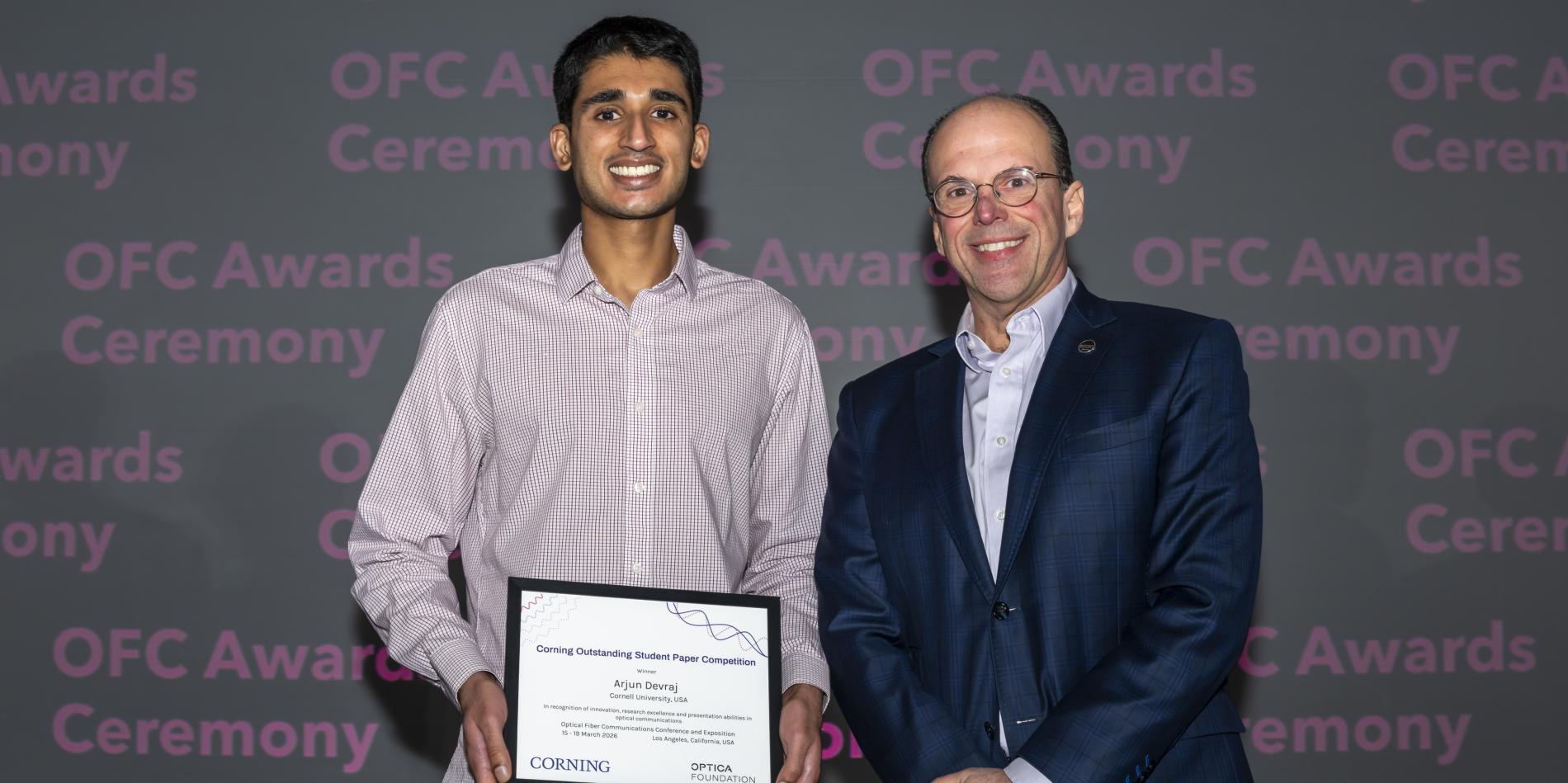
Arjun Devraj, a Ph.D. candidate in the field of computer science, received the Corning Outstanding Student Paper Award in March at the Optical Fiber Communication Conference and Exposition, the flagship conference on optics research. The competition recognizes innovation and research excellence in the field of optical communications and comes with a $3,500 stipend.
The award committee selected Devraj for his presentation, "In-Network Analog AllReduce for ML with Programmable Integrated Photonics.” In his talk, he described a new technique that uses programmable photonics to simultaneously compute and route data within the network, paving the way for reduced communication latency in large-scale distributed machine learning workloads.
Previously, Devraj received his undergraduate degree in computer science from Princeton University and worked as a software engineer at Meta. He is advised by Rachee Singh, assistant professor of computer science in the Cornell Ann S. Bowers College of Computing and Information Science.
What is your area of research, and why is it important?
The massive size of modern machine learning (ML) models requires splitting them across multiple machines during training and inference. As a result, the network connecting those machines plays a critical role in overall performance, cost, and power consumption. My research explores how we can improve network efficiency for distributed ML workloads, either by re-designing the network infrastructure itself (e.g., using switches that can simultaneously perform computations while routing data) or by designing algorithms that reduce the amount of data that must be transferred over the network.
What are the larger implications of this research?
Today’s ML datacenter networks have been engineered around the needs and technological constraints of earlier generations of computing workloads. For example, traditional applications exhibited unpredictable communication patterns and relied on power-hungry electronic switching hardware that was commercially available at the time. In contrast, modern ML workloads feature more structured communication patterns, and new optical technologies offer opportunities for lower-power and potentially more efficient network designs. These changes raise important questions about the assumptions underlying the design of modern datacenter and supercomputer networks, in particular that the network’s role is solely to transmit information between endpoints. My research examines how we can leverage these recent trends to rethink the relationship between computation and communication in large-scale networked systems. I hope that these questions can help guide us toward a more sustainable, long-term vision for network infrastructure.
What inspired you to choose this field of study?
Growing up, I really enjoyed math, but I was first exposed to computer science as an undergraduate. In college, I realized that CS heavily involved the style of applied mathematical problem-solving that I most enjoyed. I was also drawn to the fact that ideas from computer science research can rapidly transform the world—for example, through technologies such as the internet. I ultimately specialized in computer networking because I was fascinated by the incredible feat of human engineering that has enabled planet-scale communication systems.
What are your hobbies or interests outside of your research or scholarship?
Outside of research, I enjoy running, reading, and traveling. I also enjoy listening to many genres of music, and I’m trained in Indian classical music.
Why did you choose Cornell Bowers to pursue your degree?
I chose Cornell Bowers for several reasons, including my advisor’s research interests and expertise, the strong sense of community among graduate students, and the collaborative culture in the department. Cornell’s CS faculty are pioneers in the field, and I have benefited tremendously from the opportunity to learn from and collaborate with them.
Patricia Waldron is a writer for the Cornell Ann S. Bowers College of Computing and Information Science.