Autonomous drones could deliver packages, inspect bridges and skyscrapers, monitor emergencies like wildfires and, eventually, ferry people. But the airspace still lacks the testing and coordination infrastructure needed to prove drones can operate safely around people, buildings, aircraft and each other.
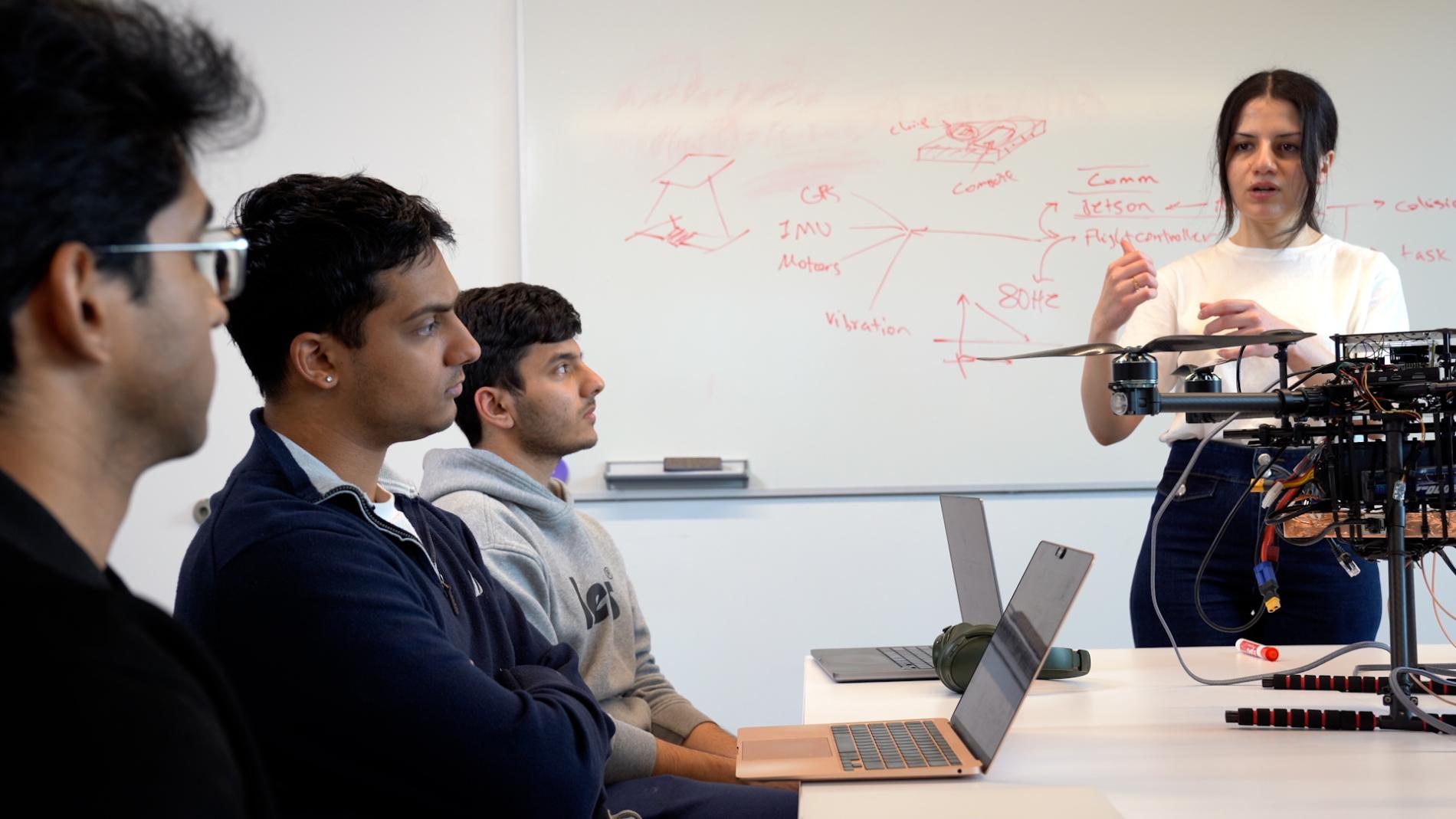
Mehrnaz Sabet, a doctoral student in the field of information science in the Cornell Ann S. Bowers College of Computing and Information Science, is working to create that infrastructure.
Sabet is the principal investigator behind Project Orion, an autonomous airspace coordination system built around a real-time simulation and validation technology she developed at Cornell. The platform combines simulation, field testing, vehicle-to-vehicle communication and hardware-in-the-loop validation, a technique integrating real drone hardware with simulated airspace environments. The project seeks to test autonomous drone operations under realistic conditions, train their onboard artificial intelligence models and prepare them for safe, autonomous flight.
“Airspace as we know it is going to change,” said Sabet, who has led a team of Cornell graduate and undergraduate students on the project for the last two years. “Many types of drones are going to be integrated into the airspace. We need new infrastructure that, like the drones themselves, is highly automated and autonomous.”
Project Orion has received support from NASA and the National Science Foundation, and Sabet has engaged with federal agencies and industry stakeholders including the Federal Aviation Administration, National Institute of Standards and Technology (NIST), Qualcomm Technologies, Inc. and commercial drone operators. Last month, Sabet published a technical report for government and industry, drawing on Orion’s simulations and tests.
The project allows physical drones flying in an open test field to interact in real time with a simulated city-sized airspace, including virtual aircraft, buildings, obstacles, emergency scenarios and degraded communication conditions. This mixed-reality setup allows the team to test scenarios that would be difficult, expensive or unsafe to reproduce directly in public airspace.
Closing the gap between simulation and deployment
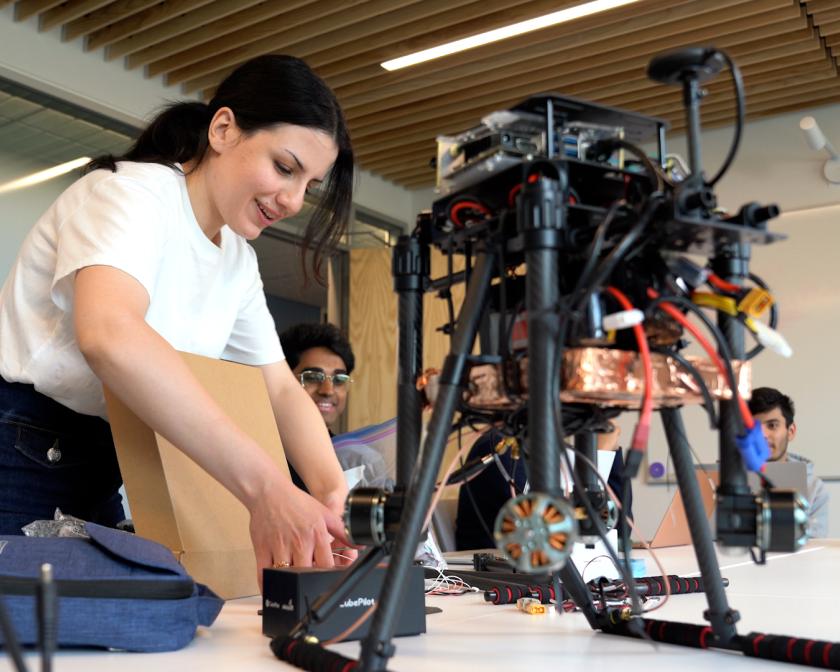
Our goal is to close the gap between simulation and deployment. Offline simulation is useful, but it does not fully capture what happens when real hardware, onboard autonomy, communication links and live operations interact in real time.
Mehrnaz Sabet
Doctoral student in the field of information science
Doctoral student in the field of information science