

Date: November 19, 2026
Time: 11:45 a.m. - 12:45 p.m.
Location: G01 Gates Hall
Title: Hidden Cryptographic Structure in AI-Generated Content and Models
Speaker: Rachel Lin, University of Washington and Google
Host: Michael Kim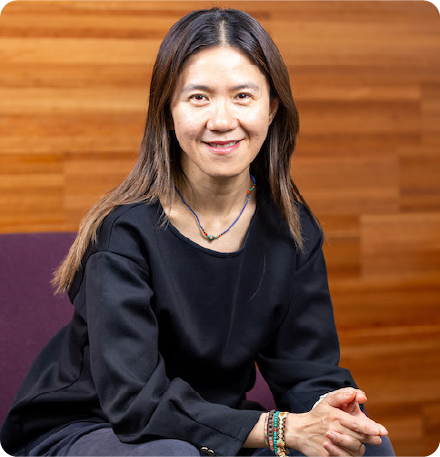
Abstract: Most cryptographic constructions produce objects of the designer’s choosing: keys are uniformly random strings, and ciphertexts and signatures take whatever form the construction needs. Honest users, in turn, must follow the designer’s algorithms for the guarantees to hold.
AI applications take both forms of control away. The text a language model outputs, the images a diffusion model generates, and the weights a training algorithm produces each follow a distribution prescribed by an algorithm with other goals in mind, and their users expect to modify them freely. Some of these objects are not even discrete. For instance, model weights are vectors in a high-dimensional continuous space, far from the bit strings and finite groups where cryptography is most at home. Can we plant hidden and robust cryptographic structure inside such prescribed distributions, and what can that structure do?
We develop this emerging direction through recent results on watermarking AI-generated text and images and on fingerprinting model weights. In each case, the embedded structure is invisible: without a cryptographic key, marked objects are computationally indistinguishable from unmarked ones. It is also robust: the structure must remain detectable with the key even though generation itself is noisy, and even after the object is edited, transformed, or fine-tuned within permitted limits. Finally, the hidden structure can carry more than a mark. Suitably enriched, it lets detection certify where an object came from in a way that no adversary can forge, giving trustworthy provenance for AI-generated data and models.
We view these results as a first step toward building richer cryptographic functionality into structures hidden inside distributions we did not get to choose.
This talk is based on joint work with Min Jae Song and Kameron Shahabi, and on prior watermarking literature.
Bio: Huijia (Rachel) Lin is a professor in the Paul G. Allen School of Computer Science & Engineering at the University of Washington, where she holds the Ed Lazowska Endowed Professorship. Her research explores the possibilities and limits of cryptography: which capabilities can be realized, what assumptions they require, and how security holds up when many parties and protocols interact. She has made foundational contributions to program obfuscation, functional encryption, secure multiparty computation, non-malleability, and concurrent security; her work on indistinguishability obfuscation gave the first construction of this central primitive from well-founded assumptions. Her recent work brings cryptographic guarantees to AI-generated content and models.
Lin’s research has received best-paper honors at STOC and EUROCRYPT, and she is a recipient of an NSF CAREER Award. In 2022 she was an invited speaker at the International Congress of Mathematicians and was named one of Science News’s “10 Scientists to Watch”; she gave an invited talk at EUROCRYPT 2025.
Lin earned her Ph.D. in computer science from Cornell University, completed postdoctoral research at MIT CSAIL and Boston University, and was an assistant professor at the University of California, Santa Barbara before joining UW.