

Date: November 6, 2026
Speaker: Kuan Fang, Assistant Professor, Department of Computer Science, Cornell Bowers
Title: Physically Grounded Robot Learning for Open-World Dexterous Manipulation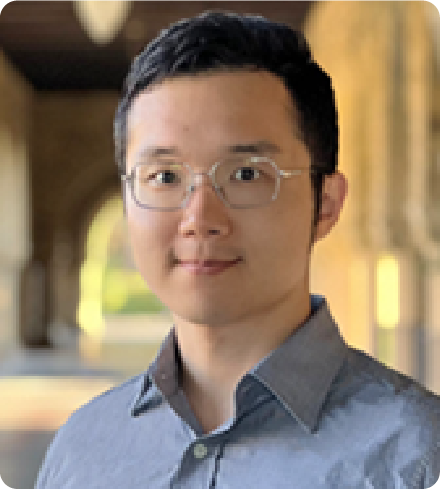
Abstract: Robots working in factories and homes will need to perform dexterous manipulation for diverse task goals in unstructured environments. Such open-world dexterous manipulation hinges on contact-rich and dynamic physical interactions that are difficult to perceive, specify, and control. Today's robot learning systems treat physical interaction implicitly, expecting physical understanding to emerge from scaling data and models, with little evidence of when or whether it will. In this talk, I present our recent progress toward physically grounded robot learning, in which explicit yet learnable representations of physical interaction underlie how manipulation skills are specified, learned, transferred, and improved. First, I will present a framework that grounds high-level task specifications into structured spatial representations of interaction, which enables a mobile manipulator to generalize across environments, task objectives, and forms of user input. Second, I will present an approach that decouples embodiment-agnostic task reasoning from embodiment-specific motor control through contact-based interaction intents, which enables zero-shot skill transfer across structurally different robot hands and from human demonstrations. Third, I will present a data-generation engine that expands a single human demonstration into millions of diverse, physically validated training examples, which enables robust functional dexterous grasping of novel objects. Together, these results suggest that anchoring learning in physical interaction offers a scalable path toward generalizable dexterity in the open world.
Bio: Kuan Fang is an Assistant Professor of Computer Science at Cornell University. His research draws on robotics, machine learning, and computer vision to enable robots that acquire, transfer, and continually improve their skills in the open world. Before joining Cornell, he was a postdoctoral researcher at UC Berkeley and a researcher at the Boston Dynamics AI Institute. He received his Ph.D. and M.S. from Stanford University and his bachelor's degree from Tsinghua University. His research has been recognized with the Best Paper Awards of IEEE RA-L and ICRA, and a Computing Innovation Fellowship.