Date: September 18, 2026
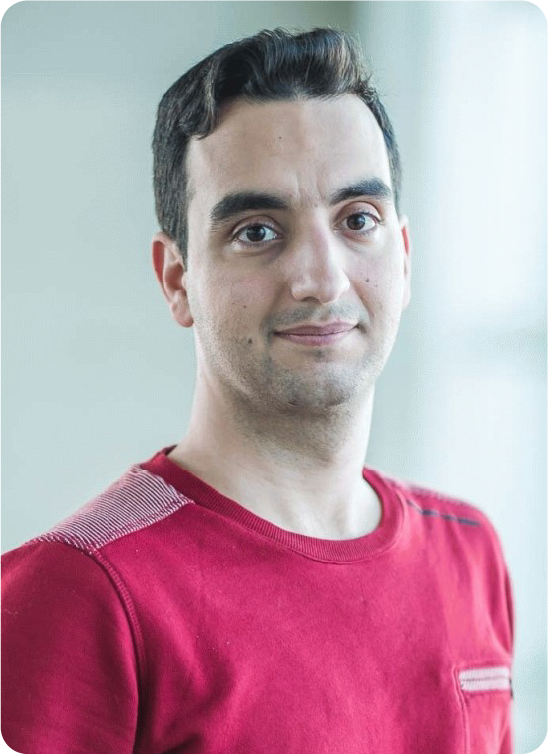
Speaker: Soroosh Shafiee, Assistant Professor, ORIE, Cornell University
Title: Learning with local and global adversarial corruptions
Host: Kevin Ellis
Abstract: We consider learning in an adversarial environment, where an $\eps$-fraction of samples from a distribution $P$ are arbitrarily modified (global corruptions) and the remaining perturbations have average magnitude bounded by $\rho$ (local corruptions). Given access to $n$ such corrupted samples, we seek a computationally efficient estimator $\hat{P}_n$ that minimizes the Wasserstein distance $W_1(\hat{P}_n,P)$. In fact, we attack the fine-grained task of minimizing $W_1(\Pi_\sharp \hat{P}_n, \Pi_\sharp P)$ for all orthogonal projections $\Pi \in \R^{d \times d}$, with performance scaling with $\rank(\Pi) = k$. This allows us to account simultaneously for mean estimation ($k=1$), distribution estimation ($k=d$), as well as the settings interpolating between these two extremes. We characterize the optimal population-limit risk for this task and develop an efficient finite-sample algorithm with error bounded by $\sqrt{\eps k} + \rho + \tilde{O}(d\sqrt{k}n^{-1/(k \lor 2)})$ when $P$ has bounded covariance. This guarantee holds uniformly in $k$ and is minimax optimal up to the sub-optimality of the plug-in estimator when $\rho = \eps = 0$. Our efficient procedure relies on a novel trace norm approximation of an ideal yet intractable 2-Wasserstein projection estimator.
Bio: Soroosh Shafiee is an assistant professor in the School of Operations Research and Information Engineering at Cornell University. Before that, he held positions as a postdoctoral researcher at both the Tepper School of Business at Carnegie Mellon University and the Automatic Control Laboratory at ETH Zurich. He held a B.Sc. and M.Sc. degree in Electrical Engineering from the University of Tehran and a Ph.D. degree in Management of Technology from EPFL. His primary research interests revolve around low-complexity decision-making, optimization under uncertainty and optimal transport.

