

Date: May 1, 2026
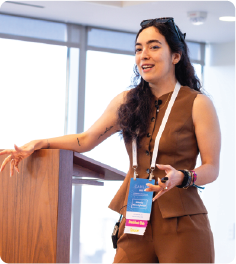
Speaker: Niloofar Mireshghallah, Technical Staff Member, humans&
Title: 2026 Is the New 2016, but Make It Privacy: On Federated Memory, Contextual Privacy, and Personalized Agents
Abstract: As LLMs evolve into persistent personal agents—managing calendars, emails, and health records across sessions—they accumulate rich user memories that enable powerful personalization but create new privacy risks. The recent explosion of tools like OpenClaw, where tens of thousands of always-on AI agents were deployed with full access to users' messages, credentials, and conversation histories, makes these risks concrete and urgent. What should an agent remember, and who should it tell? In this talk, we explore both sides of this question. First, through CIMemories [ICLR 2026], we introduce a compositional benchmark for evaluating whether LLMs respect contextual integrity when drawing on persistent memory. Our evaluation reveals that frontier models exhibit up to 69% attribute-level violations, leaking sensitive information in inappropriate contexts, and that these violations accumulate unpredictably across tasks and runs—exposing fundamental instability in how models reason about context-dependent disclosure. We then ask: can we architect systems that avoid this trade-off entirely? In PPMI, we present a hybrid framework that decomposes tasks between a powerful but untrusted remote LLM and a trusted local model, using Socratic chain-of-thought reasoning and homomorphically encrypted vector search over private data. Our approach, pairing GPT-4o with a local Llama-3.2-1B, outperforms GPT-4o alone on long-context QA—demonstrating that privacy and utility need not be at odds. We conclude by arguing that these failures are not bugs that scale will fix: they reflect a missing notion of contextual norms in model training and architecture. As agents gain persistent memory and autonomy, the line between personalization and surveillance thins—making principled privacy reasoning not just a feature, but a prerequisite for trustworthy AI.
Bio: Niloofar Mireshghallah is a Member of Technical Staff at humans&, working on building AI systems that model the long-term social good of people. Beginning Fall 2026, she will join Carnegie Mellon University as an Assistant Professor jointly appointed in the Language Technologies Institute (LTI) and the Department of Engineering & Public Policy (EPP), and will be a core member of CyLab. Previously, she was a Research Scientist in the Alignment group at Meta's Fundamental AI Research (FAIR) lab until November 2025, working on privacy-preserving AI systems and LLM safety. Before that, she was a post-doctoral scholar at the Paul G. Allen School of Computer Science & Engineering at the University of Washington, advised by Yejin Choi and Yulia Tsvetkov. She received her Ph.D. in Computer Science from UC San Diego in 2023. Her research focuses on privacy-preserving AI systems, LLM policy and ethics, contextual integrity in AI, and AI for science and health. Niloofar's work has been recognized with the Tinker Academic Research Compute Grant (2025), Modal Academic Research Compute Grant (2025), NCWIT Collegiate Award (2020), finalist distinction in the Qualcomm Innovation Fellowship (2021), the Rising Star in Adversarial ML Award (2022), and selection for the Rising Stars in EECS workshop (2022).