Description
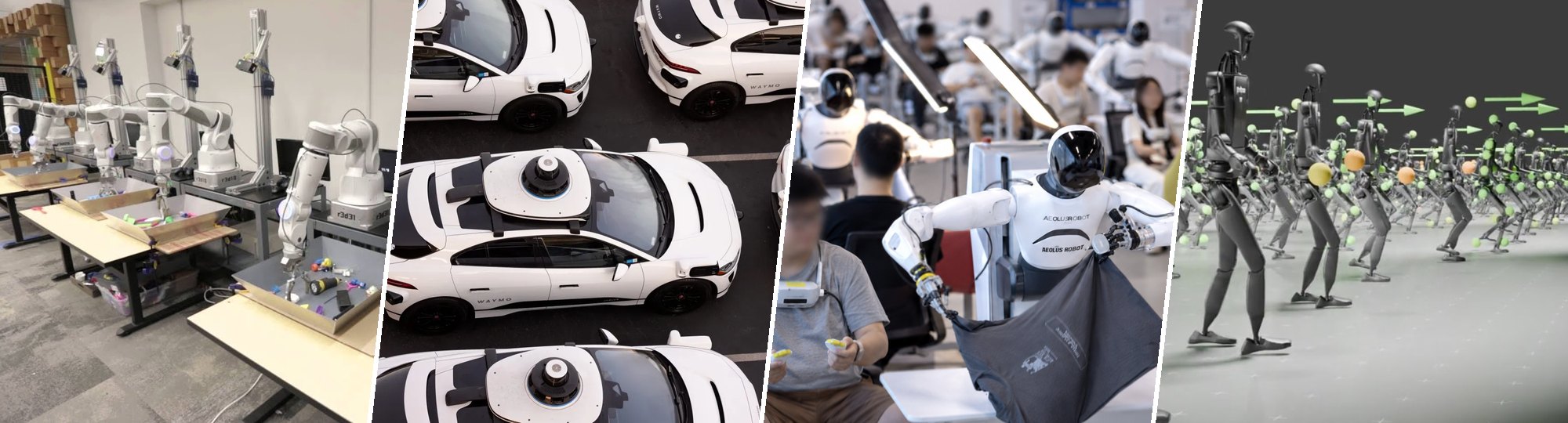
Deep learning has become a pivotal force in recent robotics research advancements, from estimating the state of the world to solving long-horizon tasks in unseen environments. The new paradigm shifts from traditional feature and model engineering to learning task-relevant representations from raw data. This is fueled by increasingly more affordable hardware and diverse data sources from which algorithms may learn from. This graduate-level course examines how deep learning approaches have been applied to robotics problems, including various topics of perception and decision making. We will also discuss the recent trend of large-scale representation learning and foundation models for robotics.
Course Staff


For a timely response, please include both the instructor and the teaching assistant on any course-related email.
Format
This course interleaves lectures and guided discussions. We will first spend a few lectures at the beginning of the semester to review the fundamentals of robot learning. Then, after each lecture on Thursday, we will read two papers and discuss them in class on the next Tuesday. Each discussion will be led by an assigned group of student presenters. Before each discussion, everyone in the class is expected to submit a short review of the required readings as homework. Another significant portion of the class comes from a semester-long project, where you will work in a team of 1–4 students on a research project that is related to the course topics.
Prerequisites
CS 4756: Robot Learning is the most closely related course. It is not a requirement. Students who have completed CS 4756 are considered to have satisfied the prerequisites listed below.
- Machine learning. CS 4780 or equivalent is a prerequisite. We will be assuming knowledge of concepts including, but not limited to stochastic gradient descent and logistic regression, and pre-requisites such as probability theory, multivariable calculus, and linear algebra. Some familiarity with deep learning is recommended as the course will build on deep learning concepts such as backpropagation, convolutional networks, and other deep learning techniques.
- Robotics. While it is not a hard requirement, we recommend you to come with some familiarity with basic concepts of robotic control, computer vision, and reinforcement learning. CS 5750, CS 4756, CS 5670, or equivalent would be preferred.
- Enrollment troubleshooting. If you have troubles enrolling in this course due to prerequisite or other reasons, please follow the instructions in this link.
Schedule
| Date | Lecture |
|---|
Select any class to open it in the list view.
Coursework
Course discussion takes place on Ed. Written work is submitted through Gradescope, except for presentation slides, which are emailed to the instructor and the teaching assistant.
Deliverables
There is no midterm or final exam. Across the semester you produce four things: written reviews of the papers we discuss, one group paper presentation, a semester-long project, and in-class participation.
Paper reviews
10 reviews · due 11:59 pm the day before each discussionWrite reviews for the papers selected for presentation (paper list is in the schedule). You are required to complete 10 paper reviews (based on your choice among the 20 papers that we will discuss) throughout the semester. If you submit more than 10 paper reviews, your grade will be computed based on the 10 reviews which get the highest scores. The review needs to be submitted the day before the presentation (Deadline: 11:59 pm). Please refer to this guide and template to learn how to write reviews for robot learning papers.
Paper presentation
2 papers per group · slides due 5 days beforeAn integral component of this course is to conduct a systematic literature review on robot learning research through student presentations and in-class discussions. You will be divided into presentation groups (each of 2–3 students) based on your preference of papers. Each group will present two papers during the semester. To ensure the quality and clarity of the presentations, we expect you to
- Read the assigned papers thoroughly and gain a good understanding before making the presentation slides (template).
- Email the slides and a list of open-ended questions on the topic to the TA and the instructor 5 days prior to the presentation date (e.g., for a presentation on Tuesday, the deadline is on the Thursday before that week) for feedback and revision (Deadline: 11:59 pm).
Failures to email the slides on time would incur a 20% deduction on the presentation score. Presentation for each paper should be 20 min (± 2 min). The presentations will be graded in the following aspects:
- Clarity of presentation (problem formulation, key insights, proposed method, key results).
- Presentation of the background material (basic concepts to understand the research improvement).
- Review of prior work and the challenges addressed by this work.
- Analysis of the strengths and weaknesses of the research.
- Discussion of potential research extensions and applications.
- Response to student questions.
After the presentation, we will do a 10 min Q&A about the presentation and then we will have a 20 min open-ended discussion. The slides of the presentations will be shared on the course webpage within one week of the presentation date.
Course project
Teams of 1–4 · report due Fri, 12/11The course project aims to help the students gain in-depth, hands-on experiences applying learning-based techniques to practical robot perception and decision making problems. You may work in a team of 1–4 students. Teamwork is encouraged, and team size is taken into account in grading. The project consists of four milestones: a project proposal, a proposal talk, a final report, and a spotlight talk. The spotlight talk will be hosted in the week 15. Here is a list of potential project ideas worth investigating, for your reference. You can also come up with any other ideas that you would like to pursue for the project.
In-class participation
Attendance from Week 3 · questions in every class- Attendance. Attendance will be taken at each of the 10 paper discussions and 2 guest lectures, starting in Week 3. You may miss up to 2 of these classes with no penalty. Each additional missed class deducts 1% from your final grade.
- Questions. Each student is expected to ask at least two questions over the course of the semester. Every question asked during a lecture or a paper discussion counts toward the participation grade, with no upper limit. After you ask a question, please come to the TA after class to record it.
Grading Policy
The course has no midterm or final exams. You will be graded on the basis of homework, class participation, and a course project. The final grade will be tentatively based on the following weights:
| Component | Weight | Breakdown |
|---|---|---|
| Paper reviews | 20% | 10 reviews × 2%; the 10 highest-scoring reviews count if you submit more |
| Paper presentation | 20% | 2 papers × 10%; slides emailed late incur a 20% deduction on that presentation |
| Course project | 40% | Proposal 5% · proposal talk 5% · final report 20% · spotlight talk 10% |
| In-class participation | 20% | Attendance 10% (2 free misses, then −1% each) · questions 10%, every question in class counts |
Generative AI Policy
AI assistance is allowed only where stated here. You may not use it for paper reviews, which are meant to record your own reading of the paper. You may use it when preparing paper presentations for the slides themselves and for wording, but not for the content or the analysis, which should come from your reading of the work. For the course project you may use it for code and for literature search, and you should state how you used it in the final report. In every case you remain responsible for the accuracy and existence of each citation, including any an AI suggests, and violations are handled under the Cornell Code of Academic Integrity.