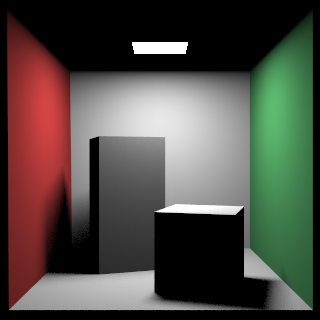
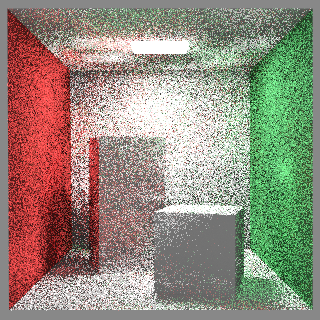
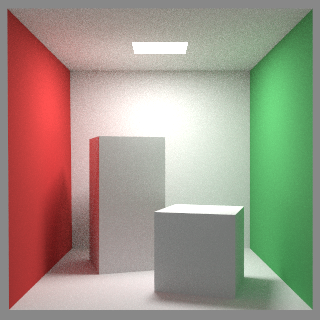
From left to right: direct only (luminaire sampling); brute force path tracer (depth 5); Kajiya path tracer with luminaire sampling (depth 5).
Here is the assignment handout for Homework 5.
Here is the framework for the assignment. To facilitate merging with your existing code, here is a summary of changes from the solution to the previous assignment:
There are a few test scenes for this assignment, which are listed below together with the output from my implementation.
First, some numerical-answer scenes. A diffuse enclosure (of any shape) with walls that have emitted radiance L and reflectance R has a very simple answer under global illumination: the radiance everywhere is L / (1 - R). This kind of environment is called a furnace:
Remember you can get a numerical answer from the renderer by setting the image size to 1 by 1.Pure absorption in a backlit slab of homogeneous medium:
Single scattering from a slab of homogeneous medium with a distant source and camera has an analytic solution (but not for multiple scattering):
A sufficiently deep layer of non-absorbing medium, under multiple scattering, reflects all of the incident light. You'll need to let the paths get pretty long, though:
Here is the classic test scene, the Cornell Box:
The following images were computed at 100 samples per pixel:
From left to right: direct only (luminaire sampling); brute force
path tracer (depth 5); Kajiya path tracer with luminaire
sampling (depth 5).
The Cornell box, with no light source; it is just illuminated by the background.
The following image was computed at 100 samples per pixel:
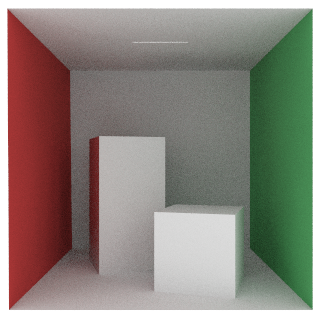
Here the brute force algorithm works just fine.
An empty Cornell Box with a cube of scattering medium in it:
The following images were computed at 400 samples per pixel:
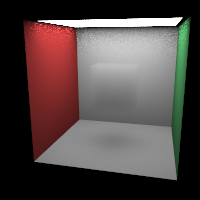
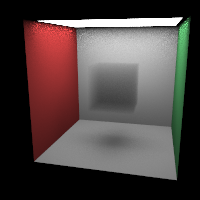
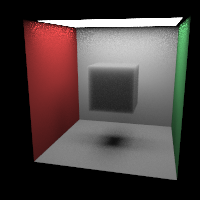
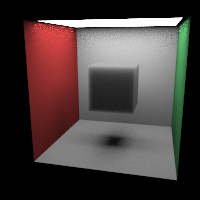
These are all with direct only, using luminaire sampling. They
have different absorption and scattering coefficients, in the
range 0.000–0.050, indicated in the filenames.
The Cornell Box illuminated by a shaft of light coming in through a hole in the ceiling, with and without a scattering atmosphere:
The following images were computed at 100 samples per pixel:
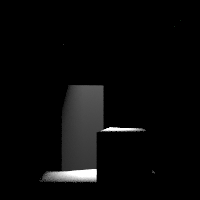
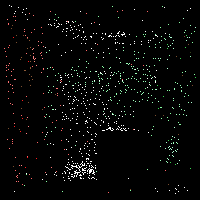
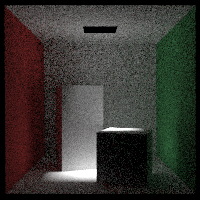
From left to right: direct only (luminaire sampling); brute force
path tracer (depth 5); Kajiya path tracer with luminaire
sampling (depth 5).
The following images were computed at 400 and 1600 samples per
pixel respectively:
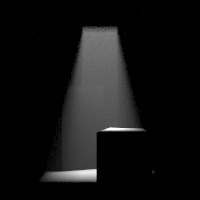
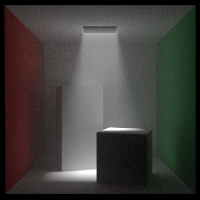
From left to right: direct only (luminaire sampling); Kajiya path
tracer with luminaire sampling (depth 5).