What is a bug? New ways to test verification tools.
My project is driven by a deceptively simple question: What is a bug in a program verification tool?
In the following blog post, I will:
- Explore a relaxed definition of a bug that ought to enable more effective testing of verification tools.
- Outline how to apply my definition to abstractly test floating-point verification software.
- Discuss my prototype implementation and preliminary results.
                                _______
                               /       \
                            ---|       |---
                               |  Bug  |
                            ---|       |---
                               \_______/
                                /  |  \
                               /   |   \
                              "    |    "
What is a bug?
Consider a verification tool VERIFY to take some program p(x) and provide a GUARANTEE such that for all inputs x, GUARANTEE(p(x)) holds. At first blush, one might define a bug as follows:
Definition (bug). A bug in VERIFY exists iff there exists an input x such that GUARANTEE(p(x)) does not hold.
This is a perfectly reasonable definition. If you can violate a guarantee, it seems like you have a bug.
But deep down in our hearts, there is secretly a stronger notion of correctness that we’d like the verification tool to respect. In particular, it would be really bad if I published a paper claiming my tool does $BLAH and prove $BLAH to be a sound technique when in reality it does $BLEH. That sounds like a bug!
In other words: we’d like our verification tool to faithfully implement its own theory (and respect its corresponding soundness proof). This is an entirely reasonable demand for a user to have. I absolutely want my tool to do what it claims to be doing.
Assuming the tool’s theory is sound, we can define a new notion of bug, which I call an abstract bug (for reasons what will become apparent).
Definition (abstract bug). An abstract bug in VERIFY exists iff it does not faithfully implement its own theory.
Note that an abstract bug is a stronger definition of bug. In particular, if an abstract bug exists in a verification tool, there may not exist concrete counterexamples $x$ such that GUARANTEE(p(x)) is violated.
Interlude: Abstract Interpretation
To make this more concrete, consider a verification tool that relies on abstract interpretation. To do abstract interpretation, we need the following five ingredients:
- A concrete domain
- An abstract domain corresponding to the analysis you wish to perform
- A programming language syntax
- A programming language semantics
- Abstract transformers taking operations (from our programming language syntax and semantics), defined over our concrete domain, to be over our abstract domain
satisfying certain soundness conditions.
A verifier (e.g. a sign analysis) will prove that for a program p and a particular programming language semantics (e.g. IMP), there does not exist any inputs x such executing p(x) under the semantics will violate the results of the analysis.
The key idea we will exploit in this blog post is that there are many different semantics (ingredient no. 4) for which the same concrete domain (1), abstract domain (2), programming language syntax (3), and abstract transformer (5) are still sound for! We will now proceed to construct an exceedingly adversarial programming language semantics to test the verifier.
Abstract Testing of Floating-Point Software
With a fancy new definition, let’s hunt for bugs! Observe that many (but not all) verification tools operate over an abstract domain using overapproximate simplifying assumptions.
For example, the “standard model of floating-point error” assumes that each floating-point operation $(op_{float} \ x \ y)$ can introduce up to $1+\epsilon$ error. To be precise, for every operation, the following overapproximation (of the IEEE floating-point spec) holds for some unit round-off value $u$ (determined by the float precision and rounding mode used):
$\exists |\epsilon| \leq u, (op_{float} \ x \ y) = (op_{real} \ x \ y) * (1 + \epsilon)$
Different tools may use other overapproximations, but the principle is the same: to tractably verify you (typically) need to overapproximate in a way that admits multiple implementations. That is, the above overapproximate model is sound to verify against the IEEE floating-point semantics. It is also sound to verify against a defective floating-point semantics where we add up to $u$ error at every single floating point operation.
So, how to test? Let’s craft a deliberately defective implementation (that does not comply with the IEEE floating-point spec) that our verifier is still good for!
For floating-point verification, we can sample concrete inputs and opportunistically construct bad $\epsilon$s at every floating-point operation to violate the verification tool. Note that the IEEE floating point spec is fully deterministic (which would constrain our test space if we were testing things concretely), but our overapproximate, abstract error model is not (which lets us adversarially fish around for bad $\epsilon$s).
In other words, our testing game is to find input $x$ and $\epsilon$-trace of distinct $\epsilon_1$, $\epsilon_2$, $\epsilon_3$ … added at to each corresponding floating-point operation encountered at run-time such that we can violate GUARANTEE.
That’s my project, in a nutshell! Every overapproximation provides a bigger testing budget to smash the verification tool with. 1
                                           Abstract Testing
                                              =======
                                              =     =
                                              =     =
                                              =======
                                                | |
                                                | |
                                                | |
                                                | |
                                                | |
                                                |_|

                                _______
                               /       \
                            ---|       |---
                               |  Bug  |
                            ---|       |---
                               \_______/
                                /  |  \
                               /   |   \
                              "    |    "
Side quest: finding a good $\epsilon$-trace
A natural question to ask is: how do we find a good $\epsilon$-trace? To build some intuition, consider a simple floating point program:
$$p := \frac{a - b}{c + d}$$
We wish to maximize the final error term in this program. Assuming that $a, b, c, d$ are all non-negative, it suffices to:
- Maximize the error term in the numerator ($a-b$). Recursing further, we
realize we wish to
- minimize the error term in $b$.
- maximize the error term in $a$, and,
- Minimize the error term in the denominator ($c + d$). Doing the obvious
thing, we realize we need to
- minimize the error term in $c$, and,
- minimize the error term in $d$.
Once we know which direction to point each $\epsilon$, we can assign the most extreme values (either $+u$ or $-u$) to get a pretty good $\epsilon$-trace.
For this program, the $\epsilon$-trace we computed happens to be the worst-case, which is awesome. This technique generalizes in a pretty straightforward manner to a backwards static analysis. 2
Implementation and Preliminary Evaluation
To implement this technique, I interpret a program twice:
- under an ideal (infinite-precision) semantics with no floating point error, and,
- under an approximate semantics that adds a trace of $\epsilon$s at run-time.
To evaluate, I selected a few benchmarks from the FPBench. I had already written a parser and could reuse infrastructure for another project. My weapon of choice was OCaml for similar practical considerations. 3
Charts and Graphs
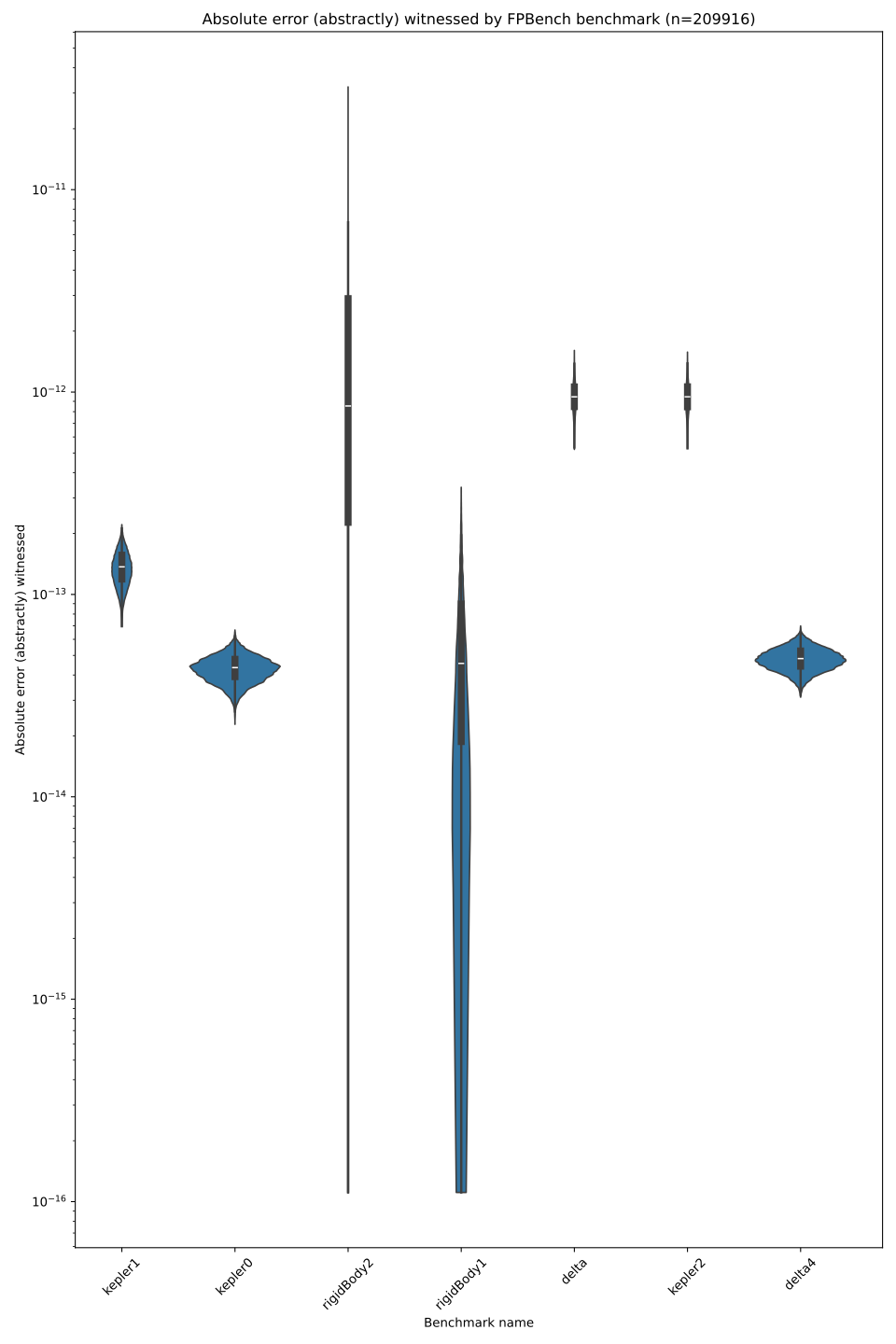
Below is a log-scale violin plot showing the distribution of absolute error abstractly witnessed by my prototype tool, broken down by benchmark program. The distribution comes from uniformly sampling from the program input space and using the corresponding $\epsilon$-trace for each program constructed via the backwards static analysis described above. 4 (Aside: I think more people should use violin plots.)
Finally, here is a table showing the minimum and maximum error sampled on a few selected benchmarks along with the corresponding guarantees provided by FPTaylor and Daisy:
| Name | Min. error sampled | Max. error sampled | FPTaylor Guarantee | Daisy Guarantee |
|---|---|---|---|---|
| delta | 5.20879e-13 | 1.60481e-12 | 2.197089e-12 | 2.346965e-12 |
| delta4 | 3.11052e-14 | 6.98128e-14 | 7.676607e-14 | 1.160113e-13 |
| kepler0 | 2.28324e-14 | 6.66749e-14 | 3.463896e-14 | 1.044053e-13 |
| kepler1 | 6.96139e-14 | 2.21175e-13 | 3.689493e-13 | 4.806242e-13 |
| kepler2 | 5.27134e-13 | 1.57429e-12 | 2.199272e-12 | 2.464839e-12 |
| rigidBody1 | 1.11022e-16 | 3.38285e-13 | 2.948752e-13 | 2.948752e-13 |
| rigidBody2 | 1.11022e-16 | 3.21759e-11 | 3.574474e-11 | 3.606626e-11 |
As you can see, the maximum error sampled can get quite close to the guarantee provided by the various tools. Entries that are bolded indicate a potential bug, in either the verification tool under test (~thousands LOC) or the testing framework itself (a few hundred LOC).
For future work, it would be cool to hunt down the bugs found and run this on more tools and benchmarks. Additionally, a question not addressed by this tool (and omitted in the blog post) is how to find a good input $x$. Currently, the testing tool uniformly samples from the input space. One technique I wrote in my initial proposal (but did not have the time to properly implement and evaluate) is to use automatic differentiation. Future work could explore this further.
For the sake of exposition and conceptual clarity, I am omitting various details on other overapproximations a tool might use and tricks like Sterbenz’s lemma that complicate the picture somewhat.
A wrinkle occurs when terms can be shared. If a verification tool cannot
reason about shared error terms, this algorithm still produces a worst-case
$\epsilon$-trace. Otherwise, this one might need to do a little searching to
find the worst-case $\epsilon$-trace. In particular, if error terms can be
shared, we start to care about the constants in the floating-point expression.
Concretely, (x - 2x) is quite different from (2x - x); in the former we wish
to minimize the error term in x, while in the latter we wish to maximize the
error term in x.
The implementation and evaulation is at: https://github.com/Athena-Types/numerics-playground.
To make the violin plot semi-legible and suitable for a blog post, some
very small error samples are dropped. Specifically, the error values
that were equal to 0 once cast to a float (at the very end of testing) are
dropped from the plot. This only affects the plots for benchmarks rigidBody1
and rigidBody2. You may see the unadulterated range of error values sampled in
the table shown.