Chlorophyll: synthesis-aided compiler for low-power spatial architectures
Summary
Chlorophyll is a synthesis-aided compiler that targets a spatial array of ultra-low power scalar cores. Chlorophyll takes a subset of C as input and maps the computation to the hardware in a process similar to FPGA high-level synthesis. Each core of the GreenArrays GA144 is extremely barebones. They have their own proprietary ISA, it only has 64 18b words of memory, and the cores are not clocked synchronously. While the paper’s compilation problem is posed around an extremely niche hardware architecture, the authors’ contributions of modular superoptimization is deserving of a close look.
In this blog post, we will breakdown the subproblems of program synthesis and qualitatively judge how effective their synthesizer is at optimizing programs for spatial architectures. To summarize, the main two claims the authors make are (1) that the loss of QoR (quality of results) is worth the increased level of automation and (2) that modular superoptimization is effective enough at finding peephole optimizations like strength reduction and bit-hacks.
Full citation:
Phitchaya Mangpo Phothilimthana, Tikhon Jelvis, Rohin Shah, Nishant Totla, Sarah Chasins, and Rastislav Bodik. 2014. Chlorophyll: synthesis-aided compiler for low-power spatial architectures. SIGPLAN Not. 49, 6 (June 2014), 396–407. https://doi.org/10.1145/2666356.2594339
Background
Here is a quick background on some of the terms and concepts used by the paper:
Spatial Architecture is a type of computer architecture where the computation is broken down into separate components that run in parallel on distinct physical modules. The term “spatial” refers to the fact that the data flows from one module to another to get processed, rather than the traditional architecture where the data is stored in a single location and the operations are applied one after another. Spatial architectures are also known as dataflow architectures.
Stack-Based ISA describes an instruction set architecture where the instructions can only access the top of a stack. Eliminating the random addressablity of registers allows for a simpler and more power-efficient design. E.g, on a register-based ISA, any bit of the register address may flip; on a stack-based ISA, the address can only be incremented or decremented by one, leading to fewer bit flips.
Type Inference is the process of automatically deducing the types of expressions in a program. Usually the type inference problem starts with a set of initial type annotations and some predefined type rules. The rules describe how the types of expressions evolve as operations are applied to them. In this paper, the authors formulate the design partitioning problem as a type inference problem.
The Architecture
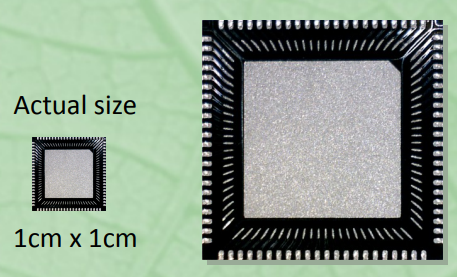
The target architecture of the Chlorophyll compiler is the GA144 from GreenArrarys. It is a spatial architecture with 144 F18A processor cores. Each core only has 64 18b words of memory, and employs a stack-based ISA for lower power consumption. The cores are laid out in a 8x18 mesh grid, where one core can only communicate with its neighbors. Designed to be simple and low power, GA144 does not support any global synchronization mechanisms such as locks and barriers that are common on an ordinary shared-memory multicore machine.
The figure below is taken from the official GA144 document:
The Compiler
As stated before, Chlorophyll is a compiler for the GreenArrays GA144 chip with a frontend that can process a subset of C. In addition, the input C code can be annotated with ‘@’ and ‘!’ symbols to signify where a value originates from and where it is sent to, respectively. The paper provides the following example of partitioned code using their syntax:
int@0 mult(int@2 x, int@1 y)
{
  return (x!1 *@1 y)!0;
}
With just these modifications to C, the compiler has enough information to map the code to the spatial layout of the GreenArray chip. The compilation is broken down into the following steps:
- Design Partitioning
- In this step, the locations of the data and compute operations are inferred from the source program. Given some initial partitioning annotations, the compiler synthesizes the rest of the annotations as a type-inference problem. Every high level operation, variable read, and variable write is partitioned with a location index.
- Placement
- Given that the design is broken down into logical partitions, the compiler must then place these partitions to specific cores within the layout. The target architecture in this paper is an 8x18 grid of cores that each can communicate to their neighbors to the north, south, east, and west.
- Code Separation
- The purpose of a spatial architecture is to break the computation down into separate components that run in parallel, sharing intermediate results. Hence, the compiler needs to transform the source program into separate executables, one for each core. For each partition, code separation filters out the portions of code that are not relevant to it. For the segment of code that pertains to that partition, each variable use and assignment is converted into a
read()andsend()operation, respectively.
- The purpose of a spatial architecture is to break the computation down into separate components that run in parallel, sharing intermediate results. Hence, the compiler needs to transform the source program into separate executables, one for each core. For each partition, code separation filters out the portions of code that are not relevant to it. For the segment of code that pertains to that partition, each variable use and assignment is converted into a
- Code Generation
- Finally, an initial version of machine code is generated for each partition. Then, the bulk of the synthesis-aided optimization occurs. The superoptimizer searches the entire space of instruction reorderings within the boundaries of
read()andsend()operations. Great effort went into scaling superoptimization for larger applications. In short, the authors split the machine code into segments and superoptimize along a sliding window.
- Finally, an initial version of machine code is generated for each partition. Then, the bulk of the synthesis-aided optimization occurs. The superoptimizer searches the entire space of instruction reorderings within the boundaries of
Modular Superoptimization
Chlorophyll uses an initial pass to generate machine code as a baseline. Then, the authors use an SMT solver to carry out all their superoptimization steps on a sliding window of instructions:
- Load the optimization window up with enough segments from the input to fill the minimum size
- Run the SMT solver.
- Was a solution found? Emit the optimized output and go back to step #1 if there is more input.
- If a solution is not found, pop the first segment from the window to the output and go to step #2.
- If the solver times out, remove the last segment, place it back into the input, and go to step #2.
- Use this loop until the input is empty.
Figure 3 has a more detailed diagram of the modular superoptimization loop operating on a CFG:
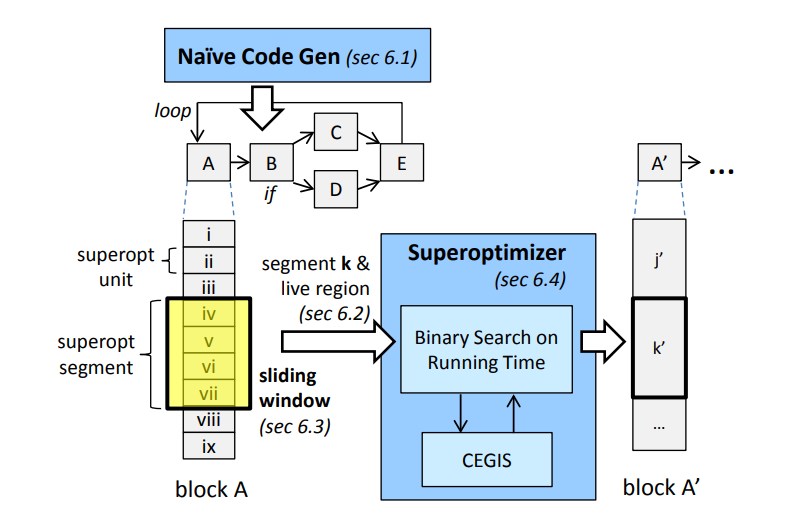
Program equivalence is encoded into the SMT formulas by tracking the encapsulating state of the program: the data stack, the call stack, data memory, and stack pointer. For a candidate optimization to be a solution, the live region of the stack must be equivalent (the authors elaborate what this means in section 6.1). As a result, the relaxed constraints do not require the entire core end state be equivalent, allowing the synthesizer to do its job.
Evaluation
The superoptimization technique does show improvements over the initial code generation. However, the synthesis-aided compiler still does not meet the performance of the hand-optimized benchmarks:
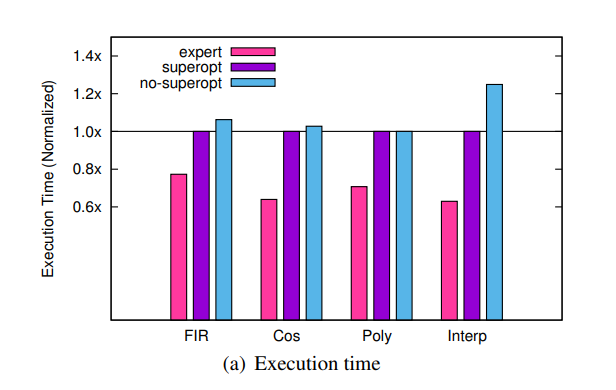
In the single core benchmarks tested, the superoptimized program was still closer to initial code generation rather than the hand-written programs. In order to show a positive result, the authors needed to record results with synthetic benchmarks. They show that the superoptimizer can discover bit-twiddling optimizations, using examples from Hacker’s Delight. However, the time needed to compile is on the order of hours, and this is another shortcoming of the paper. The superoptimization time largely hinges on the program length, meaning the max segment size is another parameter that needs to be balanced.
The finite impulse response (FIR) benchmark is their best result, because the compiler is able to automatically parallelize the application to more cores. Judging by this case, it seems like the best use case for Chlorophyll is for applications which are embarrasingly parallel. This allows developers to quickly explore the sequential / parallel tradeoffs on PPA. For more sequential tasks that use fewer cores, the merits of this paper fall a bit flat. Finally, we want to note that the authors did not fully address the issue of placement and routing. Because each core can only communicate with its direct neighbor, we anticipate that the issue of design partitioning would overtake code optimization as the main compilation challenge for larger designs.
Discussion
Overall, a lot of the novelty of this paper stems from the challenges in compiling to such a unique spatial architecture. The authors’ methods are a vertical slice of everything you would need to automate in order to map a legacy language like C to a reconfigurable overlay. Even though the authors specifically target a GreenArrays chip, the compiler description is generic enough to be able to extract the theory out and compare it to modern high-level synthesis for FPGAs and ASICs. More elaborate high-level (HLS) synthesis compilers try not to lean on code annotations so much, support some C++ classes, and compile to a hardware netlist instead of binaries. If the reader is curious, we would recommend reading an intro to high-level hardware synthesis or taking a look at ECE6775.
As for their superoptimization technique, we think the problem formulation is too narrow to be useful. We think the very limited results are evidence that compiling to spatial architectures requires some higher-level reasoning other than peephole optimizations. By limiting the superoptimization to code segments within communication boundaries, there is are not many ways for the compiler to parallelize the computation. As long as communication across the chip is held constant, that heavily constrains the types of optimizations that can be found. We’re left to speculating on this, because of the lack of benchmarks in the paper. The authors only picked five programs that has an expert-level code on the target chip, without explaining the selection criteria. We think this is understandable, because of the uniqueness of the target architecture. Moreover, the authors position their work as a way of kickstarting the compilation framework for a new architecture; in other words, they are serving as the baseline. We do want to note that the authors also tried to hack an existing compiler, STOKE, to target the GA144. However, the performance was too poor to serve as a meaningful baseline. When evaluating a new architecture, justifying the selection of benchmarks is a recurring problem.
In any case, the paper still has value in demonstrating how to create a optimizing compiler for novel architectures. As the authors state, the main contribution of the paper is to show how simple program synthesis can be and still be useful. While such a method will not produce the highest performing compilers, this paper demonstrates the value of program synthesis as a quick way to ‘kickstart’ the evaluation of a new architecture.