CS 4414/5416:
Systems Programming
Intro to Asynchronous Programming
2026-11-10
Logistics
Upcoming
- P5 (Tetris) posted! Groups of 3-4 preferred
- Yes, preferred vs required
- Check-in is Nov 11
- Final is Nov 18
- Lab 12 is Friday: practice with async/await
Final Exam Plans
- Targeting practice out before Thanksgiving
- Early exam is Dec 7, 6-8 PM
- If you filled the form, you’re set!
- If not, and you want this, email me ASAP
- Regular final is Dec 16, 9-11 AM
Where We Are
This module: Asynchronous programming and company
- Asynchronous programming essentials
- Behind the scenes and nonblocking I/O
Poll Everywhere!
Which of these might be most appropriate for a web browser to interact with a game server?
- Long polling
- Server-sent events
- Web sockets
Respond at: https://PollEv.com/davidbindel252 or send davidbindel252 to 22333
Lay of the Land
Recall
Concurrency vs parallelism:
- Concurrency: logically overlapping
- Parallelism: physically overlapping
- Parallelism implies concurrency, but not vice-versa
Why Concurrency?
- Because sometimes it is “natural”
- For parallelism
- To do useful work during I/O
- Can mix all of the above!
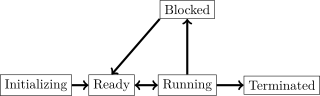
Process Picture
Pre-Emption
To share a core pre-emptively:
- A process gets a time slice
- When timer interrupt ends slice
- Save process info, move to “ready”
- Schedule another process that is “ready”
- What about “waiting” state?
Waiting
Three ways to exit running state
- Termination
- Pre-emption at end of time slice
- Yield CPU to wait for an event
- Could be I/O or a timeout
Concurrency Approaches
Spectrum based on style and workload:
- How much compute? Throughput?
- Many small tasks or few big ones?
- Scheduling with pre-emption or cooperative?
- Organize around time order or by events?
Concurrency Approaches
Spectrum based on style and workload:
- One thread per core
- Several threads/core
- Many interacting actors
Concurrency Approaches
One thread per core
- Great for compute-intensive workloads
- This is all about parallelism
- Cache stays warm, little scheduling overhead
- Have to manually manage load balance?
- Twiddle thumbs during I/O?
Concurrency Approaches
Several threads/core
- Better for I/O, high throughput situations
- Context switch still not free
Concurrency Approaches
Run-time scheduled tasks or handlers
- Dominated by cooperative sharing
- Does not rule out parallelism!
- Good for waiting on many I/O streams
Asynchronous Approaches
- Explicit
selectloops (event loops)- Loop to ask the OS what file handles have data
- When data is ready, process it and go back to loop
- Modern takes:
poll,epoll,kqueue
- Event-based models
- Register event handlers for incoming data, clicks, etc
- Still feels like “programming by state machine”
- Task-based / coroutine-based models (our focus)
Terminology
With some ambiguity in all cases:
- Green threads
- Coroutines
- Tasks
- Generators
- Futures
Green Threads
Term from Java (designed by Green Team at Sun)
- Cooperative thread abstraction, managed by run-time
- Some run-time calls (e.g. I/O) yield control to scheduler
- Lighter weight than full threads (but no pre-emption)
Coroutines
A coroutine is a subroutine that can be suspended
- Can call, suspend, and re-enter an invocation
- Local data persists across calls
Many variations across languages!
Generator
A generator is a common type of coroutine
- Use
yieldto return multiple outputs - Common for iterators in some languages (Python)
Rust uses generators as an internal
Tasks
- A task is a coroutine + execution state
- Often like to dynamically create many tasks!
- This is useful for parallelism or concurrency
Future (aka Promise)
- Also known as a delayed or deferred result
- Idea: A handle for a result
- Split start of execution from result
- E.g. think of a
JoinHandlein Rust
A Rust Future is between this and a coroutine
Tricky Business
- Even languages with “same” model differ a lot!
- See “A Design Space Exploration of Async/Await”
- Also a nice blog post
Ask Me a Question!
Async Rust
Recall Last Thursday
Hello world!
use tokio::time::{sleep, Duration};

async fn hello(id: usize, time: u64) {
    println!("{id}: Hello, ... (and pause for {time} s)");
    sleep(Duration::from_secs(time)).await;
    println!("{id}: world!");
}

#[tokio::main]
async fn main() {
    // All guaranteed to run on the same thread
    tokio::join!(hello(0,2), hello(1,1), hello(2,1));
}
Moving Pieces
- Tokio provides an async run-time (no Rust default)
- Also: async version of std library, lots of extras
asyncfunctions and blocks return aFutureawaitawaits completion of an operation- Only from an
asyncfunction or block - Does not block thread
- Only from an
Async Functions
async fn hello(...) is syntactic sugar for
where an async block compiles to a Future instance
The Future Trait
cx used to access Waker (more on this Thursday)
Cold Start
What is the output?
Cold Start
- A
Futuredoesn’t execute itself! h.awaitpauses currentasyncfunction until result ofhis ready
Futures and Streams
- Only get one output with
await - Can establish a channel for richer communication
- Or use
Stream(cfasync_streamcrate)
A Peek Behind the Curtain
- A
FutureorStreamcompiles to a state machine - States are:
Start: Initial stateDone: Completed state- A state for each
awaitoryield
- Poll operation checks for transitions
- Code executes on the transitions
(A little like the state machine for a process)
Executor and Tasks
- Examples:
tokio,smol - Manage/schedule/execute collection of tasks
- A task is the concurrent unit
- Contains a top-level future
- May also have one or more nested tasks
- Executor advances scheduled tasks, which
pollfutures - The
#[tokio::main]lauchesasync mainin executor
Reactors (Event Loops)
- Only want to be awakened when something happens!
- Reactors manage this (say when to
poll) - React to OS event (e.g. data on a socket) or other
- Build on
epoll/kqueue/ etc (maybe viamio) - Mark as runnable any tasks that are attending
- Build on
The Full Picture
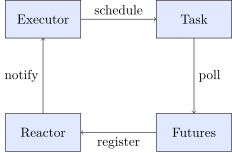
Adapted from https://rust-training.ferrous-systems.com/latest/slides/async-intro#/17
Ask Me a Question!
Poll Everywhere!
Which of these best describes a Rust task?
- A type of thread
- An execution state for a future (or futures)
- Another name for an event loop
Respond at: https://PollEv.com/davidbindel252 or send davidbindel252 to 22333
Wrap-Up
Up Next
- P5 (Tetris) posted! Groups of 3-4 preferred
- Check-in is Nov 11
- Final is Nov 18
- Lab 11 is Friday: multithreaded web service
- Next week: Start asynchronous programming