CS 4414/5416:
Systems Programming
Threads and Message Passing
David Bindel
2026-10-24
Logistics
Upcoming
- P4 (netsim) revision
- No check-in – work on lab tomorrow instead
- Shortened assignment due Monday, 11/2
- Lab 9 is Friday: working on P4
Final Exam
- Final is Dec 16 at 9 AM
- Alternate time request is linked here (and is posted on Ed)
Recap
Where We Are
This module: Concurrent programming with threads
- Message-based concurrent programming
- Shared memory concurrent programming
- Synchronization and deadlock
- Concurrent network programming
This Week
- Tue: Concurrency, parallelism, and intro to Rust threads
- Today:
- Borrowing and threads
- Patterns with channels
- Bounded channels, non-
stdcrates - A network simulator project
Fork/Join
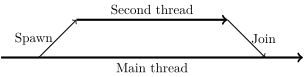
thread::spawntakesFnOnce() -> T, returnsJoinHandle<T>handle.join()returnsthread::Result<T>- Can also drop the handle without join
- Result is a detached thread
- Detached threads terminate on
main()exit
Error Handling
- Unrecoverable:
Errvariant onJoinHandleAnyis a trait to emulate dynamic typingSendmeans safe to move between threads- Needs to have
'staticlifetime
- Recoverable: make closure return
T = Result<S,E>- Get
Ok(Err(err))forerr: E
- Get
Channels
Poll Everywhere!
Which of these is true?
sendtakes ownership of the message argument- Returns from
thread::spawnneed not satisfy'static panic!()in a thread will terminate the program
Respond at: https://PollEv.com/davidbindel252 or send davidbindel252 to 22333
Safety and Threads
Marker Traits
- Rust has marker traits in
std::marker - Used as info about types vs for methods
- Some automatically supported (e.g.
Sized) - Others you derive (e.g.
Copy) - Two automatic traits for thread:
SendandSync
Ownership Transfer
Thread communication involves ownership transfer
- Sending across a channel does this
- So do arguments in / return values out
- Allocations in one thread to safely
dropin another
Send
A Send type is safe to transfer across threads.
- Automatically derived in most cases
- Basic types,
String,TCPStream,VecareSend - Also:
Receiver<usize>andCell<usize> !Send:Rc<String>, raw pointers
Sync
A type T is Sync if &T is Send
- More restrictive than
Sync! - Basic types,
String,TCPStream,VecareSend !Sync:Receiver<usize>andCell<usize>- Also
!Sync:Rc<String>, raw pointers
Lifetimes
- Hard to reason about lifetimes across threads!
- Standard default: Transfer ownership vs references
- Transferred references should be
'static 'staticmeans “contains no non-static references”- Owned types generally satisfy
'staticbound
- Owned types generally satisfy
Deliberate leaks
How do we get static data?
- String constants are static…
- Otherwise:
leakon containers (Box,String,Vec) - Returns
'staticmutable ref or slice to contents - Use cautiously!
Scoped threads
- Sometimes we want non-
'staticdata! - When
thread::scopecompletes, all threads guaranteed to be joined
Ask Me a Question!
Channel Patterns
The Ack Pattern
Channels are unidirectional – how to get replies?
Ackpattern:senddata containing aSender- Recipient
sends data on the receiver - One-shot messaging gets special fast path in Rust
- Switch methods when sending second message
- Also switch methods when sender is
cloned
The Ack Pattern
use std::sync::mpsc::{channel, Receiver, RecvError, Sender};
use std::thread;

struct Command(String, Sender<String>);

fn echo_client(id: usize, tx: Sender<Command>) {
    let (response_tx, response_rx) = channel();
    tx.send(Command(format!("Ping {id}"), response_tx)).unwrap();
    println!("{id} received: {}", response_rx.recv().unwrap());
}

fn echo_server(server_rx: Receiver<Command>) -> Result<(), RecvError> {
    loop {
        let Command(s, tx) = server_rx.recv()?;
        println!("Server received: {s}");
        tx.send(s).unwrap();
    }
}
The Pipeline Pattern

The Pipeline Pattern
The Pipeline Pattern
fn main() {
    let (channel_in, channel_out1) = channel();
    let (channel_in2, channel_out2) = channel();
    let (channel_in3, channel_out) = channel();
    thread::spawn(move || {
        stage(channel_out1, channel_in2, |x: usize| 2*x)
    });
    thread::spawn(move || {
        stage(channel_out2, channel_in3, |x: usize| x+1)
    });
    channel_in.send(5).expect("Channel died prematurely");
    channel_in.send(10).expect("Channel died prematurely");
    assert_eq!(channel_out.recv().unwrap(), 11);
    assert_eq!(channel_out.recv().unwrap(), 21);
}
The Client-Server Pattern
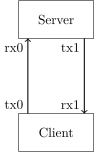
The Client-Server Pattern
The Client-Server Pattern
Worker Queue Pattern
- Work queue at a server (e.g. work queue)
- Worker clients interact by
- Sending work requests
- Sending work results
- Alternative: Queue is client, workers are servers
Ask Me a Question!
Beyond
Bounded channels
channelproduces an asynchronous channel- Will allocate space for pending messages
sendnever blocks on calling thread
sync_channel(b)produces a synchronous channel- Buffers up to
bmessages sendblocks until there is buffer space
- Buffers up to
Crossbeam and Rayon
- Crossbeam
dequeand MPMC queues- Epoch-based garbage collector
- And more!
- Rayon
- A data parallelism library
- Supports fork/join, scopes, thread pools
- Also parallel iterators, parallel sort, parallel collections
Poll Everywhere!
What is the default channel type from std::mpsc::channel?
- A bounded, synchronous channel with a fixed buffer
- An unbounded, asynchronous channel that does not block on
send - A multi-producer multi-consumer channel
- A single-producer multi-consumer channel
Respond at: https://PollEv.com/davidbindel252 or send davidbindel252 to 22333
A Network Simulator
High-Level Picture
Want to understand performance of networked applications
- Maybe with hardware we don’t have
- Maybe at a scale we don’t have
- Maybe in presence of rare transient errors
Hard to do in practice. Simulate!
Moving pieces
- Actors
- Manager thread keeps global state
- Process threads simulate node apps
- Timeline comprising
- Log of past events
- Priority queue of future events
- Collection of messages
- Virtual network for time of comm events
The Story So Far
https://github.coecis.cornell.edu/cs4414-f26/p4-netsim
- This version got too ambitious!
- Working on scaling it down before release
Ask Me a Question!
Wrap-Up
Summary
- Rust safety model enables “fearless concurrency”
- Relatively – still plenty of room to screw up!
- Several common channel-based patterns (mirroring IPC)
- There is a wider ecosystem beyond!
- A realistic problem brings interesting challenges
Up Next
- Next week: Concurrency with shared state
- Two weeks: Deadlock and live-lock; multithreaded network programming
Outro
- On Ed: What is the muddiest point from this week?
- Remember to fill the alternate final time form if relevant