CS 4414/5416:
Systems Programming
Intro to Concurrent Programming
2026-10-20
Logistics
Upcoming
- P4 (netsim) checkin due Monday, 10/26
- Lab 9 is Friday: working on P4
Final Exam
- Final is Dec 16 at 9 AM
- Alternate time request is linked here (and is posted on Ed)
Catching Up
- Attendance (from paper era) should be up to date
- PollEv through 10/6 is freebies
- If you still have trouble post 10/6, reply #225 on Ed
- P4 should go up tonight
- Makeup midterm ETA is now end of week (with apology)
Interlude
Why Are You Here?
Halfway through the semester: why are you (still) taking this class?
Respond at: https://PollEv.com/davidbindel252 or send davidbindel252 to 22333
Why Am I Here?
There are so many things that I think you should know.
And that’s why I’m bothering telling you so. …
– Dr. Seuss, Oh Say Can You Say
- I like to switch things up sometimes!
- It was a chance to really learn Rust
- And someone needs to teach this stuff
Why Am I Asking This?
Sermon
The best thing for being sad .. is to learn something. That is the only thing that never fails. … That is the only thing which the mind can never exhaust, never alienate, never be tortured by, never fear or distrust, and never dream of regretting.
– T.H. White, The Once and Future King
Courtesy The Marginalian.
Recap
Where We Are
This module: Concurrent programming with threads
- Message-based concurrent programming
- Shared memory concurrent programming
- Synchronization and deadlock
- Concurrent network programming
This Week
- Today
- Concurrency and parallelism
- Threads in Rust
- (Start) message passing with channels
- Thu: More advanced message passing + P4
Concurrent programming
Concurrent Programming
- Overlapping logical execution flows
- Could be multiple processes or threads
- Arguably also coroutines, green threads
- Drivers:
- Useful work while dealing with I/O
- Responsiveness of shared resources
- Faster computation (parallelism)
Basic Concerns
- When and where does computation happen?
- How does data move between processes/threads?
- How do we manage synchronization?
Approaches to Concurrency
- Dataflow programming
- Message passing
- Bulk synchronous programming
- Synchronized shared data structures
and more!
Threads vs Processes
| Process | Thread |
|---|---|
| Own PC and stack | Own PC and stack |
| Own heap (can share pages) | Shared heap |
| Own file descriptors | Shared file descriptors |
| Pre-emptive multitasking | Usually pre-emptive |
Parallelism
Concurrency vs Parallelism
- Concurrency: logically overlapping execution
- But may involve time-sharing a core
- Parallelism: actually overlapping execution
- Think different cores for the moment
- Though recall ILP from earlier in the course!
Parallel Performance
Consider executing on \(p\) cores vs one core:
\[\mbox{Speedup} = \frac{T_{\mbox{serial}}}{T_{\mbox{parallel}}(p)}\]
Usually don’t get perfect speedup \(p\), so
\[\mbox{Efficiency} = \frac{\mbox{Speedup}}{p}\]
NB: Can rarely get apparent efficiency > 1! Why?
Amdahl’s Law
Amdahl’s Law
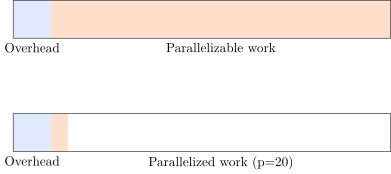
How fast can things potentially go?
- Suppose fraction \(s\) of work is serial
- Rest speeds up perfectly (by a factor of \(p\))
Amdahl’s law shows \(s\) can be a bottleneck:
\[\mbox{Speedup} = \frac{1}{s + (1-s)/p} < \frac{1}{s}\]
Strong and Weak Scaling
Strong scaling: Fixed problem size, varying \(p\)
\[\mbox{Speedup} = \frac{T_{\mbox{serial}}(n)}{T_{\mbox{parallel}}(n,p)}\]
Weak scaling: Vary size, keep work/processor constant
\[\mbox{Scaled speedup} = \frac{T_{\mbox{serial}}(n(p))}{T_{\mbox{parallel}}(n(p),p)}\]
A very different metric!
Gustafson’s Law
For scaled speedup, if serial work is \(s\):
\[\mbox{Scaled speedup} \leq s + (1-s)p = p - s(p-1)\]
This is Gustafson’s Law (compare Amdahl).
Truth in Advertising
- Get near perfect speedup on crap code!
- Keep your eye on time to solution
- Honest comparison should be vs tuned serial code
Spring Course Ad!
CS 5220: Applications of Parallel Computers
- I taught this for many years (last in 2024)
- Prof Giulia Guidi more recently (and in S27)
Poll Everywhere!
Which of these is true about parallel efficiency?
- It usually improves with the number of cores
- It is between 0 and 1 by definition
- Is is usually between 0 and 1, but could be greater than 1 if the serial baseline is poorly tuned
Respond at: https://PollEv.com/davidbindel252 or send davidbindel252 to 22333
Thread basics
Spawn and Join
Spawn and Join
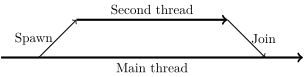
thread::spawntakesFnOnce() -> T, returnsJoinHandle<T>handle.join()returnsthread::Result<T>- Can also drop the handle without join
- Result is a detached thread
- Detached threads terminate on
main()exit
Error Handling
- Unrecoverable:
Errvariant onJoinHandleAnyis a trait to emulate dynamic typingSendmeans safe to move between threads- Needs to have
'staticlifetime
- Recoverable: make closure return
T = Result<S,E>- Get
Ok(Err(err))forerr: E
- Get
Spawn and Join
Map-Reduce Pattern
use std::thread;

fn count_even_par(v: &[u32]) -> usize {

    // Independent mappers run on parts of data
    let mut handles: Vec<thread::JoinHandle<usize>> =
        v.chunks(1024).map(|c| {
            let c = c.to_vec(); // Can do this better!
            thread::spawn(|| -> usize {
                c.into_iter().filter(|x| *x % 2 == 0).count()
            })}).collect();

    // Reduce results at the end
    handles.drain(..).map(|h| h.join().unwrap()).sum()
}
Monte Carlo Example
use std::thread;
use rand::prelude::*;
use rand::rngs::Xoshiro256PlusPlus;

fn run_mc(ntrials: usize, p: usize) -> f64 {
    let mut handles: Vec<thread::JoinHandle<f64>> =
        (0..p).map(|_| {
            let mut rng: Xoshiro256PlusPlus = rand::make_rng();
            thread::spawn(move || {
                let mut x = 0f64;
                for _ in 0..ntrials {
                    x += run_trial(&mut rng);
                }
                x
            })
        }).collect();
    let n = (p*ntrials) as f64;
    handles.drain(..).map(|h| h.join().unwrap()).sum::<f64>() / n
}
Ask Me a Question!
Channels
Messages vs Shared Data
Do not communicate by sharing memory; instead, share memory by communicating.
– Effective Go
Putting message-passing first is not accidental!
- Shared memory often looks simpler
- But synchronization is hard
- And often end up with contention from over-sharing
- Message passing (Actor model) forces being explicit
Rust mpsc
mpsc= Multiple Producer / Single Consumer- Unidirectional with
(Sender, Receiver)pair
Multiple producers
use std::sync::mpsc;
use std::thread;

fn main() {
    let (tx, rx) = mpsc::channel();
    let tx2 = tx.clone();
    thread::spawn(move || {
        tx.send(String::from("hi")).unwrap();
    });
    thread::spawn(move || {
        tx2.send(String::from("hello")).unwrap();
    });
    println!("Got: {}", rx.recv().unwrap());
    println!("Got: {}", rx.recv().unwrap());
}
What Does a Channel Carry?
- Channel carries typed data
- Generally involves transfer of ownership
Tmust implementSend(most types, not all)- Errors when other end is dropped
The Ack Pattern
Channels are unidirectional – communicate other way by
- Return values from threads (or captures)
- Separate channel passed on input
- Passing an “ack” channel via an existing channel
The Ack Pattern
use std::sync::mpsc::{channel, Receiver, RecvError, Sender};
use std::thread;

struct Command(String, Sender<String>);

fn echo_client(id: usize, tx: Sender<Command>) {
    let (response_tx, response_rx) = channel();
    tx.send(Command(format!("Ping {id}"), response_tx)).unwrap();
    println!("{id} received: {}", response_rx.recv().unwrap());
}

fn echo_server(server_rx: Receiver<Command>) -> Result<(), RecvError> {
    loop {
        let Command(s, tx) = server_rx.recv()?;
        println!("Server received: {s}");
        tx.send(s).unwrap();
    }
}
The Ack Pattern
fn main() {
    let (server_tx, server_rx) = channel();
    let mut clients: Vec<thread::JoinHandle<()>> = Vec::new();
    thread::spawn(move || echo_server(server_rx));
    for i in 0..10 {
        let tx = server_tx.clone();
        clients.push(thread::spawn(move || echo_client(i, tx)));
    }
    for c in clients.drain(..) {
        c.join().unwrap()
    }
}
Ask Me a Question!
Wrap-Up
Summary
- Concurrency: logically overlapping execution
- Useful for covering I/O, sharing resources
- Parallelism: actual overlapping execution
- Useful for performance (and concurrency)
- Threads are one mechanism for concurrency
- Can coordinate by fork/join, message passing, shared mem
- Message passing (“actor model”) has some advantages
Up Next
- More advanced message passing
- Intro to P4 (which brings lots together)
Outro
- Take a walk with a friend this week!
- Remember to fill the alternate final time form if relevant