CS 4414/5416:
Systems Programming
File Systems
2026-09-29
Warm Up
How might you make this faster when xs is large?
Logistics
Upcoming
- P2 (fast edit) due tomorrow (09/30)
- P3 (minishell) released
- Keep an eye on Ed (may have an issue Thu)
- Lab 6 is Friday: memory-mapped I/O
Lab notes
- Yes, you can now “do the lab” without coming in
- But this is also a time/place to work with peers
- Yes, Claude can probably do this for you
- Lab material is fair game for the final
Poll Everywhere!
unsafe extern "C" {
    fn memmove(dst: *mut c_void, src: *const c_void,
               len: size_t) -> *mut c_void;
}

fn my_memmove(dst: &mut [u8], src: &[u8]) -> *const u8 {
    if src.len() > dst.len() { panic!(); }
    unsafe {
        memmove(dst.as_mut_ptr() as *mut c_void,
                src.as_ptr() as *const c_void, src.len()) as *const u8
    }
}
This code compiles; should I still worry? (5 min, then poll)
- Yes, a safe wrapper cannot return a raw pointer
- Yes, this violates Rust borrow safety rules
- No, this should function as advertised
Poll Everywhere!
This code compiles; should I still worry? (5 min, then poll)
- Yes, a safe wrapper cannot return a raw pointer
- Yes, this violates Rust borrow safety rules
- No, this should function as advertised
Respond at: https://PollEv.com/davidbindel252
or send davidbindel252 to 22333
Recap
Where We Are
This module: Unix abstractions
- Basic abstractions (files, pipes, virtual memory)
- Processes and inter-process communication
- Introduction to TCP sockets
(Yes, some overlap with 3410/4410.)
This Week
- Today: file systems, focusing on
- Persistence
- Naming
- Data structure interfaces
- Thu: virtual memory
- Fri: lab on memory-mapped I/O
Unix Filesystem Interface
What’s In the Box?
(base) dbindel@dhcp-vl2041-13487 lec % ls /
Applications    etc         private    Users
bin             home        sbin       usr
cores           Library     System     var
dev opt tmp Volumes- How does
lsknow what to show? - What do the entries in
devmean? - What other stuff is hiding here?
Jeopardy!
I’ll take operating systems for 100!
A: Unix
Q: What if everything was a file?
Two key pieces of OS functionality:
- Persistent storage data structures
- A naming system - files, processes, pipes, sockets, …
Plus programmatic interfaces to this functionality
Unix FS Data Structures
Raw Bits
Abstraction from HW interfaces (e.g. SCSI)
- Storage is a giant logical array (like memory)
- Allow block read/write (usually 512 bytes)
- Access times may be non-uniform (like memory)
- No notion of files, directories, permissions, etc
Persistent Data Structure
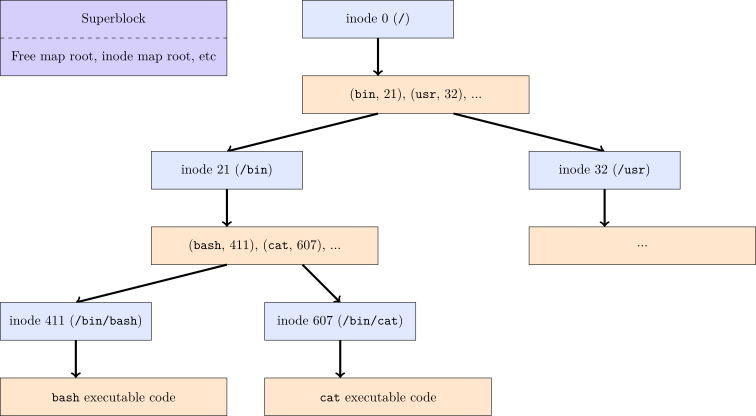
(Partial picture; orange boxes represent their own structures)
Persistent Data Structure
Components include:
- Tracking of filesystem metadata
- Free list (and maybe inode list)
- Index nodes (inodes) with file info
- Data blocks referenced by inodes
- May be arranged in tree (or list for FAT)
Index Nodes
AKA inodes, they contain metadata:
- File type
- File size
- Ownership and permissions
- Timestamps
- Reference count
- Data block pointers
- etc
Files
Ordinary files are files!
- Just a bag of bytes!
- No text vs binary distinction
Directories
Data blocks list (name, inode) pairs
- Always includes
- (
., current dir inode id) - (
.., parent dir inode id) - At root,
..maps to current dir inode
- (
- Name vs path (typically at most 255 char)
Does not directly include directory path.
FIFOs and Unix Domain Sockets
Everything is a file! With different inode types
- Devices (disks, keyboards, mouses, NICs)
- Named pipes (FIFOs)
- Unix domain sockets
Unifies naming and interfaces, but no data blocks.
Access Control
- Standard UNIX access metadata specified
- File owner and group
- Read/write/execute permissions for owner, group, world
- Permissions for owner/group/world in three octal digits
- Three bits per digit, high to low: read, write, execute
- Ex:
chmod 700 foomeans owner (but not group or world) can read (4), write(2), execute (1)
- Many systems have richer access control list metadata
Hard and Soft Links
Link a file for access via a different path
- Hard link (
ln foo bar)- Add directory entry (bar, inode id for foo)
- Increments the inode reference count
- Soft link (
ln -s foo bar)- Create a symbolic link inode referencing foo
- Add directory entry (bar, inode for bar)
Unlinking
Use rm to unlink a file
- Removes file from a directory
- Decrements the inode reference count
- If reference count hits zero, free space
Poll Everywhere!
Which of the following do you think is true? (5 min, then poll)
- Hard links to directories are not allowed
- Soft links to directories are not allowed
- Linking directories in general is not allowed
- Why would you disallow any linking?
Respond at: https://PollEv.com/davidbindel252
or send davidbindel252 to 22333
Virtualization
Often virtualize file systems (VFS)
- Hook an FS onto an existing FS (mounting)
- Unifies multiple underlying file systems
- Data centers around vnode (virtual node)
- May or may not map to inode on persistent store
Involve in-memory (vs persistent) structure.
Ask Me a Question!
Unix FS Interfaces
A Simple Example
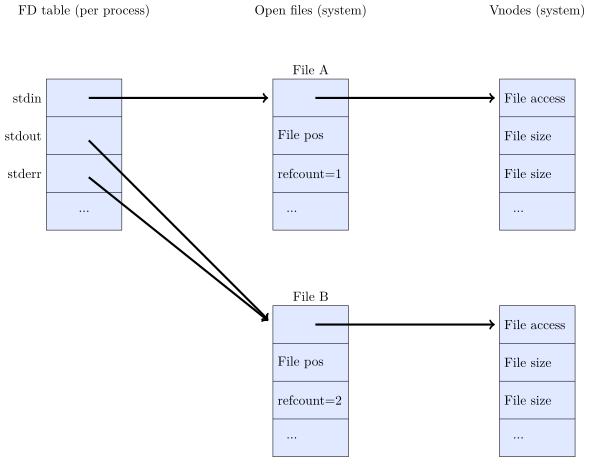
- Standard input from
A.txt - Standard output to
B.txt - Standard error duplicates standard output
What does the kernel make of this?
What the Kernel Sees
What the Kernel Sees
Kernel maintains three-level structure
- Per process file descriptor table
- Open file table (file descriptions)
- Vnode table (VFS analogue of inodes)
Let’s consider each
Per Process FD Table
Table of file descriptor pointers
- 0: Standard input
- 1: Standard output
- 2: Standard error
and others via system open
Kernel Open File Table
Contains file descriptor structs with
- Pointer to vnode
- Reference count
- Offset
This is a system-wide data structure
Vnode Table
Contains vnodes (virtual nodes)
- Metadata about virtual files
- Copy of inode for regular files (roughly)
- May have vnodes with no associated inode!
This is again a system-wide data structure
Why Not Per-Process Positions?
Matters for sharing! Consider
- Open paren starts a new shell process
- Redirect sets
stdouttofoo.txt echois a built-in, advances output positioncatis a new subprocess!- It inherits parent file descriptors
- Gets a consistent view of position
Why Three Layers?
- Multiple FD entries to the same open file entry
- Things like
stderrandstdoutthe same - Or subprocesses sharing
stdoutwith parent - Latter means it can’t be per process
- Things like
- Multiple open files for same vnode
- Unrelated readers/writers might not share file pos!
An Aside on Buffering
- Default Rust I/O is unbuffered
- Can use
BufReaderandBufWriter - Remember buffering when reasoning about position!
- Kernel read position may be ahead user view
- Kernel write position may be behind user view
- Important to
flushbuffered writers!- Errors during flush in
dropare ignored
- Errors during flush in
Pipes and Redirection
Can set standard input, output, error
- Redirection: Set to input/output file
- Or set it to a pipe connecting processes
- (Usu) associated with a FIFO vnode
- Not associated with an inode…
- Except for named pipes (next week)
Wrap-Up
Summary
Unix filesystem gives
- Persistence
- Via data structures on drive or SSD
- Consistent naming
- Of files, directories, pipes and sockets, etc
- Standardized interface
Plus three-layer structure to manage shared access
Up Next
- This Thu: Virtual memory
- Next week: Inter-process communication
Reminder
- P2 is due tomorrow at 11:59 PM
- P3 is out (writing a mini shell)
- Lab 5 is Friday (mmap and I/O)
Outro
On Ed: What was the muddiest point today?