CS 4414/5416:
Systems Programming
Performance, ILP, and memory
2026-09-15
Logistics
Class sheets, labs, slides
- Class sheets: you might not like them, the course staff definitely don’t! So:
- PollEverywhere for attendance and in-class polling
- Freebie this lecture to let you get set up
- Ed threads for some longer responses
- Lab submissions will switch to just GradeScope
- Also, PDF slides are now available on the course page
Project 2
- I know you have an exam!
- Initial tasks are straightforward (blocking for performance)
- Rest has straightforward baseline with room to play
- Will have timing targets on GCP nodes
Midterm
- Practice exam up soon!
- Exam from 7:30-9:30 (target 7:30-9:00) on 9/22
- NetID A-L: Olin 155; M-V: Olin 255; W-Z: Olin 165
- Early exams (5:30) in Statler 396
- There is a conflict form if main time does not work
- Fill it out today
- SDS exam accommodations should also be sorted by now
- Covers the Rust material (first three weeks)
Where we are
This module: fundamentals of single-thread performance
- Hardware effects (particularly memory)
- Performance modeling and measurement
- Using the compiler and tools effectively
Concurrency and multi-threaded performance comes later.
Rage Against the Machine
Idealized Machine
- Address space of named words
- Basic ops: register read/write, logic, arithmetic
- Everything runs in program order
- High-level language means “obvious” machine code
- All operations take about the same time
Real World
Memory operations are not all the same!
- Speeds vary (registers and caches)
- Memory layout dramatically affects performance
Real World
Instructions are non-obvious!
- Pipelining allows instructions to overlap
- Functional units run in parallel (and out of order)
- Instructions take different amounts of time
- Cost depends on order, instruction mix
Real World
Goal: Understand how to help the compiler.
Sketching Reality
Today, a play in two acts:
- One core is not so serial
- Memory matters
Act 1: Not So Serial
Laundry
- Three stages: wash, dry, fold
- Three loads: darks, lights, underwear
- How long?
Laundry
Serial execution:
| 1 | 2 | 3 | 4 | 5 | 6 | 7 | 8 | 9 |
|---|---|---|---|---|---|---|---|---|
| wash | dry | fold | ||||||
| wash | dry | fold | ||||||
| wash | dry | fold |
Laundry
Pipelined execution:
| 1 | 2 | 3 | 4 | 5 |
|---|---|---|---|---|
| wash | dry | fold | ||
| wash | dry | fold | ||
| wash | dry | fold |
RISC Pipeline
Classic five-stage pipeline (MIPS and company)
| 1 | 2 | 3 | 4 | 5 | 6 | 7 | 8 | 9 |
|---|---|---|---|---|---|---|---|---|
| IF | ID | EX | MEM | WB | ||||
| IF | ID | EX | MEM | WB | ||||
| IF | ID | EX | MEM | WB | ||||
| IF | ID | EX | MEM | WB | ||||
| IF | ID | EX | MEM | WB |
RISC Pipeline
- Fetch - read instruction and increment PC
- Decode - determine registers and addresses
- Execute - where the actual computation occurs
- Memory - any memory accesses
- Writeback - results into register file
Pipelining
- Improves bandwidth, not latency
- Potential speedup = number of stages
- What if there’s a branch?
Current versions are much more complicated!
We will be using AMD EPYC Turin (the c4d-highcpu-2 GCP instances) for timing P2.
Wide Front-End
Fetch/decode or retire multiple ops at once
- Limited by instruction mix
- Different ops use different port
- NB: May dynamically translate to micro-ops
Hyperthreading
Support multiple HW threads/core
- Independent registers, program counter
- Shared functional units
- Helps feed core independent work
Out-of-Order Execution
- Internally reorder operations
- Have to commit results in order
- May discard uncommited results
(speculative execution) - Limited by data dependencies
SIMD (Vectorization)
- Single Instruction Multiple Data
- Cray-1 (1976): 8 registers \(\times\) 64 words of 64 bits
- Resurgence in mid-late 90s (for graphics)
- Now short vectors (256-512 bit) are ubiquitous
Pipelining
Different pipelines for different units
- Front-end has a pipeline
- Functional units have their own pipelines
- Example: FP adder, multiplier
- Divider often not pipelined
All Together, Now…
- Front-end reads several ops at once
- Ops may act on vectors (SIMD)
- Break into mystery micro-ops (and cache)
- Out-of-order scheduling to functional units
- Pipelining within functional units
- In-order commit of finished ops
- Can discard before commit
(speculative execution)
All Together, Now…
Modern single-core architecture is complex! Desiderata
- Maintain (mostly) serial semantics
- In-order retirement, precise exceptions
- Make lots of latent parallelism available
- Wide issue, SIMD, pipelining
- Help programmer/compiler manage complexity
- Out-of-order execution
Punchline
Compiler understands CPU in principle
- Rearranges instructions to get a good mix
- Tries to use FMAs, SIMD instructions, etc
Punchline
Compiler needs help in practice
- Set optimization flags, pragmas, etc
- Make code obvious and predictable
- Expose local independent work
- Use special intrinsics or library routines
- Data layouts, algorithms to suit machine
Punchline
The goal:
- You handle high-level optimization
- Compiler handles low-level stuff
Note memory layouts are part of your job!
Act 2: Memory Matters
Basic Problem
- Memory latency = how long to get a requested item
- Memory bandwidth = steady-state rate
- Bandwidth improves faster than latency
- Inverse bandwidth remains worse the flop rate
Locality
Programs usually have locality:
- Spatial locality: things close to each other tend to be accessed consecutively.
- Temporal locality: we tend to use a “working set” of data repeatedly.
The cache hierarchy is built to take advantage of locality.
How Caches Help
- Hide memory costs by reusing data
- Exploit temporal locality
- Use bandwidth to
- Fetch by cache line (spatial locality)
- Support multiple reads
- Prefetch data
This is mostly automatic and implicit.
Cache Basics
- Organize in cache lines of several bytes
- Cache hit when copy of needed data in cache
- Cache miss otherwise. Basic types:
- Compulsory: never used this data before
- Capacity: cache full, working set too big
- Conflict: insufficient associativity for access pattern
Cache Associativity
Where can data go in cache?
- Direct-mapped: Each address can go in only one location (e.g. store address xxxx1101 only at cache location 1101)
- \(n\)-way: Each address can go in one of \(n\) possible cache locations (store up to 16 words with addresses xxx1101 at cache location 1101).
Higher associativity costs more in hardware.
Caches on My Laptop
Apple M1 Pro (Firestorm core?)
- 128 KB L1 data cache
- 12 MB L2 cache (shared)
- 24 MB system level cache
A memory benchmark
Membench on My Laptop
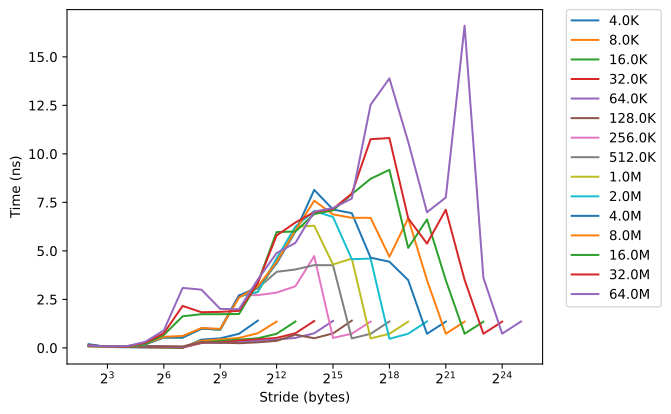
Membench on My Laptop
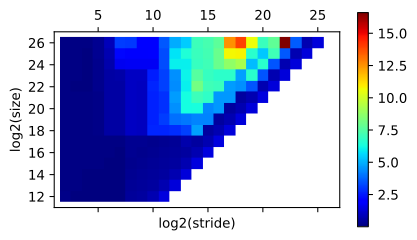
Features
- Vertical: 128 B cache lines (\(2^6\)), 16 KB pages (\(2^{14}\))
- Horizontal: 128 KB L1 (\(2^{17}\)), 12 MB L2 (\(< 2^{24}\))
- Diagonal: 8-way set assoc, 256 page L1 TLB, 3072 page L2 TLB
The Moral
Even for simple programs, performance is a complicated function of architecture!
- Need to know a little to write fast programs
- Want simple models to understand efficiency
- Want tricks to help design fast codes
- Example: blocking (also called tiling)
Outro
- Ed Thread: Have you done any performance tuning elsewhere (courses, internships, personal projects)? Anything you are particularly proud of?