CS 4414/5416:
Systems Programming
The End of the Tour
2026-09-10
Warm-up exercise
- Who is your neighbor?
- What is (or was) their most fun non-CS undergrad class?
Logistics
Class sheets
- Marked as graded the ones that (I think) are done
- New class sheets have combs!
- Feel free to print your own (with typed netids)
Lab 3
- You have a lab tomorrow
- These are opportunities to practice Rust
- This is not work I need solved
- AI producing this code misses the point
- This is a time to ask more questions!
Project 1
- The
README.mdand files are updated - You have new functionality to implement in
keys.rs - This includes tests for
anagrams.rsandkeys.rs- You should edit
tests/keys_test.rs
- You should edit
- You should submit a
cratefile for P2- Just submitting
rsfiles will not work!
- Just submitting
Midterm
- Exam from 7:30-9:30 (target 7:30-9:00) on 9/22
- NetID A-L: Olin 155
- NetID M-V: Olin 255
- NetID W-Z: Olin 165
- Early exams (5:30) in Statler 396
- There is a conflict form if main time does not work
- Covers the Rust material (first three weeks)
Next module: Writing fast code
Performance of single-thread codes, requiring
- Modeling
- Measurement
- Understanding memory effects
- Using the compiler effectively
Two weeks:
- Next: Profiling, memory, and optimization
- Then: Compilation, linking, loading, and build systems
Google Cloud Platform
- Next week, we start using GCP
- Retrieval link for Google Cloud coupons is on Ed
- One per student email
- Please use your Cornell-based email!
- Recommended: GCE Linux VM walk-through
- Use an inexpensive instance for setup
- Clean it up when done
Recap
Why Rust?
- This is a class on systems programming
- Low-level, performant, resource-constrained
- Load-bearing code at the “bottom of the stack”
- Rust is a safe systems programming language
- Safety improves security
- See CISA/NSA joint guide (and 2024 report), “Safer with Google”
- Safety improves reliability generally
- Safety can also improve performance (more on this later)
- Safety improves security
Rust in the Real World
- Started by Mozilla, currently about 13% of Firefox codebase
- Currently more than C, less than C++
- NB: about half of codebase is HTML, JS, or Python
- Used in Linux, Android, Microsoft (firmware and systems components), Amazon (across AWS), OpenAI (Codex CLI), Discord…
- Adoption is quite fast given legacy scale!
- And Code Metal and Google and Microsoft working on large-scale translation of C/C++ into Rust
Familiar Rust
What’s familiar from C/C++/Java?
- Lots of control flow and syntax, basic data types
- Traits a bit like Java interfaces
- Generics are reminiscent of C++ templates
What’s familiar from functional languages?
- Broadly used type inference
- Enums, structure matching,
match - Some functional features
New Friends
What’s unfamiliar? Ownership and borrowing.
- Each entity has one owner
- One mutable or many shared refs (not both)
- All references must be valid
Also maybe error handling with Result? Macros?
Where I Hope We Are
Stated module goals:
- Understanding fundamentals of Rust
- Understanding how some of this is implemented
But:
- Three weeks is just enough for a survey
- Learn more by doing the projects this semester!
Okay, on to some remaining topics…
Modules (try 2)
Modules
Visibility
Hierarchy
- Module hierarchy tracks file hierarchy in a crate
- Top level in
lib.rsormain.rs - In crate,
boots::catssays to look insrc/boots/cats.rs
- Top level in
superpoints to parent moduleselfpoints to current moduleusebrings a name into current space (pub usere-exports)
Dynamic traits
Different uses of traits
- Static polymorphism (generics)
- Everything resolved at compile time
- May produce multiple versions of code
- No (direct) run-time cost, inlining possible
- Dynamic polymorphism (dyn traits)
- Resolve version to dispatch at run time
- Single code version works for multiple types
- Requires dispatch via a vtable
Usage
trait Hello { fn speak(&self); }
struct Dog { name: &'static str }
struct Cat { name: &'static str }

impl Hello for Dog {
    fn speak(&self) { println!("{} says woof!", self.name); }
}

impl Hello for Cat {
    fn speak(&self) { println!("{} stares aloofly", self.name); }
}

fn speak_to(who: &dyn Hello) { who.speak(); }

fn main() {
    speak_to(&Dog {name: "Fido"});
    speak_to(&Cat {name: "Pete"});
}
Usage
Restrictions
- Don’t know size of a dyn trait object
- Can only get to it via some pointer type
- Implementation is a fat pointer:
(ptr, vtable ptr)
- Methods are stored in a virtual function table (vtable)
- Assembled by the compiler, one slot per method
- Must also contain information on how to
drop
dyn Traitinterfaces must be type generic- Can’t use associated types
- Can’t return
Self
Implementation
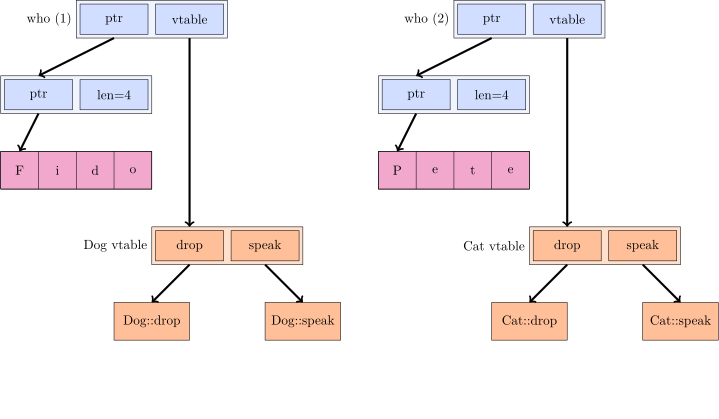
Dynamically sized types
What’s a DST?
Dynamically sized type examples:
- Trait objects
- Slices
str
Size is not known at compile time.
Sized and ?Sized
Two special trait bounds:
Sizedwhen size is known at compile time- Can call
std::mem::size_of::<T>()forSizedtypes
- Can call
?Sizedwhen unknown size is allowed
Type parameters and associated types are Sized unless explicitly declared ?Sized
New Type idiom
Idiom?
An idiom is a common code pattern
- Every language has its own idioms
- Often libraries, frameworks, etc do as well
- Code following standard patterns is idiomatic
- One standard Rust idiom is NewTypes
NewType idea
- Just a single-field struct!
- Type carries semantic information (e.g. units)
- Can add functionality via methods, traits
NewType example
- The structs are public, the fields are not!
GithubId,Password, andStringare now different types
NewType example
pub fn lookup_user(user: &GithubId) -> Result<UserRecord, GithubId> {
    //...
}

pub fn validate_password(user_rec: UserRecord, password: &Password)
    -> Result<(), PasswordError> {
    //...
}

pub fn login(user: &GithubId, password: Password)
    -> Result<Session, LoginError> {
    let user_info = lookup_user(user);
    validate_password(user_info, &password)?;
    //...
}
Student’s choice
Unsafe Rust
Five additional actions:
- Dereference a raw pointer
- Call unsafe functions or methods (includes FFI)
- Access or modify a mutable static variable
- Implement an unsafe trait
- Access fields of
union
What unsafe Rust is not
Not a free-for-all!
unsafecode is scoped (use in small doses)- References are still checked in unsafe code
- Ownership guarantees must still be respected
- OK C code may be erroneous in analogous unsafe Rust
- e.g. it’s Not Good to mutate something when a shared reference has been borrowed
For more see the Rustonomicon
Bonus! Unsafe! Content!
- CS colloquium today - Jonathan Aldrich on BorrowSanitizer and Rust/C FFI (video link will go up presently)
- We will indeed see unsafe Rust again when dealing with FFI
Ownership and borrowing
Basic rules
- Each entity has one owner
- One mutable ref or many immutable refs (not both)
- References must always be valid
… with addenda for smart pointers (esp RefCell)
Good examples in Rust By Example!
Ownership
- Each entity has one owner
- Ownership can be transferred (e.g. functions that consume arguments)
Reference exclusivity rules
- One mutable ref or many immutable
Reference validity
- No way to try to create uninitialized references in Rust
- Checked: references cannot outlive what they point to
Generics and trait bounds
Rust generics parameterize over types, constants
- But not every type will work!
- Trait bounds specify required functionality
Generics and trait bounds
fn mymax<T,Titer>(mut t: Titer) -> Option<T>
where
    T: Ord,
    Titer: Iterator<Item=T>
{
    let Some(item) = t.next() else { return None; };
    let mut max_item = item;
    for item in t {
        if item > max_item {
            max_item = item;
        }
    }
    Some(max_item)
}

fn main() {
    let v = vec![1, 2, 2, 1];
    println!("{:?}", mymax(v.iter()));
}
Trait bound summary
Basic idea: T: S + R for traits S and R means
- Type
Tmust implementSandR - Implementing trait
TrequiresSandR- We say
SandRare supertraits ofT
- We say
Again, Rust by Example has great examples!
Wrapping up
Next steps
- We are done talking just about Rust
- But there will be lots more Rust ahead
- … in the interest of actual systems programming
- Start reading from CS:APP3e!
Outro
What are your thoughts on course logistics?
- Slides + exercise format?
- Class sheets?
- Labs?
Constructive feedback would be great!