CS 4414/5416:
Systems Programming
Testing, Cargo, Functional Features
David Bindel
2026-09-08
Warm-up exercise
- What might memory look like for representing this?
- What did the person next to you do this weekend?
Recap
Where we are
- Last Tue
- Traits and generics
- Error handling
- Modules and libraries (on your own)
- Last Thu
- Memory layouts
- Smart pointer types
- Ownership, lifetimes, borrowing revisited
- Fri: Process registry lab, part 1
Where we’re going
- Today
- Closures and iterators
- Cargo and crates
- Testing
- Thu
- Dynamic traits and vtables
- Advanced Rust, student choice
- Fri: Process registry lab, part 2
- And then on to performance tuning.
Logistics (P1)
- Updated prompt and code is posted (and grader is ready)
- Check-in is due today (not yesterday) at 11:59 PM
- Final submission due Monday, 9/14 at 11:59 PM
- For check-in, can submit just
anagram.rsif needed
Logistics (prelim)
- Prelim is evening of Sep 22
- Will post conflict form info soon
- Will all be material from first three weeks
- You may bring one page as “cheat sheet”
- Viable questions
- Things like I asked in class
- Things that appeared in P1
- I will try not to be deliberately tricky
Closures
Closure syntax
- Several syntactic variants
- Often used where the tersest syntax makes sense
- Can often suppress types (via type inference)
Captures
- Closures can access variables in environment!
- How does this interact with ownership?
Ownership and captures
- Default is to borrow references to data
- Only borrow mutable reference if needed
- Seems like a problem for returning closures
- What if they capture stack frame data?
Ownership and capture
Move closures
movekeyword says to move rather than borrow- For
Copydata, results in a copy - Even for
Copydata, makes a difference
Behind the scenes
Closures are syntactic sugar for:
- Make a new
structtype- implements trait
Fn,FnMut, orFnOnce
- implements trait
- Populate with any needed environment
- Execute code using
structfields
Closure types
Fn: Only borrows shared refs to capturesFnMut: Borrows mutable refs to capturesFnOnce: Moves data- Call consumes closure and values
- When taking a closure, prefer
FnOnce - When defining a closure, prefer
Fn
Using closure types
FnOnce is a trait, not a concrete type, so:
Using closure types
Can also use impl argument:
Using closure types
Exercise
Iterators
Iterator traits
The next method
- Returns
Some(item)if there is one available - Returns
Noneif the collection is exhausted - Updates to the next item
Iterator usage
forloop consumes an iterator
IntoIterator
- Collections implement
IntoIteratorfor default iterator - Have seen this implicitly already (iterate over
Vec)
Iterator adapters
Collect
- The
collectmethod collects iterator output- Sometimes materializing data is not what we want!
- Need to specify type we are collecting into
Iterator example
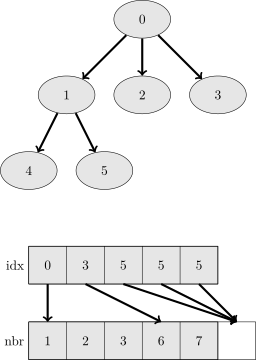
Compressed sparse graph storage:
nbrstores packed neighbor listsidxstores neighbor list offsetsnbr[idx[i]..idx[i+1]]is neighbors ofi
Iterate through edges (i,j)?
Iterator example
// Neighbors of node i are in neighbors[idx[i]..idx[i+1]]
struct CompressedSparseGraph {
    neighbors: Vec<usize>,
    idx: Vec<usize>
}

struct EdgeIterator<'a> {
    g: &'a CompressedSparseGraph, // Graph reference
    i: usize, // Current first node
    k: usize  // Offset of second node in neighbors
}

impl CompressedSparseGraph {
    fn edges<'a>(&'a self) -> EdgeIterator<'a> {
        EdgeIterator { g: &self, i: 0, k: 0 }
    }
}
Iterator example
Iterator example
Iterator example
Alternate strategy:
- Build iterator for edges on each node
- Iterate over edge list iterators
- Combine edge list iterators with
flatten
Zero-cost abstractions?
- Explicit loops may not beat iterator chains!
- Compiles to something pretty close to
forloops - Unsurprising, given that
foruses iterators!
- Compiles to something pretty close to
- But some things to consider in inner loops
- Helps to provide
size_hintifcollecting - Can combine phases (
filter_mapvsfilter+map)
- Helps to provide
Exercise
Cargo
Swiss army knife!
cargo new      # Start a new project
cargo fmt      # Reformat to Rust standard
cargo doc      # Build package documentation
cargo clean    # Clean up directory
cargo add      # Add external crate dependency to Cargo.toml
cargo build    # Build software
cargo run      # Re-build if needed and run
cargo clippy   # Lints your code
cargo test     # Run tests
cargo bench    # Run benchmarks
cargo package  # Build a package
cargo install  # Install a package from Crates.io
… and more – see the Cargo book!
Building and build profiles
Profiles let you alter compiler settings
- Specified in
Cargo.tomlin[profile]table - Default profiles:
dev,release,test,bench- Usual
devcorresponds to debug mode - Use
--releaseflag if you want your code to go fast!
- Usual
Build scripts
Build script is build.rs in package root
- Written in Rust (vs a
Makefileor something) - Not restricted to running
rustc- Can auto-generate code, build C codes, etc
- Cargo doing lifting (e.g. around dependency management)
Lints and Clippy
cargo clippy runs a linter
- Mostly tells you what could be done better
- You need not always follow its advice!
- … but it’s worth running it
Packaging and submission
cargo packagecreates a.cratefile- Ex
p1_maxagram-0.1.0.crate - This is really a Unix tarball format
- Ex
- Starting with P1 final submission, please upload
cratefiles!
NB: Changed crate name to p1_maxagram in P1
Crates.io
cargo publishuploads a crate to a registry- Default registry is https://crates.io
- You can install packages from the registry!
- With a login, you can push your own
- Warning: supply chain attacks!
- People do publish malicious code
- AI assistance makes this easier than ever
- Maintainers try to manage, but caveat emptor
Custom commands
cargo installinstalls things incargospace- Any executable
cargo-*can be acargocommand - Ex:
cargo install cargo-llvm-covto getcargo llvm-cov
Testing
Run the code!
“Beware of bugs in the above code; I have only proved it correct, not tried it.”
— Don Knuth, 1977
Starting from failure
Tests should initially fail
- How else will you know that they’re actually testing?
- Tricky tests help you clarify corner cases
- Testability is part of design
- Extreme version is test-driven-development (TDD)
There are implications for P1.
Types of tests
- Small (maybe private) functions and data structures?
- Behavior involving interacting system components?
- Parameterized behavior?
- Behavior involving large workloads?
- Return later to stress tests and benchmarks
Unit tests
Goal: Check functions, small data structures, etc
- Lives in code files in
srctree #[cfg(test)]to only build on test- Mark test functions with
#[test]
Integration tests
Integration tests
- Separate files in
tests - Again mark test functions with
#[test] - Not “in” the crate
- Need to use crate’s external interface
Assertion tooling
assert!(condition and optional string)assert_eq!,assert_ne!#[should_panic(expected = "less than")]- Or
assert!(value.is_err())to check recoverable errors
Filtering tests
Wrapping up
Beyond the language
Some nice things about the Rust ecosystem:
- Lots of good documentation and users
- Actively maintained and updated
- Single standard tools (
cargo,rustc,rustdoc) - Standardized build and package management with
cargo - Many external crates on https://crates.io
Language choice is never just about the language!
Outro
- What do you want to hear about on Thursday?
- Are you worried about the prelim?
- If so, how can we help?