CS 4414/5416:
Systems Programming
Memory Layouts and Smart Pointers
2026-09-03
Warm-up exercise
Recap
Plan for this week
- Tue
- Traits and generics
- Error handling
- Modules and libraries (probably on your own)
- Today
- Memory layouts
- Smart pointer types
- Ownership, lifetimes, borrowing revisited
- Fri: Process registry lab, part 1
Where we’re going (revised)
- Next Tue
- Testing
- Iterators and closures
- Cargo and crates
- Next Thu
- Dynamic traits and vtables
- Advanced Rust, further resources
- Fri: Process registry lab, part 2
- And then on to performance tuning.
Logistics
- Project list is posted!
- First project repository is linked
- Check-in submission due next Tuesday
- Final submission due two Mondays hence
- We have Google cloud credits! See Ed for details
- Add deadline is Sep 8 – ticket if you need it!
Logistics
- Write your name and netid on class sheets
- Print netid, ideally in pen!
- To simplify the end of class
- Pass class sheets right and up
- Pass blank sheets left and up
Memory Layouts
Basic setup
- Program runs in own virtual memory
- Hardware and OS map virtual to physical memory
- More about virtual memory in a few lectures
- Virtual address space is partitioned into segments
Stack, heap, and global
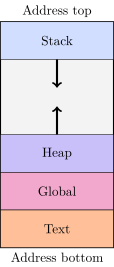
Segments (high to low):
- Stack segment
- Heap segment
- Global data segment
- Text segment (program code)
Stack frames
Keep track of per-call state
- Function arguments
- Return address
- Local variables (fixed size)
Frame is popped when call returns
Can’t touch this
- Caller receives an invalid pointer!
- Only makes sense until the frame is popped
- Ignores valid lifetime of referenced data
- Legal C (but undefined behavior)
- Borrow checker prevents this in Rust
Heap data
- Place for data that outlives calls
- Also for variable-length allocations
- Valid lifetime is decoupled from calls
- Managed (semi)-explicitly in Rust, C/C++
Heap data
- Allocator map says what’s available
- Bad allocation patterns fragment the heap
- Allocation/free is inexpensive, not totally free
- Resizing may cause copying (which can get expensive)
- In Rust, release automatically at end of life
dropcall when owner goes out of scope- Can choose to leak in some cases
Global data
Used for
- String literals
- Other compile-time constants
staticitems- Associated with
'staticlifetime (more on this soon)
- Associated with
Data size/placement is set at compile time.
Memory representations
- Stack, heap, and global are where data is stored
- What about the representations?
- Scalar types should be familiar from 3410
- What about tuples, structs, and enums?
- Or more elaborate things?
Structs in C
Representation in memory:
- 1 byte for
tag - 7 bytes of padding (for alignment of
value) - 8 byes for
value
Usual advice: order fields by decreasing size to minimize alignment padding
Struct and tuple representation
- Mostly just list the fields
- Compiler is allowed to reorder
- This is different from C!
- Even with reordering, may need to pad for alignment
- Ex: a
u64usually starts at an 8-byte boundary
(an address that is a multiple of 8)
- Ex: a
Enum representation
- Simple enums (no payload) are coded as a small integer
- Can force values with
= value(as in C - The
reprmacro makes it a specific integer type - Use
code as u16to get value (asis like a cast)
Enum representation
- Enums with payloads are coded as a tagged union
- Must reserve space for tag plus largest variant
String layout example
Pretend this was not optimized to nothing.
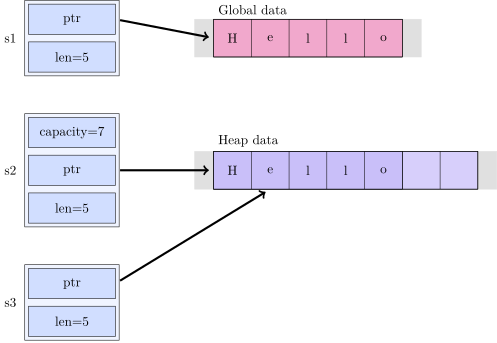
What is the memory picture?
String layout picture
String layout notes
- Types of metadata objects
- Raw pointers (and references) are just addresses
- Slices are “fat pointers” (address and length)
Stringis astructwith capacity, address, length
- Capacity and length parameters are in bytes
- Note UTF-8 coded characters vary in length
- Metadata is stored separately from data
Strings and ownership
For a String:
- The metadata object owns the heap data
- Transfer of ownership means copying metadata object
- Or just renaming it – up to the compiler
- Only one owner avoids multiple frees
- Compilers track lifetime to avoid use-after-free
Strings and cloning
The clone method (trait Clone) usually makes a deep copy
- Copy the data and make new metadata
- New metadata has different pointer, to new data!
helloconsumessand clone (calldropat return)
Exercise
String::from(s)copies data froms. Why?- What is the size of an
Option<u16>? AnOption<u32>? - Did the person next to you ever have pets? What type?
Pointer types
Rust pointer types
- Basic pointer types (non-owning)
- References:
&Tand&mut T - Slices:
&[T]and&mut [T] - Raw pointers:
*const Tand*mut T(unsafe)
- References:
- Smart pointer types
Box<T>: Owning pointerRc<T>: Reference counted smart pointerRefCell<T>: Run-time checked references
- Many containers (
String,Vec) use pointers internally.
Box type
- A
Box<T>is an owning pointer to aTon the heap - Implements the
Dereftrait,*accesses contents- Can therefore call
Tmethods directly onBox<T>
- Can therefore call
- Also gives us borrow operator (
&and&mut)
Box type and linked lists
Rc types
Rc types
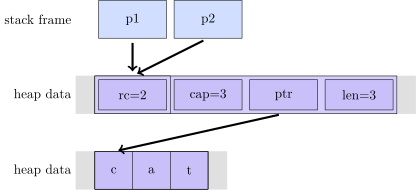
rcis the strong reference count- For concurrent code, need atomic updates of
rc - Will talk about
Arc(andMutex) later in semester
- For concurrent code, need atomic updates of
Rc types
- Both
p1andp2point to the same heap data - Data is stored along with a reference counter
- Can lead to leakage with cycles
- But cycles are hard to create
- Requires interior mutability
RefCell
- Single owner (like
Box<T>) - Usual rules apply
- One mutable ref or many immutable (but not both)
- References must always be valid
- But with
RefCell, enforce borrow safety at runtime - Good for a little mutability (e.g. logging)
RefCell
- Can change contents of
xeven thoughxis immutable - This is interior mutability
- OK, but violating borrow rules causes runtime panic
Exercise
What might memory look like for representing this?
Borrowing and Lifetimes
Borrow revisited
Basic rules
- Each entity has one owner
- One mutable ref or many immutable refs (not both)
- References must always be valid
… with some addenda for smart pointers
Passing and returning
- So far, we mostly passed references into functions
- Can’t
dropreference passed from caller while in callee! - What about references passed out of functions?
What could go wrong?
Passing out references seems dangerous!
- Could I violate reference exclusivity rules?
- What about reference validity rules?
Want to relate input and output references somehow.
Why does this work?
- One reference goes in (
&self) - One slice comes out
- Assume you borrowed out of
&self- So
&self(and return value) remain borrowed on return - This is a lifetime constraint
- So
- If assumption is wrong, you need to annotate
Implicit lifetime tracking
#[derive(Debug)]
struct Point2d(f64, f64);

fn borrow1(p: &Point2d) -> &f64 { return &p.0; }
fn get1(p: &Point2d) -> f64     { return p.0;  }
fn change2(p: &mut Point2d)     { p.1 = 1.0;   }

fn main() {
    let mut p = Point2d(0.0, 0.0);
    //let x = borrow1(&p); // Compile error
    let x = get1(&p);      // This is OK
    change2(&mut p);
    println!("{x} {p:?}");
}
Explicit lifetimes
'ais a lifetime parameter- Name doesn’t really matter; where it appears does
- Here, compiler assumes both inputs borrowed on output
Lifetimes in compound types
Lifetime elision rules
When returning a reference, can skip lifetime parameter if
- Only one reference is passed into a function
- Lifetime of return is the same as
&selfin a method
Otherwise, need an explicit parameter.
Wrap-up
Upcoming
- Project 1 is launched!
- Check-in is Tuesday, Sep 8, 11:59 PM
- Project is due Sep 14 at 11:59 PM
- Partner finding social today, Gates 114, 4:30-5:30
- Consulting hours and Ed Discussions are open!
- Lab 2 is tomorrow
Outro
What would you like to hear about from me
(course material or otherwise)?
- Write your name and netid on class sheets
- Print netid, ideally in pen!
- To simplify the end of class
- Pass class sheets right and up
- Pass blank sheets left and up