CS 321
Exact sequence comparison.
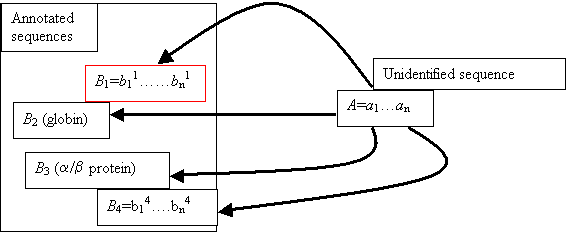
Sequence alignment is a tool to test for similarities between a sequence of an unknown target protein, and a single (or a family of) well-characterized protein(s). It is assumed that sequence similarity implies similarity in function.
Figure 1: A cartoon plot illustrating the use of a database of annotated proteins to identify a novel sequence
We denote the
sequence of the unknown protein by  . It is
 a
short cut for an abbreviation of the explicit sequence 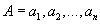 , where
  is an amino acid
placed at the
is an amino acid
placed at the  position along the
sequence. The sequences of the known proteins, that make the comparison database,
are called
position along the
sequence. The sequences of the known proteins, that make the comparison database,
are called  where
where 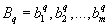 , and
, and  is the total number
of proteins in the database. For sequences only, the database may include
hundreds of thousands of entries [http://www.expasy.ch/srs5/]. Databases that
include both sequences and structures are limited to about ten thousand entries [http://www.rcsb.org/pdb/].
For brevity we omit the index from
is the total number
of proteins in the database. For sequences only, the database may include
hundreds of thousands of entries [http://www.expasy.ch/srs5/]. Databases that
include both sequences and structures are limited to about ten thousand entries [http://www.rcsb.org/pdb/].
For brevity we omit the index from  and use
  to represent a member
of the comparison set.
to represent a member
of the comparison set.
Table 1: A sample of protein sequences. Typical lengths of protein sequences vary from a few tens to a few hundreds. The single letter notation (one character for an amino acid) is used.
Serine Protease inhibitor
EDICSLPPEV GPCRAGFLKF
AYYSELNKCK LFTYGGCQGN ENNFETLQAC XQA
Amicyanin alpha
MRALAFAAALAAFSATAALAAGALEAVQEAPAGSTEVKIAKMKFQTPEVR
IKAGSAVTWTNTEALPHNVHFKSGPGVEKDVEGPMLRSNQTYSVKFNAPG TYDYICTPHPFMKGKVVVE
Major Histocompatability Complex (class I)
MAVMAPRTLV LLLSGALALT QTWAGSHSMR
YFSTSVSRPG RGEPRFIAVG YVDDTQFVRF
DSDAASQRME PRAPWIEQEG
PEYWDRNTRN VKAHSQTDRV DLGTLRGYYN QSEDGSHTIQ
RMYGCDVGSD GRFLRGYQQD
AYDGKDYIAL NEDLRSWTAA DMAAEITKRK WEAAHFAEQL
RAYLEGTCVE WLRRHLENGK
ETLQRTDAPK THMTHHAVSD HEAILRCWAL SFYPAEITLT
WQRDGEDQTQ DTELVETRPA
GDGTFQKWAA VVVPSGQEQR YTCHVQHEGL PEPLTLRWEP
SSQPTIPIVG IIAGLVLFGA
VIAGAVVAAV RWRRKSSDRK GGSYSQAASS DSAQGSDVSL
TACKV
b.2 An introduction definition
ofto
the alignment score
We need a more precise definition of similarA
more precise definition of similar
is needed. The simplest definition (one) is the fraction of amino acids in  that are identical to
 . In proteins, high sequence identity (roughly above 35
percent) immediately implies close relationship. A more subtle definition of
similarity (two) uses
amino acids with similar physical or biochemical properties. For example,
replacing a hydrophobic amino acid like leucine (L) by valine (V) is (usually)
an acceptable mutation. The effect on the hydrophobic core of the protein is
expected to be small. However, changing (L) to a charged residue like arginine
(R) is likely to be damaging and significantly affect protein stability.
. In proteins, high sequence identity (roughly above 35
percent) immediately implies close relationship. A more subtle definition of
similarity (two) uses
amino acids with similar physical or biochemical properties. For example,
replacing a hydrophobic amino acid like leucine (L) by valine (V) is (usually)
an acceptable mutation. The effect on the hydrophobic core of the protein is
expected to be small. However, changing (L) to a charged residue like arginine
(R) is likely to be damaging and significantly affect protein stability.
Hence,
there is a gray area between an exact matching (two identical amino acids) and
a complete mismatch. This gray area is better described by a scoring function
with a wide spectrum. The scoring function gives the highest score to an
identical pair and the lowest possible score for (to) substitutions
that do not make chemical, physical or biological sense.
To
make sequence comparison compact and easily extendable to a wide range of
sequences, we simplify the process. We assume that the total score  of comparing
sequences
of comparing
sequences and
and  will be given by a
sum of terms, each term comparing two elements, an element from
will be given by a
sum of terms, each term comparing two elements, an element from  and an element from
  . An element is either an amino acid or a “space” (gap). For
example, consider the case in which
. An element is either an amino acid or a “space” (gap). For
example, consider the case in which  is significantly
longer than
is significantly
longer than  . In
. In that (this) case it is obvious that some amino
acids of  will be aligned
against “spaces” (gaps). The choice of the
pairs of elements for the similarity test is called an alignment and is
the focus of the present section.
will be aligned
against “spaces” (gaps). The choice of the
pairs of elements for the similarity test is called an alignment and is
the focus of the present section.
Table
2. An example of an alignment of the two sequences and the selection of pairs
of elements for comparison. The sequences of myoglobin and hemoglobin are
placed on top of each other and pairs are compared horizontally.
PLACE
TABLE 2 HERE
There are two different problems that we
need to address: The selection of the alignment and the determination of the
scoring function. Let us start with the score. Since we simplified the
calculation of the total score, making it a sum of element comparisons, we need
to consider only comparison of individual amino acids and comparisons of an
amino acid against a gap. However, we do not need to consider separately scores
of pairs of amino acids since  .
.
The scores of pairs of amino acids, which
measure the similarity of the  -s and the
  -s, form the so-called substitution matrix
  . The matrix is symmetric, and of size
  (the number of amino
acid types). Note that the term “substitution” may be misleading since it
suggests a direction (substituting
(the number of amino
acid types). Note that the term “substitution” may be misleading since it
suggests a direction (substituting  by
by  implies that
  was there first). A
symmetric matrix does not have a sense of time, and the order of substitutions
does not change the score, or the degree of similarity.
was there first). A
symmetric matrix does not have a sense of time, and the order of substitutions
does not change the score, or the degree of similarity.
Nevertheless, a non-symmetric variation of the sequence as a function of time is of considerable interest. A direction in sequence-similarity-scores is potentially informative, providing molecular fingerprints for evolutionary time scales. However, it is hard to estimate it without a specific model in mind. At present, for the purpose of finding protein relatives, we shall use the simplest way out and ignore the time arrow of evolution. A widely used (symmetric) substitution matrix is given below
The BLOSUM 50 matrix [x]
|
|
|
|
|
|
|
|
|
|
|
|
|
|
|
|
|
|
|
|
|
|
|
|
|
A |
R |
N |
D |
C |
Q |
E |
G |
H |
I |
L |
K |
M |
F |
P |
S |
T |
W |
Y |
V |
|
|
:A |
5 |
-2 |
-1 |
-2 |
-1 |
-1 |
-1 |
0 |
-2 |
-1 |
-2 |
-1 |
-1 |
-3 |
-1 |
1 |
0 |
-3 |
-2 |
0 |
:A |
|
:R |
-2 |
7 |
-1 |
-2 |
-4 |
1 |
0 |
-3 |
0 |
-4 |
-3 |
3 |
-2 |
-3 |
-3 |
-1 |
-1 |
-3 |
-1 |
-3 |
:R |
|
:N |
-1 |
-1 |
7 |
2 |
-2 |
0 |
0 |
0 |
1 |
-3 |
-4 |
0 |
-2 |
-4 |
-2 |
1 |
0 |
-4 |
-2 |
-3 |
:N |
|
:D |
-2 |
-2 |
2 |
8 |
-4 |
0 |
2 |
-1 |
-1 |
-4 |
-4 |
-1 |
-4 |
-5 |
-1 |
0 |
-1 |
-5 |
-3 |
-4 |
:D |
|
:C |
-1 |
-4 |
-2 |
-4 |
13 |
-3 |
-3 |
-3 |
-3 |
-2 |
-2 |
-3 |
-2 |
-2 |
-4 |
-1 |
-1 |
-5 |
-3 |
-1 |
:C |
|
:Q |
-1 |
1 |
0 |
0 |
-3 |
7 |
2 |
-2 |
1 |
-3 |
-2 |
2 |
0 |
-4 |
-1 |
0 |
-1 |
-1 |
-1 |
-3 |
:Q |
|
:E |
-1 |
0 |
0 |
2 |
-3 |
2 |
6 |
-3 |
0 |
-4 |
-3 |
1 |
-2 |
-3 |
-1 |
-1 |
-1 |
-3 |
-2 |
-3 |
:E |
|
:G |
0 |
-3 |
0 |
-1 |
-3 |
-2 |
-3 |
8 |
-2 |
-4 |
-4 |
-2 |
-3 |
-4 |
-2 |
0 |
-2 |
-3 |
-3 |
-4 |
:G |
|
:H |
-2 |
0 |
1 |
-1 |
-3 |
1 |
0 |
-2 |
10 |
-4 |
-3 |
0 |
-1 |
-1 |
-2 |
-1 |
-2 |
-3 |
2 |
-4 |
:H |
|
:I |
-1 |
-4 |
-3 |
-4 |
-2 |
-3 |
-4 |
-4 |
-4 |
5 |
2 |
-3 |
2 |
0 |
-3 |
-3 |
-1 |
-3 |
-1 |
4 |
:I |
|
:L |
-2 |
-3 |
-4 |
-4 |
-2 |
-2 |
-3 |
-4 |
-3 |
2 |
5 |
-3 |
3 |
1 |
-4 |
-3 |
-1 |
-2 |
-1 |
1 |
:L |
|
:K |
-1 |
3 |
0 |
-1 |
-3 |
2 |
1 |
-2 |
0 |
-3 |
-3 |
6 |
-2 |
-4 |
-1 |
0 |
-1 |
-3 |
-2 |
-3 |
:K |
|
:M |
-1 |
-2 |
-2 |
-4 |
-2 |
0 |
-2 |
-3 |
-1 |
2 |
3 |
-2 |
7 |
0 |
-3 |
-2 |
-1 |
-1 |
0 |
1 |
:M |
|
:F |
-3 |
-3 |
-4 |
-5 |
-2 |
-4 |
-3 |
-4 |
-1 |
0 |
1 |
-4 |
0 |
8 |
-4 |
-3 |
-2 |
1 |
4 |
-1 |
:F |
|
:P |
-1 |
-3 |
-2 |
-1 |
-4 |
-1 |
-1 |
-2 |
-2 |
-3 |
-4 |
-1 |
-3 |
-4 |
10 |
-1 |
-1 |
-4 |
-3 |
-3 |
:P |
|
:S |
1 |
-1 |
1 |
0 |
-1 |
0 |
-1 |
0 |
-1 |
-3 |
-3 |
0 |
-2 |
-3 |
-1 |
5 |
2 |
-4 |
-2 |
-2 |
:S |
|
:T |
0 |
-1 |
0 |
-1 |
-1 |
-1 |
-1 |
-2 |
-2 |
-1 |
-1 |
-1 |
-1 |
-2 |
-1 |
2 |
5 |
-3 |
-2 |
0 |
:T |
|
:W |
-3 |
-3 |
-4 |
-5 |
-5 |
-1 |
-3 |
-3 |
-3 |
-3 |
-2 |
-3 |
-1 |
1 |
-4 |
-4 |
-3 |
15 |
2 |
-3 |
:W |
|
:Y |
-2 |
-1 |
-2 |
-3 |
-3 |
-1 |
-2 |
-3 |
2 |
-1 |
-1 |
-2 |
0 |
4 |
-3 |
-2 |
-2 |
2 |
8 |
-1 |
:Y |
|
:V |
0 |
-3 |
-3 |
-4 |
-1 |
-3 |
-3 |
-4 |
-4 |
4 |
1 |
-3 |
1 |
-1 |
-3 |
-2 |
0 |
-3 |
-1 |
5 |
:V |
|
* |
* A |
R |
N |
D |
C |
Q |
E |
G |
H |
I |
L |
K |
M |
F |
P |
S |
T |
W |
Y |
V |
* |
Note the high scores for a substitution of an amino acid to self (the diagonal elements of the matrix). Note also that certain amino acids have higher tendency for self-preservation (e.g. Cysteine) while a small and polar amino acid like threonine can be substituted to other amino acids more easily.
sequence
alignment: definitions
Of
course, theThe choice of pairs of amino acidselements (amino acids or
gaps) from  and
and  is not completely
free. The order of the amino acids in the sequence (the primary “structure” of
the protein) counts, and our comparison should maintain that order. This is a
significant restriction on the comparisons that we may make and limits our
choices considerably. We
are seeking the alignment of the two sequences that will give us the
optimal (highest) score. Adding further to the complexity
is not completely
free. The order of the amino acids in the sequence (the primary “structure” of
the protein) counts, and our comparison should maintain that order. This is a
significant restriction on the comparisons that we may make and limits our
choices considerably. We
are seeking the alignment of the two sequences that will give us the
optimal (highest) score. Adding further to the complexity of the
problem is the observation that not all proteins are of the same
length; we need to account forpay attention to the variation in the lengths
of the proteins and for the fact that some amino acids will not have
corresponding amino acids to match. Two closely related proteins may be
different at a specific site in which an amino acid was added to one protein
but not to the second. To describe such cases we introduce a “gap” residue. A
gap residue is denoted by “-“ and is used to indicate an empty space along the
sequence. For example, the comparison of two proteins below (PDB codes 1rsy and
1a25_A, the “_A” denotes the first chain
in the data entry) yields the following optimal arrangement of the two
sequences with gaps:
TABLE: Optimal
alignment of two sequences (top is 1rsy, Synaptotagmin I (First C2 Domain) ,
lower 1a25, Protein Kinase C ( );
Chain: A). The percentage of sequence identity is 33 percent.
);
Chain: A). The percentage of sequence identity is 33 percent.
EKLGKLQYSLDYDFQNNQLLVGIIQ-AAEL-PALDMGGTSDPYVKVFLLPD-K-KKKFE
ERRGRIYIQAHID-R--EVLIVVVRDAKNLVP-MDPNGLSDPYVKLKLIPDPKSESKQK
TKVHRKTLNPVFNEQFTFKVPYSELGGKTLVMAVYDFDRFSKHDIIGEFKVPMNTVD-F
TKTIKCSLNPEWNETFRFQLKESDKD-RRLSVEIWDWDLTSRNDFMGSLSFGISELQKA
GHVTEEWRDLQS
G-V-DGWFKLLS
A gap is placed
in one sequence (say  ) to match an amino acid in the second sequence (say
  ). It indicates a missing amino acid in the
  sequence when
comparing it to the
sequence when
comparing it to the  sequence. Note that
it is not possible for us to decide if an amino acid was deleted from
sequence. Note that
it is not possible for us to decide if an amino acid was deleted from  or added to
  , without a detailed evolutionary mechanism linking the two
proteins to a common ancestor. At the level of alignment of a pair of sequences the two mechanisms are
equivalent. It is therefore common to use the term indel to describe a
gap (indel = an INsertion or a DELetion), a name that remains undecided about
the mechanism of gap formation.
, without a detailed evolutionary mechanism linking the two
proteins to a common ancestor. At the level of alignment of a pair of sequences the two mechanisms are
equivalent. It is therefore common to use the term indel to describe a
gap (indel = an INsertion or a DELetion), a name that remains undecided about
the mechanism of gap formation.
Our goal is to
find the best match between two sequences including the possibilities of gaps. A score of a match is given (as
argued above) by a sum of scores of matching elements. In
order to score a given alignment and decide if it is good or bad we need a
score for an indel.
What is the
score of the gap, i.e. the alignment of an indel against another amino acid? It
is philosophically useful to think ofn a gap as
an ordinary amino acid and ask what is the score for substituting an amino acid
type “ ” with an amino acid type “
 ”. Such an approach is good in theory and there are some
studies following this line of investigation. Unfortunately so far, determining
gap scores (also called gap penalties) is still an open question. Formulation of statistical
theories of gaps is difficult since the number of gaps in aligned sequences is not known to begin with.
This difficulty in
determining scores for gaps is in contrast
”. Such an approach is good in theory and there are some
studies following this line of investigation. Unfortunately so far, determining
gap scores (also called gap penalties) is still an open question. Formulation of statistical
theories of gaps is difficult since the number of gaps in aligned sequences is not known to begin with.
This difficulty in
determining scores for gaps is in contrast with to the substitution
matrices of amino acids that are pretty well established.
A common practice in alignment programs is to
leave the gap energy as a parameter to be determined by the user, setting a
default value of (for example) zero. This is not to say that the score of the gap is insignificant. The
score of a gapIt clearly influences the alignment. If it is
set too lowhighly negative, then it is difficult to match related
proteins of considerable variation in lengths (remote homologous proteins). If
it is set too high, two vastly different proteins may get fragmented to many
small overlapping pieces and a large number of gaps. The fragmented alignment of two unrelated proteins
(with high score
for gaps
scoring) may still maintain a good overall score. This is not what we expect, since We
expect that proteins are related only if a substantial continuous fraction
of the two sequences is similarfound to be similar.
High-scoring
short-sequence segments can be analyzed statistically to determine their
significance. In fact such an analysis is behind the popular BLAST algorithm
[x]. To the first order BLAST does not
consider gaps at all. A statistical test determines if short compatible
segments of aligned sequences are significant. In some sense, BLAST solves the
gap problem by avoiding it all together. The BLAST algorithm will be discussed
in the section: Approximate alignments.
A typical
practical solution estimate for of the indel/gap
penalty is to give it a single negative value, say  , regardless of the pairing amino. Hence, t
The
gap penalty is set to be independent of the type of the amino acid it is
aligned to (e.g. the pair  score the same as the
pair
score the same as the
pair  ). This choice is non intuitive since
  (tryptophan) is much
larger than
(tryptophan) is much
larger than  (glycine). The space
left for the “-“ residue by the removal of
(glycine). The space
left for the “-“ residue by the removal of  or
or  will be therefore
different and the cost is likely to be dissimilar. The less detailed
treatment of gaps, (compared to usual amino acids),
will be therefore
different and the cost is likely to be dissimilar. The less detailed
treatment of gaps, (compared to usual amino acids), can may lead to poor
alignments. Therefore a few suggestions of extending the simple model of gap
penalty were proposed.
One popular
model is to differentiate between opening and extension of gaps. It is based on
the argument that gaps should aggregate together. Claims were made that
insertions and deletions are likely to appear at certain structural domains of
proteins (mostly loops). The concentration of gaps at a few structural sites makes the indels
appear together, and aggregate. To maximize the size of groups of gap (and
minimize the number of gap clusters), two gap penalties are assigned:.
One penalty is for initiating a gap group. A second (lower penalty) is for
growing an existing gap cluster of gaps. For example, (we construct our
alignment from left to right), extending an alignment from  to
to  is less favorable
than the extension of the pair
is less favorable
than the extension of the pair  to
to  . This is regardless of the fact that in both cases the same
pair
. This is regardless of the fact that in both cases the same
pair  was added to an
existing alignment.
was added to an
existing alignment.
This model
improves the overall appearance of the alignments. However, the present author
is not enthusiastic about it. It This model is highly asymmetric with respect
to other “amino acids” (remember, we would like to consider a gap to be an
amino acid), and it is not obvious that the asymmetry is indeed required. It is
also making the identification of optimal alignment messier. Alternative
modeling of gaps (so far less popular) will be discussed later and include
structural dependent gap. For the moment we shall concentrate on the simplest
model of gaps (one value does it all), and after solving that problem, the effect of the
extensions will be examined.
We wish to place the gaps in such a way that the alignment or the comparison of the two sequences will be “optimal”, that is that the two sequences will be as similar to each other as possible. Early studies of sequence comparisons found optimal alignments manually. Gaps were inserted “by hand” into positions that made biochemical sense and increased the number of good-looking pairs [x]. For an implementation on the computer we consider an optimal alignment to be an arrangement of the two sequences with respect to each other in such a way that the total score of the alignment is as high as possible.
Let us examine
in more details the problem of optimal alignments and possible arrangements of
sequences. There are many ways of aligning a sequence  against a sequence
  once gaps are
introduced (even if the original order of the amino acids is maintained). Gaps
can enter anywhere and in wide range of numbers in the alignment, creating many
alternative arrangements. We denote the extended sequences of
once gaps are
introduced (even if the original order of the amino acids is maintained). Gaps
can enter anywhere and in wide range of numbers in the alignment, creating many
alternative arrangements. We denote the extended sequences of  and
and  (with gaps) as
  and
and  . For example,
  might be
  . The introduction of the extended sequences raises another
intriguing question, what is the maximum length of the sequences
. The introduction of the extended sequences raises another
intriguing question, what is the maximum length of the sequences  (or
(or  )?
)?
Of course, the
lengths may vary, but they still have upper bounds. Consider two sequences  and
and  of the same length --
 .
. The maximum length of 
and 
should be 
. In the alignment of the extended-sequences
that are also maximally long, every amino acid of  or
or  is aligned against a
gap --
is aligned against a
gap --  and
and  . An increase of the length beyond
 the 
limit will
necessarily include an alignment of an indel with respect to another indel,
i.e.  . Such an alignment does not make sense from a scientific
point of view. We have no way to determine the number of “double gaps” or their
locations. Moreover, also from a technical view point there is a problem if the
. Such an alignment does not make sense from a scientific
point of view. We have no way to determine the number of “double gaps” or their
locations. Moreover, also from a technical view point there is a problem if the
 pair generates a
favorable plausible score. Consider the alignment
pair generates a
favorable plausible score. Consider the alignment
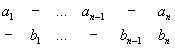
Let the total
score be  . Extending the above alignment by one more pair of indels,
we have
. Extending the above alignment by one more pair of indels,
we have
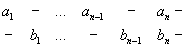
The new score is
 where
where  is the element of the
substitution matrix replacing an indel by an indel. If the new score is better
than
is the element of the
substitution matrix replacing an indel by an indel. If the new score is better
than  , it is trivial to construct even a better alignment (and
score) by adding yet another pair of indels with yet a better score of
, it is trivial to construct even a better alignment (and
score) by adding yet another pair of indels with yet a better score of  . The favorable extension with indels can proceed to infinite
and is unbound. We therefore
eliminate in our sequence-to-sequence alignments the possibility of
. The favorable extension with indels can proceed to infinite
and is unbound. We therefore
eliminate in our sequence-to-sequence alignments the possibility of  . Note however, that if we wish to compare more
than two sequences simultaneously (multiple sequence alignment), then the possibility of
matching a gap against a gap exists. For example, two gaps may appear in the element comparison
. Note however, that if we wish to compare more
than two sequences simultaneously (multiple sequence alignment), then the possibility of
matching a gap against a gap exists. For example, two gaps may appear in the element comparison  when matching three
sequences.
when matching three
sequences.
Ok. It is
settled then, the maximum length of  is
is  . How many possible alignments (with gaps) do we have? In a naïve approach, this
number may be related to the number of scores we need to compute before
deciding on the optimal alignment.
. How many possible alignments (with gaps) do we have? In a naïve approach, this
number may be related to the number of scores we need to compute before
deciding on the optimal alignment. Or how many we need to
examine before deciding on an optimal alignment?
1.2 Counting
alignments
To count the
number of possible alignments, and as a starting point of the discussion on optimal
alignments, we consider the dynamic matrix. The dynamic matrix is a table used
for the alignment of two sequences. Below we provide one example for two
sequences with the same length ( ). The rows are associated with the
  sequence and the
columns with the
sequence and the
columns with the  . The numbers at different matrix entries will be explained
below.
. The numbers at different matrix entries will be explained
below.


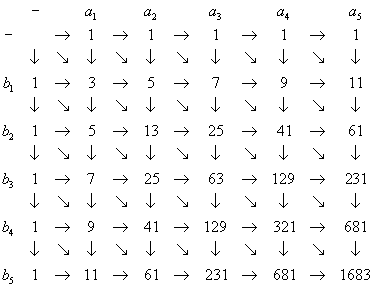
The hairy
picture with the numerous arrows is actually telling. Paths in this table,
which start at the upper left corner and end at the right lower corner, present
all the possible alignments of the whole two sequences. From each entry in the
dynamic matrix, there are three alternative moves: following Going down along the
diagonal, going straight
down, or
moving to the right. A step in the matrix, which is a part of a legitimate
alignment, never proceeds from to the left to right or
up. For example, the thick line in the above matrix corresponds to the
alignment:
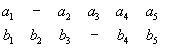
A move along a
diagonal aligns an amino acid against another amino acid. A vertical step in
the matrix aligns a “ ” amino acid against an indel and a horizontal step puts a
gap against an “
” amino acid against an indel and a horizontal step puts a
gap against an “ ” amino acid. Note that we use “
 ” for the gap “residue” (or an indel).
The numbers at
the different entries of the table denote the number of paths (alignments) that
can reach this point. For example, there are 5 possible alignments of  against
  (check the table
element at the cross between
(check the table
element at the cross between  and
and  ). They are:

The last three
alignments are essentially the sameinclude the same elements for
comparison and are their scores are therefore degenerate. It is therefore not
possible to
decide on a “best” alignment from the group of three. There is more than one
optimal alignment. At present, we consider all paths, including the
degenerate pathsones. In the Appendix a clever
counting protocol (by Dr. Jaroslaw Meller) is outlined that estimates the
number of non-degenerate paths. Interestingly, the exact number of non-degenerate
paths is  . It has the same asymptotic behavior as the approximate
lower-bound expression we sketched below for the number of all paths.
. It has the same asymptotic behavior as the approximate
lower-bound expression we sketched below for the number of all paths.
Another
interesting property of this table is a summation rule and the possibility of
constructing a recursion formula for the number of alignments. There are three
ways (“sources”) to extend a shorter alignment to obtain one of the five longer
alignments listed above. (a) Extend an earlier alignment by the pair  , a diagonal move in the above table. Alternatively, (b) the
pairs
, a diagonal move in the above table. Alternatively, (b) the
pairs  ,
or (c)
,
or (c)  (horizontal or
perpendicular moves in the above table) can be used to extend a shorter
alignment and to obtain a member of the above group.
(horizontal or
perpendicular moves in the above table) can be used to extend a shorter
alignment and to obtain a member of the above group.
Each of the
three “sources”  has
has its owna corresponding position
in the matrix. The
number at the entry to the matrix is the with a corresponding number
of alignmentspaths aligning a segment
of A against a segment of B. For example, before adding the pair  we were at a table
entry aligning
we were at a table
entry aligning  against
  . We find that there is only one-way of aligning
  against a gap and “1”
is indeed the corresponding entry.
against a gap and “1”
is indeed the corresponding entry.
Another example
of extending the alignment is to add a gap against  , which means that our earlier position in the table was the
alignment of
, which means that our earlier position in the table was the
alignment of  and
and  . The last alignment can be done in three different ways and
therefore the table entry is “3” (
. The last alignment can be done in three different ways and
therefore the table entry is “3” (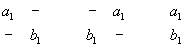 ).
).
If we add the
number of paths starting at the previous three “sources”, and
leading to the number of alignments of  with respect to
we obtainsummed up to  , exactly the number of alignments of our target.
To summarize the above empirical observations more precisely:
The number of
possible alignments of 
 -s against
 -s is defined as
  , this number can be determined using the recursive formula
  , and the initial conditions
  . Note that the definition of
  was done for
computational convenience and it does not imply that “nothing” against
“nothing” can be aligned in exactly one way.
was done for
computational convenience and it does not imply that “nothing” against
“nothing” can be aligned in exactly one way.
While this
formula can be used directly, it is useful to have a quick,n
order-of-magnitude estimate of the number of alignments. This estimate is
especially useful if we are planning a computation that will enumerate all of
the alignments. If a calculation is not feasible with existing computer
resources it is better knowing that it is not feasible in advance, and not after
a few weeks of futile attempts to execute the desired computation.
A simple lower
bound for  can be obtained
quickly.
can be obtained
quickly.  is a positive number,
so we can write
is a positive number,
so we can write  (we “forgot” for
convenience the term
(we “forgot” for
convenience the term  in the original
equality). So, the alternative recursion formula
in the original
equality). So, the alternative recursion formula  (with the same
initial conditions as for
(with the same
initial conditions as for  ) always yields lower numbers than
  . For
. For  we have a close
expression:
we have a close
expression: 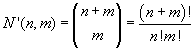 . This formula is easy to verify by direct substitution of
the closed expression to the recursion. Note that this
. This formula is easy to verify by direct substitution of
the closed expression to the recursion. Note that this I stheis the same as the (exact)
results derived by Meller for non-degenerate
paths (Appendix).
We now make use
of the Stirling
formula:  [x], valid for large
 -s.
-s.
The
logarithm of the number of alignments  is estimated as

And the lower
bound for the number of alignments is  . For a short protein (
 ;
;  ) the number is substantial.
 and is beyond what we can
do today in a systematic search. Even if the computation of a
single alignment requires a nanosecond ( second), which is unrealistically fast, it still necessary
to use
second), which is unrealistically fast, it still necessary
to use  to examine all
possible alignments.
to examine all
possible alignments.
If this is not
impressive enough, remember that this is a lower bound and the precise counting
of all paths will yield a number significantly larger than this one. For
example, for  we have
  already a number
significantly lower than the exact number in the table (1683). Hence, this estimate underlines
the
already a number
significantly lower than the exact number in the table (1683). Hence, this estimate underlines
the statement claim that it is impossible to examine all
alignments one by one
in order to find the alignment with the highest score.
Readers with a
background in structural biology may recall the Levinthal paradox in protein
folding. The paradox puts in contrasts
the huge number of plausible protein conformations and the efficiency in which
proteins fold in
nature. We
cannot be sure (until the next section) that there is a solution for the
sequence alignment problem. However, nature solves the protein folding problem. So at least the existence
of the solution for
the protein folding problem is confirmed. This is (again) in contrast to sequence alignment for which an
efficient solution exists.However, as As we see below a
large space to search does not necessarily mean that optimization in that space
is difficult. It is not obvious that the optimization must be performed at a
cost proportional to the volume of that space. In fact it can be profoundly
cheaper.
1.3 Dynamic programming and optimal alignments
After this long
detour, it is about the time to return to the basic question: What is the
optimal alignment of  and
and  ? The score matrix and the gap penalty are provided and we
need is to fish out the alignment(s) with the highest overall score(s). This is
a point in which algorithms developed by computer scientists can be extremely
useful. The fact that the number of possible alignments is exponentially large
in the sequence length does not mean that the search for the optimal alignment
needs to be done in exponential time. Sequence alignments can be done with
dynamic programming, an algorithm that requires only order of
? The score matrix and the gap penalty are provided and we
need is to fish out the alignment(s) with the highest overall score(s). This is
a point in which algorithms developed by computer scientists can be extremely
useful. The fact that the number of possible alignments is exponentially large
in the sequence length does not mean that the search for the optimal alignment
needs to be done in exponential time. Sequence alignments can be done with
dynamic programming, an algorithm that requires only order of  operations to find
the alignment with the best score, a remarkable saving compared to
operations to find
the alignment with the best score, a remarkable saving compared to 
operations- the number of all
possible alignments.
The efficient
search for the optimal alignments consists of two steps. In the first step a
dynamic matrix is
constructed (with different entries than what we have seen before) is
constructed and in the second step an optimal path is found in the
newly constructed table just
constructed. The first step is similar to the counting of possible
alignments and the recursive expression we wrote use to compute the
total number of alignments. We denote the optimal score of the alignment
of a sequence length  against a sequence
with length
against a sequence
with length  by
by  , and consider the following question:
Assuming that a very kind fellow gave us
the optimal scores for the following alignment:  ,
,  ,
,  , can we construct the score
  ?
?
The answer is
yes(!).
Since the total score is given by a sum of the scores of the individual aligned
pairs, we construct the score  from the three
alignments leading to it. We consider three possibilities to obtain an
alignment of
from the three
alignments leading to it. We consider three possibilities to obtain an
alignment of  against
  amino acids.
Option a:
Align  against
  amino acids (this
alignment has the known optimal score of
amino acids (this
alignment has the known optimal score of  ). Extend it by the alignment of
  with a score of
  which is the
substitution score according to the types of the amino acids at
which is the
substitution score according to the types of the amino acids at  and
and  (e.g., the BLOSUM
matrix). Hence the first suggestion for an optimal score is
(e.g., the BLOSUM
matrix). Hence the first suggestion for an optimal score is  .
.
Option b:
Align  amino acids against
  amino acids. This
alignment also has a known score, which is
amino acids. This
alignment also has a known score, which is  . Extend this alignment by
  with a corresponding
score
with a corresponding
score  for a gap. The second
possibility for an optimal alignment is therefore
for a gap. The second
possibility for an optimal alignment is therefore  .
.
Option c:
Align  amino acids against
  amino acids with the
known (optimal) score of
amino acids with the
known (optimal) score of  . Extend the alignment, by adding
  with a corresponding
score of
with a corresponding
score of  . The third suggestion is therefore
  .
.
Note that we use the simple model of gaps in which only a single score is associated with an indel, regardless of the amino acid it is aligned against.
Our final task is to select the highest score from one of the three alternatives:
 ,
,  ,
,  , which is the optimal score of
  .
.
More compactly,
we write: 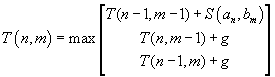
The above
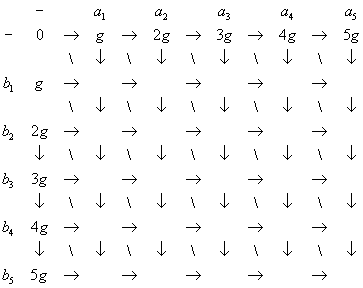
recursion can be used to fill with optimal scores the complete dynamic matrix.
We start with the condition 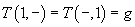 and use the initial
values to grow the matrix. For example,
and use the initial
values to grow the matrix. For example, 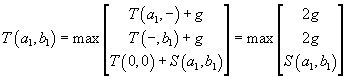
Where  denotes alignment of
nothing that (not surprisingly) scores zero. Another simple example is of
denotes alignment of
nothing that (not surprisingly) scores zero. Another simple example is of 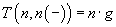 . Hence, there is
only one alignment against “all gaps” arrangement, providing us with immediate
optimal scores for the first row and column of the dynamic matrix. It is also
clear that similarly to the direct counting of the number of paths we can also
construct all the optimal scores.
. Hence, there is
only one alignment against “all gaps” arrangement, providing us with immediate
optimal scores for the first row and column of the dynamic matrix. It is also
clear that similarly to the direct counting of the number of paths we can also
construct all the optimal scores.
A simple pseudo code to create the dynamic matrix is given below
/* fill the first (zero) column and the first (zero) row */
T(0,0) = 0
Do I=1:n
T(I,0) = I*g
End do
Do I=1:m
T(0,I) = I*g
End do
/* Now fill the rest of the matrix picking the maximum value
from the three possibilities */
Do I = 1:n
Do J = 1:m
T(I,J) = max[ T(I-1,J)+g,
T(I,J-1)+g,
T(I-1,J-1)+S(a(i),b(j))]
End do
End do
Actually, if we
are primarily interested in the score of the alignment of  with respect to
  only a single element
of the dynamic matrix,
only a single element
of the dynamic matrix,  , is of interest. Of course, in order to get at it we need to
compute first the whole matrix. However this score, which is recorded at the
lower right side of the dynamic matrix, is only part of the story.
, is of interest. Of course, in order to get at it we need to
compute first the whole matrix. However this score, which is recorded at the
lower right side of the dynamic matrix, is only part of the story.
Besides the
score, in many cases, it is important to know the alignment itself. The path in
the dynamic matrix that corresponds to the optimal alignment can be found by a
trace-back procedure. Starting from  we ask “which of the
three possible steps could have generated the final optimal score? That is, we
examine the three possibilities
we ask “which of the
three possible steps could have generated the final optimal score? That is, we
examine the three possibilities
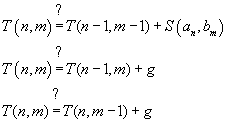
For at least one
of the tests above the equality will hold. It is possible that more than one
test is correct and in that case the optimal alignment is degenerate. Hence,
there is more than one alignment that provides an optimal score. Usually we
consider only one path. For example, if the first test is correct the alignment
ends with the pair:  and we repeat the
three tests to find the next path segment, this time starting from
and we repeat the
three tests to find the next path segment, this time starting from  . The process is repeated until it reaches the upper left
corner and provides the desired optimal alignment. The maximum number of times
that the process is repeated is
. The process is repeated until it reaches the upper left
corner and provides the desired optimal alignment. The maximum number of times
that the process is repeated is  (all the steps are
horizontal or vertical) and the smallest number of steps is either
(all the steps are
horizontal or vertical) and the smallest number of steps is either  or
or  , the larger number of the two.
We are also
ready for a rough estimate of the computational effort. As we discussed earlier
a lower bound on the number of possible alignments is  . Examining all possible alignments will require
computational effort that is growing exponentially with
. Examining all possible alignments will require
computational effort that is growing exponentially with  . The computations that we just described, using dynamics
programming, are much cheaper. Let us consider the two steps separately. In the
first step we create the dynamic matrix
. The computations that we just described, using dynamics
programming, are much cheaper. Let us consider the two steps separately. In the
first step we create the dynamic matrix  . To generate a single element we need (about) four
operations: Evaluating three expressions, and a decision which of the three is
the largest. The calculation of a single element is therefore independent of
. To generate a single element we need (about) four
operations: Evaluating three expressions, and a decision which of the three is
the largest. The calculation of a single element is therefore independent of  or
or  , and the cost associated with the computation of the matrix
is proportional to
, and the cost associated with the computation of the matrix
is proportional to  (the number of matrix
elements). To trace the path of alignment (once the matrix is known) takes a
maximum of
(the number of matrix
elements). To trace the path of alignment (once the matrix is known) takes a
maximum of  operations.