More on Gaussian random numbers:
We wish to generate pseudo-random numbers from a probability density
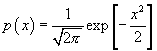 (1)
(1)
We discussed one way of producing these numbers from pseudo-random numbers that are sampled from a uniform probability density between zero and one. The first procedure was based on the Central Limit Theorem.
Here we consider an alternative that is based on the inverse of the distribution function.
The distribution function is defined
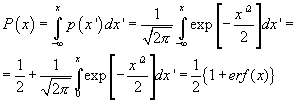 (2)
(2)
While the  is pretty well known,
there is no simple and close expression for
is pretty well known,
there is no simple and close expression for  (the inverse of the
distribution function). As a reminder, this inverse is really necessary, since
the way we sample points is by
(the inverse of the
distribution function). As a reminder, this inverse is really necessary, since
the way we sample points is by
- Sample a uniformly distributed
 between 0 and 1.
 - Compute x =

The lack of explicit expression for an inverse of a function is one of the common difficulties in using the above procedure. This is a point where there is a need to be creative in order to find a way around the problem. The Gaussian random numbers are so important that if a technique will not work in that case, it is a very bad sign…
Here is the solution for Gaussian pseudo-random numbers using an inverse of a distribution function:
The trick is to use a two-dimensional Gaussian instead of one-dimensional Gaussian. We have:
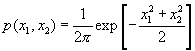
Consider the change of variable
to  and
and 
The probability density in the new variables is

The integral of the distribution function becomes (in the new variables)

If we now set  where
where  is uniformly distributed, we have
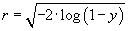
We note that the angle  is already
distributed uniformly between 0 and
is already
distributed uniformly between 0 and  . To generate
  , we sample uniform numbers
  between 0 and 1 and
multiply the
between 0 and 1 and
multiply the  by
by  .
.
The two random number  and
and  are computed from the
geometric relationship
are computed from the
geometric relationship

or
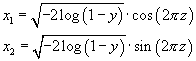
- Can we save a little time and replace
 by
by  ?
? - How would you get variances different from 1?
It is possible to avoid the (expensive) calculation of trigonometric function by using yet another trick of sampling points on the unit circle:
- Sample two uniformly distributed numbers
 between –1 and
1.
between –1 and
1. - Check that
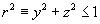 , repeat the sampling until satisfied
 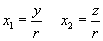 are Cartesian
coordinates sampled at the unit circle (therefore making it unnecessary to
use sine and cosine…)
are Cartesian
coordinates sampled at the unit circle (therefore making it unnecessary to
use sine and cosine…)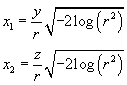 are Gaussian
random numbers without the need for trigonometric functions.
are Gaussian
random numbers without the need for trigonometric functions.