Conjugate gradient in linear algebra
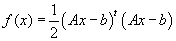
The basic target function to solve  is:
is:
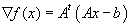
The gradient of the function
Starting from an initial point  , we search (in the steepest descent spirit) for a minimum
along the gradient direction at
, we search (in the steepest descent spirit) for a minimum
along the gradient direction at  , that is


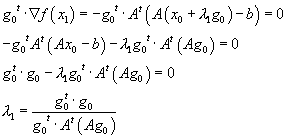
How to determine  ?
?
It is determined by the requirement that at the new
position,  , the gradient of the function
  is normal to
  (hence that we
minimized the function in the one dimensional search along
(hence that we
minimized the function in the one dimensional search along  )
)
If we continue in exactly the same way (i.e. define  ) then we are following the steepest descent algorithm.
Instead we add now the new twist (condition) that along the new direction
) then we are following the steepest descent algorithm.
Instead we add now the new twist (condition) that along the new direction  there will be no new
build up of the
there will be no new
build up of the  -- we have
  where the direction
  and the scalar
  are not known.
  is chosen in such a
way that there is no build-up of the gradient in the
is chosen in such a
way that there is no build-up of the gradient in the  direction (for any
  ). This ensures that by the end of the day we are fully
minimized in two directions
). This ensures that by the end of the day we are fully
minimized in two directions  and
and  .
.
Note that the rate of change of the gradient in the problem
at hand (quadratic problem) is a constant. This means that the condition we set
will work anywhere along the new line of search. This condition is (however)
only an approximation when functions more complex than a quadratic form are
considered. Note also that if we continue along the new direction  consists of
  then we do not
develop gradient components along
then we do not
develop gradient components along  and
and  .
.
Here is how we determine  and
and 
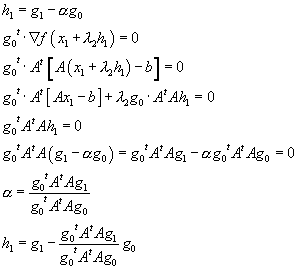
Once we determine the search direction we can compute  . We require that along the new search direction
  , the gradient of the function will be minimized.
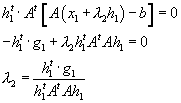
This process is repeated: e.g.
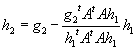
Another useful example of iterative procedure similar to this is
The determination of the largest eigenvalue:
For an arbitrary vector we have

where the  s are the eigenvectors of the matrix
computing  we have

enriching the largest eigenvalue. A process that can be repeated to desired accuracy.
How will you determine the lowest eigenvalue using CG?