MAFIA: A Maximal
Frequent Itemset Algorithm For
Transactional
Databases
Doug Burdick,
Manuel Calimlim, Johannes Gehrke
Department of
Computer Science
Cornell
University
Abstract:
We present a new algorithm for mining maximal frequent
itemsets from a transactional database.
Our algorithm is especially efficient when the itemsets in the database
are very long. The search strategy
of our algorithm integrates a depth-first traversal of the itemset lattice with
effective pruning mechanisms.
Our implementation of the search strategy combines a vertical
bitmap representation of the database with an efficient relative bitmap
compression schema. In a thorough
experimental analysis of our algorithm on real data, we isolate the effect of
the individual components of the algorithm. Our performance numbers show that our
algorithm outperforms previous work by a factor of three to
four.
1 Introduction
The association rule problem is a very important problem in
the data-mining field with numerous practical applications, including consumer
market-basket analysis, inferring patterns from web page access logs, and
network intrusion detection [7, 16, 14].
The association rule model and the support-confidence framework were
originally proposed by Agrawal et al [2, 3]. Let I be a set of items (we assume in the
remainder of the paper without loss of generality I = {1, … , N}). We call a subset of
I an itemset, and we call X a k-itemset if the cardinality of itemset
X is k. Let database
T be a multiset of subsets of I, and let support(X) be the
percentage of itemsets Y in T such that X  Y.
Informally, the support of an itemset measures how often X occurs in the database. If support(X) > minSup, we say that X is a frequent itemset, and we write X Î FI. If X is frequent and no superset
of X is frequent, we say that X is a maximally frequent itemset, and we write
X Î MFI.
Y.
Informally, the support of an itemset measures how often X occurs in the database. If support(X) > minSup, we say that X is a frequent itemset, and we write X Î FI. If X is frequent and no superset
of X is frequent, we say that X is a maximally frequent itemset, and we write
X Î MFI.
The process for finding association rules involves two
separate phases proposed by Agrawal et al [3]. In the first phase, we find the set of
frequent itemsets (FI) in the
database T. In the second step, we
use the set FI to generate
“interesting” patterns, and various forms of interestingness have been proposed
[6, 7, 9, 19, 24]. In practice, the
first phase is the most time-consuming [3]. Smaller alternatives to FI in the first phase that still
contain enough information for the second phase have been proposed including the
set of frequent closed itemsets FCI
[17, 18, 17, 27]. An itemset
X is closed if there does not exist an itemset X’ such that  and t(X) =
t(X’), with t(Y) defined as the set of transactions that
contain itemset Y.
It is straightforward to see that the following relationship
holds: MFI Ì FCI Ì FI.
and t(X) =
t(X’), with t(Y) defined as the set of transactions that
contain itemset Y.
It is straightforward to see that the following relationship
holds: MFI Ì FCI Ì FI.
The set MFI is
orders of magnitude smaller than the set FCI, which itself is orders of
magnitude smaller than the set FI. For domains where very long patterns
(patterns containing many items) are present in the data, it is often
impractical to generate the entire set of frequent itemsets or closed itemsets
[5]. Also, there are applications where the set of maximal patterns is adequate,
such as combinatorial pattern discovery in biological applications [20].
Much research has been done to develop faster methods for
generating all frequent itemsets efficiently [4, 8, 10, 12, 22, 23, 25] or just
the set of maximal frequent itemsets [1, 5, 11, 15, 26]. When the frequent patterns are long
(more than 15 to 20 items), FI and even FCI become exponentially
large and most traditional methods will end up counting too many itemsets to be
feasible. Straight Apriori-based
algorithms would count all of the 2k subsets of each k-itemset they
discover, and thus do not scale for long itemsets. Other methods use “lookaheads” to reduce
the number of itemsets to be counted (see Section 2 for a treatment of relevant
work). However, most of these
algorithms use a “breadth-first” approach, i.e. finding all k-itemsets before
considering (k+1) itemsets. This
approach limits the effectiveness of the lookaheads, since useful longer
frequent patterns have not yet been discovered. Recently, the merits of a
depth-first approach have been recognized [1].
The database representation is also an important factor in
the efficiency of generating and counting itemsets. Generating the itemset Z = (X
 Y) refers to creating t(Z) = t(X) ∩ t(Y), and
counting is the process of determining support(Z) in
T. Most previous algorithms
use the horizontal row layout, with the database organized as a set of rows and
each row representing a transaction.
The alternative vertical column layout associates with each item X
a set of transaction identifiers (tids) for the set t(X) [23]. The vertical representation allows
simple and efficient support counting (see Section 5).
Y) refers to creating t(Z) = t(X) ∩ t(Y), and
counting is the process of determining support(Z) in
T. Most previous algorithms
use the horizontal row layout, with the database organized as a set of rows and
each row representing a transaction.
The alternative vertical column layout associates with each item X
a set of transaction identifiers (tids) for the set t(X) [23]. The vertical representation allows
simple and efficient support counting (see Section 5).
1.1 Contributions Of This Paper
In this paper, we take a systems approach to the problem of
finding maximal large itemsets. We propose an efficient algorithm called
MAFIA (MAximal Frequent Itemset Algorithm)
that integrates a variety of old and new algorithmic contributions into a
practical algorithm. MAFIA assumes that the entire database (and all data
structures used for the algorithm) completely fit into main memory. With the size of current main memories
reaching gigabytes and growing, many moderate-sized to large databases will soon
become completely memory-resident.
Considering the computational complexity involved in finding long
patterns even in small databases with wide records, this assumption is not very
limiting in practice. Since all algorithms for finding association rules,
including algorithms that work with disk-resident databases, are CPU-bound, we
believe that our study sheds light on the most important performance
bottleneck.
MAFIA uses a depth-first search strategy for maximal large
itemsets with pruning methods that greatly reduce the number of itemsets
counted. Our implementation of
MAFIA uses a vertical bitmap data layout allowing for simple, efficient itemset
counting. We also describe a
compression schema that reduces the size of the bitmaps and significantly
increases the performance of MAFIA.
In a thorough experimental evaluation, we first quantify the
effect of each individual component on the performance of the algorithm. We then compare the performance of MAFIA
against DepthProject [1], the most efficient previously known algorithm for
finding maximal frequent itemsets.
Our results using real-life datasets indicate that MAFIA outperforms
DepthProject by a factor of three to four.
1.2 Paper Organization
The organization of the paper is as follows. Section 2 discusses the conceptual ideas
of the itemset lattice and subset tree we base our approach on. In Section 3, we describe the basic
depth-first algorithm and methods to prune the search space. Section 4 describes the representation
used for the MFI. Section 5
describes the database representation and counting methods, including
compression techniques that significantly speed up the counting process. We present an analysis of the components
of our algorithm and compare its performance to the DepthProject Algorithm in
Section 6. We conclude in Section 7
with a discussion of future work.
2 Formulations
In this section, we describe the conceptual framework of the
item subset lattice presented by Zaki in [26]. Assume there is a lexicographic ordering
 L of the items I in the database. If item i occurs before item j
in the ordering, then we denote this by
i
L of the items I in the database. If item i occurs before item j
in the ordering, then we denote this by
i L j.
This ordering can be used to enumerate the item subset lattice, or a
partial ordering over the powerset S of items I. We define the partial order
L j.
This ordering can be used to enumerate the item subset lattice, or a
partial ordering over the powerset S of items I. We define the partial order  on S1, S2
  S
such that S1
S
such that S1  S2 if
S1
S2 if
S1  S2. If
S1
S2. If
S1 S2, there is no relationship in the ordering.
Figure 1 is a sample of a complete subset lattice for four
items. The top element in the
lattice is the null subset and each lower level k contains all of the
k-itemsets. The k-itemsets are
ordered lexicographically on each level and all children are generated from the
lexicographically earliest subset in the previous level, e.g. itemset {1,2,3,4}
is generated from {1,2,3}, not from itemsets {1,2,4}, {1,3,4}, or {2,3,4}.
Generating children in this manner reduces the lattice to the lexicographic
subset tree originally presented by Rymon [21] and adopted by both Agarwal
[1] and Bayardo [5].
The itemset identifying each node will be referred to as the
node’s head, while possible extensions of the node are called the
tail. In a pure depth-first
traversal of the tree, the tail is all items lexicographically
larger than any element of the head.
With a dynamic reordering scheme, the tail contains only
the frequent extensions of the current node. Notice that all items that can appear in
a subtree are contained in the subtree root’s head union tail (HUT), a
set formed by combining all elements of the head and tail.
The problem of mining the frequent itemsets from the lattice
can be viewed as finding a cut through this lattice such that all elements above
the cut are frequent itemsets, and all elements (subsets) below are infrequent
(see Figure 1). The frequent
itemsets above the cut constitute as the positive border, while the
infrequent itemsets below the cut form the negative border. With a simple traversal (i.e. no
pruning), we need to count the supports of all elements above and including the
negative border. For example, in
Figure 1, a cut in the lattice has been drawn in and all of the itemsets shown
need to be counted except for {1,2,3,4} and {1,3,4}, since they are both below
the negative border.
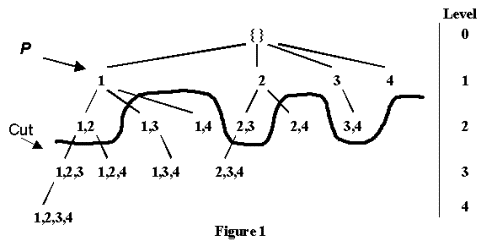
Consider node P in Figure 1 and the cut through
the lattice. P’s head
is {1} and the tail (before processing) is the set {2,3,4}. Therefore, P’s HUT is
{1,2,3,4}. Using dynamic
reordering, P’s children {1,2}, {1,3}, {1,4} will be counted
first. Based on the cut in Figure
1, only {1,2} is frequent. {3,4}
will be trimmed out of the tail of P and no new itemsets need to
be counted in the subtree rooted at P. In the rest of the search tree, itemsets
{2,3}, {2,4}, and {3,4} would also be counted. On the other hand, a pure depth-first
traversal would do extra work and compute {1,2,3}, {1,2,4}, and {2,3,4} in
addition to the itemsets counted using dynamic reordering. Thus, as the size of the tree scales
upward, dynamic reordering will trim out many branches of the search tree.
2.1 Related Work
Given this conceptual framework, we can describe the most
recent approaches to the maximal frequent itemset problem. As a baseline, Apriori traverses the
lattice in a pure breadth-first manner, discovering all frequent nodes at level
k before moving to level (k+1), and only finds support information by explicitly
generating and counting each node [3].
MaxMiner performs a breadth-first traversal of the search space as well,
but also performs lookaheads to prune out branches of the tree [5]. The lookaheads involve superset pruning,
using apriori in reverse (all subsets of a frequent itemset are also
frequent). In general, lookaheads
work better with a depth-first approach, but MaxMiner uses a breadth-first
approach to limit the number of passes over the database.
DepthProject [1] performs a mixed depth-first traversal of
the tree, along with variations of superset pruning. Instead of a pure depth-first traversal,
DepthProject uses dynamic reordering of children nodes. With dynamic reordering, the size of the
search space can be greatly reduced by trimming infrequent items out of each
node’s tail. Also proposed in
DepthProject is an improved counting method and a projection mechanism to reduce
the size of the database.
The other notable maximal pattern methods are based on
graph-theoretic approaches.
MaxClique and MaxEclat [26] both attempt to divide the subset lattice
into smaller pieces (“cliques”) and proceed to mine these in a bottom-up
Apriori-fashion with a vertical data representation. However, the algorithms both rely on a
pre-processing step having been performed that limits future mining
flexibility. Pincer-Search [15] also assumes a pre-processing step
has taken place before the algorithm executes.
The VIPER algorithm [23] has shown a method based on a
vertical layout can sometimes outperform even the optimal method using a
horizontal layout. It uses a
vertical bitvector with compression to store intermediate data during algorithm
execution, while counting is performed using a vertical tid-list approach. However, VIPER returns the entire set
FI and would not be appropriate for finding the set MFI if the
patterns are very long. Other
vertical mining methods for finding FI are presented in [13] and
[22]. An analysis of the impact of
different database representations on performance can be found in [8].
3 Algorithmic Descriptions
In this section, we describe the different components of the
algorithm and the various pruning methods used to reduce the search space. First, we describe the simple
depth-first traversal with no pruning.
We use this to motivate the pruning and ordering improvements introduced
in Section 3.2.
3.1 Simple DFS
In the
simple algorithm (see Figure 2), we traverse the lexicographic tree in pure
depth-first order. At each node n,
each element in the node’s tail is generated and counted as a possible
1-extension. If the support of {n’s
head}  {1-extension} is less than
minSup, then we can stop by the Apriori principle, since any itemset from
that possible 1-extension would have an infrequent subset. If none of the 1-extensions leads to a
frequent itemset, the node is a leaf.
{1-extension} is less than
minSup, then we can stop by the Apriori principle, since any itemset from
that possible 1-extension would have an infrequent subset. If none of the 1-extensions leads to a
frequent itemset, the node is a leaf.
Algorithmic
Descriptions and Pseudocode
Overview:
A simple DFS of the space. Lookups
in the MFI will only guarantee maximality and do not conduct any
pruning.
Pseudocode:
Simple (Current node C, MFI) {
For
each item i in C.tail {
newNode
= C  i
i
if newNode is
frequent
Simple(newNode, MFI)
}
if (C is a leaf and
C.head is not in MFI)
Add
C.head to MFI
}
Figure
2
Overview:
For each child generated, the transaction sets of the child and parent are
compared. If they match, the parent
can trim the tail by moving that child from the tail to the
head.
Pseudocode:
PEP (Current node C, MFI) {
For each item i in
C.tail
{
newNode
= C  i
i
if
(newNode.support == C. support)
Move i from C.tail to C.head
else
if newNode is frequent
PEP (newNode, MFI)
}
if (C is a leaf and
C.head is not in MFI)
Add
C.head to MFI
}
Figure
3
Overview:
A superset check is performed with {head}
 {tail} by
exploring the leftmost branch.
{tail} by
exploring the leftmost branch.
Pseudocode:
FHUT (node C, MFI, Boolean IsHUT) {
For each item i in
C.tail
{
newNode
= C  I
I
IsHUT
= whether i is the leftmost child in the tail
if
newNode is frequent
FHUT (newNode, MFI, IsHUT)
}
if (C is a leaf and
C.head is not in MFI)
Add
C.head to MFI
if (IsHUT and all
extensions are frequent)
Stop
exploring this subtree and go back up tree to when IsHUT was changed to
True
}
Figure
4
Overview:
Lookups in the MFI check whether the {head}
 {tail} is
frequent for superset pruning.
{tail} is
frequent for superset pruning.
Pseudocode:
HUTMFI (Current node C, MFI) {
name HUT =
C.head  C.tail;
if HUT is in
MFI
Stop
searching and return
For each item i in
C.tail
{
newNode
= C  I
I
if
newNode is frequent
HUTMFI(newNode, MFI)
}
if (C.head is not in
MFI)
Add
C.head to MFI
}
Figure
5
Overview:
All of the components from Figures 2-5 are included along with dynamic
reordering of children.
Pseudocode:
MAFIA (C, MFI, Boolean IsHUT) {
name HUT =
C.head  C.tail;
if HUT is in
MFI
Stop
generation of children and return
Count
all children, use PEP to trim the tail, and reorder by increasing support.
For each item i in
C.trimmed_tail {
IsHUT
= whether i is the first item in the tail
newNode
= C  I
I
MAFIA(newNode, MFI,
IsHUT)
}
if (IsHUT and all
extensions are frequent)
Stop
search and go back up subtree
if (C is a leaf and
C.head is not in MFI)
Add
C.head to MFI
}
Figure
6
Overview:
Compress bitmap X and all bitmaps in the tail to a smaller bitmap the
size of support(X)
Pseudocode:
Project(Bitmap X, node’s TAIL) {
For (each item I in
TAIL) {
Create empty bitmap I’
For
each transaction T
if bit T of X is on
Append bit T of I to I’
}
Create X’ – a bitmap
filled with ones and size of support(X)
Return set of projected
bitmaps I’ and X’
}
Figure
7
When we reach a leaf in the tree, we have a candidate for
entry into the MFI, since there are no frequent extensions of the current
node. However, a frequent superset
of the itemset may have already been discovered. For instance, suppose that the itemset
{1,2,3,4} was already discovered to be frequent (assuming a different cut in
Figure 1). When the algorithm
reaches the leaf {1,2,4}, there are no frequent extensions, but a frequent
superset already exists in the MFI.
Therefore, we need to check if a superset of the candidate itemset is
already in the MFI. If there is no
superset of the candidate in the MFI, then we add the candidate itemset to the
MFI. It is important to note that
with the depth-first traversal, we never have to worry about removing subsets
from the MFI. This is due to the
fact that itemsets already inserted into the MFI will be lexicographically
earlier (see Section 4 for more details on the MFI).
3.2 Pruning Away the Tree
While the simple depth-first traversal is a different
exploration of the search space, it is ultimately no better than a comparable
breadth-first approach, since the exact same space is generated and counted (all
elements above and including the negative border). To realize performance gains, we must
trim or prune out parts of the search tree by reusing information from earlier
discovered frequent itemsets.
3.2.1 Parent Equivalence Pruning (PEP)
One method of pruning involves comparing the transaction sets
of each parent/child pair (see Figure 3).
Let x be the node n’s head and y be an element in
the node n’s tail. If
t(x) Í
t(y), then any transaction containing x also contains
y. This guarantees that any
frequent itemset z containing x but not y has a frequent
superset, i.e. (z È
y). Since we only want the
maximal frequent itemsets, it is not necessary to count itemsets containing
x and not y.
Therefore, we can move item y from the tail to the head. For node n, x = x  y and element y is removed from n’s
tail.
y and element y is removed from n’s
tail.
3.2.2 FHUT
Another type of pruning that can be used is superset
pruning. We observe that at node
n, the largest possible frequent itemset contained in the subtree rooted
at n is n’s HUT (head union tail) as presented by Bayardo
[5]. If n’s HUT is
discovered to be frequent, we never have to explore any subsets of the HUT by
Apriori and thus can prune out the entire subtree rooted at node n. We refer to this method of pruning as
FHUT (Frequent Head Union Tail) pruning.
FHUT can be computed by exploring the leftmost path in the
subtree rooted at each node. In
fact, since the depth-first algorithm already explores the leftmost path, no
extra computation is necessary.
Careful use of passed boolean variables can determine which subtrees to
prune out of the search space (see Figure 4). A disadvantage of FHUT is that the
leftmost path contains the most items of any path in the subtree. Thus, while the subtree rooted at that
node is pruned, a large portion of the tree is still generated and counted.
3.2.3 HUTMFI
There are two methods for determining whether an itemset
x is frequent: direct counting of the support of x, and checking
if a superset of x has already been declared frequent. FHUT is one method for discovering if a
node’s HUT is frequent by counting the actual support of the HUT. Another way to determine HUT frequency
is to check if a superset of the HUT is in the MFI. If a superset does exist, then the HUT
must be frequent and the subtree rooted at that node can be pruned away. However, if no superset is found, that
does not mean that the HUT is infrequent. The subtree at that node must still be
explored.
We call this type of superset pruning HUTMFI (see
Figure 5). Note that HUTMFI does
not expand any children to check for successful superset pruning, unlike FHUT
where the leftmost branch of the subtree is explored. Therefore, in general, HUTMFI is
preferable to FHUT pruning.
3.3 Dynamic Reordering in MAFIA
The benefits of dynamically reordering the children of each
node based on support are significant.
However, dynamic reordering requires counting the support of all the
extensions of a node before processing the first child and thus, would not be a
pure depth-first traversal of the space.
Note that most of the elements of a node’s tail will
not be frequent extensions, and since tails are formed from all elements
lexicographically later than the head, these same infrequent items will appear
in many tails. Therefore, an
algorithm that trims the tail to only frequent extensions at a higher level will
save a great deal of computation.
For example in Figure 1, if the itemset {1,4} is counted and found to be
infrequent, then item 4 can be trimmed from the tail of all nodes in that
subtree. The end result is that the
itemsets {1,2,4}, {1,3,4} need never be counted in that subtree.
The order of the children is also an important
consideration. Ordering them by
increasing support will keep the search space as small as possible; the less
frequent nodes will have small subtrees while the more frequent nodes will
appear at the end of the tail and thus will be more likely to be trimmed by
superset pruning (both FHUT and HUTMFI).
This heuristic was first used by Bayardo [5]. Of particular note, PEP can be applied
much faster. Since PEP depends on
the support of each child relative to the parent’s support, pre-counting all
children can quickly identify when PEP holds. We can move all elements for which PEP
holds from the node’s tail to the node’s head at once, significantly reducing
the size of the tail.
Therefore, all of the components of the algorithm fit
together very nicely and help trim the search space. However, certain components are more
effective than others. The
interaction of the different pruning mechanisms and the effect on performance is
analyzed in Section 6.1.
4 Calculating Maximal Frequent Itemsets
With a depth-first traversal, all frequent itemsets found
will be in lexicographic order.
When a leaf is found, it is a candidate itemset, since there are
no frequent extensions. These two
facts have useful benefits in representing the set of Maximal Frequent Itemsets
(MFI). Since elements are added to
the MFI only when no frequent extensions exist and in lexicographic order, we
can guarantee that no superset of the candidate itemset will be added to the
MFI later in the search space.
The remaining problem is determining whether a superset of the candidate
itemset was added before the current itemset.
4.1 MFI Representation And Checking
Itemsets in the MFI are stored as horizontal bitmaps.
Contained in the bitmap is a bit for every item in the database, e.g. the
itemset {1,3,4} would be represented as the bitmap (1011). We call these bitmaps name
bitmaps to distinguish them from the transaction bitmaps used for
counting (see Section 5).
The name bitmaps provide a simple and efficient method for
superset checking. To determine if
itemset x1 is a superset of itemset x2, our algorithm will
bitwise-AND the bitmaps of x1 and x2 together. If the resulting bitmap matches
x2, then x2 is a subset of x1. A simple algorithm, then, for finding
supersets in the MFI is to bitwise-AND the candidate itemset’s name bitmap with
each element of the existing MFI.
If a superset is found, the candidate itemset is not added to the
MFI.
4.2 Optimization Of MFI Checks
The naïve approach to MFI checks is to search the entire MFI
set for each new itemset to insert.
However, this is clearly a quadratic time algorithm. As the number of items scales up and the
size of the MFI grows, MFI checks can significantly slow the running time. Is there a better solution using MFI
checks? An empirical analysis of
the MFI checks revealed a very interesting trend: over 90% of the supersets in
the MFI are found in the last 10 itemsets most recently inserted.
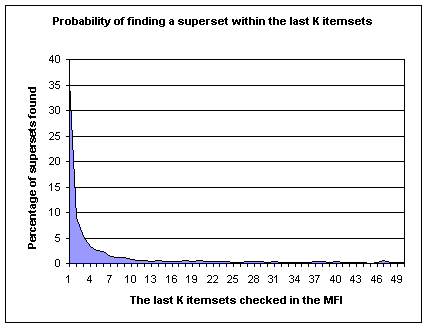
In Figure 8, we present a histogram of the number of itemsets
checked for a superset in the MFI, e.g. roughly 35% of all supersets can be
found at the last itemset inserted into the MFI, while less than 1% of the
supersets will be found at the 10th itemset recently inserted. Obviously, there is a very sharp drop
off in the graph. Searching beyond
50 itemsets only yields diminished returns. It is unlikely that a superset would be
found past 50 itemsets and the cost of searching the MFI increases
exponentially.
Figure
1
Therefore, a good approximation is to fix the number of
itemsets checked to a constant value.
The experimental data indicates that 50 itemsets yields a good compromise
between accuracy and time. Stopping
the search and declaring that no superset exists in the MFI can save a great
deal of computation. The
modification to the algorithm is simple: for each new itemset, the last 50
itemsets inserted into the MFI are checked for a possible superset. If all 50 MFI checks fail, then the new
itemset is added to the MFI.
4.3 Post-Processing
While the approximation of the last K-itemsets yields
dramatic savings, it also produces an MFI that is possibly slightly
inaccurate. It is unlikely, but not
impossible that there are supersets beyond the last 50 itemsets. Therefore, the MFI will contain extra
itemsets that are subsets of maximal frequent itemsets. If an exact representation of the MFI is
required, the non-maximal itemsets must be removed. Since this step would be conducted after
the tree has been explored, we call it the post-pruning phase. Other maximal frequent itemset
algorithms also return a superset of the MFI (MaxEclat and MaxClique [26]) and a
similar post-pruning step is used by Agarwal et al. in DepthProject[1].
5 Representation of the Database
5.1 Representation
We chose to use a vertical bitmap representation for each of
the items. In a vertical bitmap,
there is one bit for each transaction in the database. If item i appears in transaction
j, then bit j of the bitmap for item i is set to one;
otherwise, the bit is set to zero.
This naturally extends to itemsets.
Define X as the itemset corresponding to the head of the
node. Let onecount(X)
be the number of ones in the vertical bitmap for X. Note that the count of ones is exactly
the support of itemset X.
Let bitmap(X) correspond to the vertical bitmap that
represents the transaction set for the itemset X. For each element Y in the node’s
tail, t(X) ∩ t(Y) is simply computed as the bitwise-AND of
bitmap(X) and bitmap(Y).
5.2 Counting Support
As the fundamental step in generating each new node in the
lexicographic tree, support counting must be highly optimized. This necessity motivated the vertical
bitmap representation. We adapted a
two-phase byte counting method for generating and counting the extensions to an
itemset. Offline, we compute and
store the number of 1’s a particular byte value has for all 256 possible byte
values, e.g. byte value “2” has 1 one, “3” has 2 ones, and “255” has 8
ones. Generation of new itemset
bitmaps involves bitwise-ANDing bitmap(X) with a bitmap for 1-itemset
Y and storing the result in bitmap (X È
Y). Next, for each byte in
bitmap (X È
Y), we lookup the number of 1’s in the byte using the pre-computed
table. Summing these lookups gives
the support of (X È
Y).
5.3 Compression And Projected Bitmaps
The weakness of a vertical representation is the sparseness
of the bitmaps, especially at the lower support levels. Since every transaction has a bit in
vertical bitmaps, there are many zeros since both the absence and presence of
the itemset in a transaction need to be represented. However, in some cases this is the
smallest representation of the information we need possible. Given the generating and counting method
presented above, this presents a source of inefficiency since we are performing
wasted operations over regions containing useless information (regions of only
0’s in X’s bit vector).
We can make the observation that we only need information
about transactions containing the itemset X to count the support of the
subtree rooted at node N. If
transaction T does not contain the itemset X (X’s bit
vector has a 0 in bit T), then it will not provide useful information for
counting supports of N’s children and can be ignored in all subsequent
operations. So, conceptually we can
remove the bit for transaction T from X and all items in N’s
tail. This is a form of compression
of the vertical bitmaps to speed up calculations. The pseudocode describing the process
can be found in Figure 7.
In the projected bit vector for X all positions have
value 1, since each position corresponds to a transaction needed for computation
in the subtree rooted at node N.
We are guaranteed to consider every element in N’s tail at least
once when traversing the subtree rooted at N. The projection operation is
performed when the support of itemset X drops below a certain
rebuilding_threshold, expressed as a percentage of bitmap
X’s overall size (in bits).
However, there is a tradeoff on the value selected for
rebuilding_threshold.
As the rebuilding_threshold decreases, the cost of
projection rises, since many more nodes at the lower levels of the tree will
need to be projected. On the other
hand, the size of the projected bitmaps is guaranteed to be smaller and thus the
cost of subsequent generation and counting in that subtree is significantly
reduced. In practice, we found that
there is only a small difference in choosing a value for
rebuilding_threshold between 0.25 and 1. Below 0.25, the cost of rebuilding
exceeds the savings of using projected bitmaps, but between .25 and 1, the cost
of projection is balanced by the smaller vertical bitmaps. The reason for this result is that the
size of the projected bitmaps when built immediately
(rebuilding_threshold = 1) depends only on the support of the
frequent 1-itemsets they are projected against. In the real datasets considered, many
1-itemsets have low supports, and thus, any rebuilding_threshold
above the supports will yield the same projected bitmaps.
6 Experimental Results
The experiments were conducted on a 933 Mhz Pentium III with
512 MB of memory running Microsoft Windows 2000. All code was compiled using
Microsoft Visual C++ 6.0. MAFIA was
tested on three datasets that have been shown to generate long patterns [1,5]:
connect-4, mushroom, and chess. In
general, at the higher supports, the patterns vary between 5-12 items long,
while at lower supports the patterns contain over 20 items. A detailed comparison of MAFIA on these
datasets was conducted, since MAFIA yields the greatest gains when mining long
patterns from a database.
6.1 Algorithmic Component Analysis
First however, we present a full analysis of each component
of the MAFIA algorithm (see Section 3 for algorithmic details). There are three types of pruning used to
trim the tree: FHUT, HUTMFI, and PEP.
FHUT and HUTMFI are both forms of superset pruning and thus will tend to
“overlap” in their efficacy for reducing the search space. In addition, dynamic reordering will
significantly reduce the size of the search space by removing infrequent items
from each node’s tail.
Figures 9 and 10 show the effects of each component of the
MAFIA algorithm on the mushroom dataset at 1% minimum support. The number of transactions was increased
by repeating all transactions in the database by a certain scaling factor. We call this form of scaling vertical
scaling. In this case, mushroom
was scaled ten times vertically.
Note that vertical scaling will not change the search space, and will
only affect the time taken for counting the support of itemsets.
The components of the algorithm are represented in a
cube format, where the running times for all possible combinations are
shown. The top of the cube shows
the time for a simple traversal where the full search space is explored, while
the bottom of the cube corresponds to all three pruning methods being used. Two separate cubes (with and without
dynamic reordering) rather than one giant cube are presented for
readability.
Note that all pruning components yield some savings in
running time, but that certain components are more effective than others. In particular, HUTMFI and FHUT yield
very similar results, since they use the same type of superset pruning, but with
different methods of implementation.
The efficient MFI lookups that HUTMFI uses to check for frequency
explains why HUTMFI outperforms FHUT (see Sections 3 and 4). It is also interesting to see that
adding FHUT when HUTMFI is already performed yields very little savings, i.e.
from [HM] to [HM+FH] or from [HM+PEP] to [ALL], the running times do not
significantly change. HUTMFI checks
for the frequency of a node’s HUT by looking for a frequent superset in the MFI,
while FHUT will explore the leftmost branch of the subtree rooted at that
node. Apparently, there are very
few cases where a superset of a node’s HUT is not in the MFI, but the HUT is
frequent.
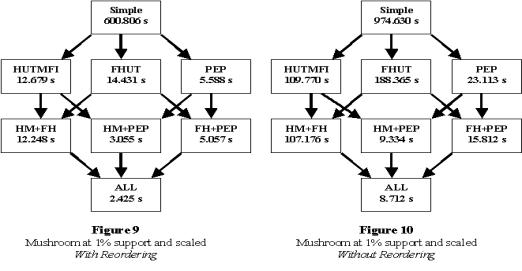
PEP has the biggest effect of the three pruning methods. All of the running time of the algorithm
occurs at the lower levels of the tree where the border between frequent and
infrequent itemsets exists, and since PEP is most likely to trim out large
sections at the lower levels, this pruning yields the greatest results. Dynamically reordering the tail also has
dramatic savings (cf. Figure 9 with Figure 10). It is interesting to note that without
PEP, dynamic reordering runs nearly an order of magnitude faster than the static
ordering, while with PEP, it is “only” 3-5 times faster. Since both PEP and reordering remove
elements from a node’s tail, it is not surprising that they overlap in their
efficacy.
6.2 Comparison With DepthProject
We tested the algorithm on “real” datasets containing long
patterns that have been used earlier [1,5]. These datasets are publicly available
from the UCI Machine Learning Repository.
At the lowest supports tested, the longest patterns in these databases
have over 20 items, making any algorithm that examines all possible subsets of
these patterns (or a significant portion) infeasible. This makes the task of finding the
patterns computationally intensive despite the small size of the databases. For some of the experiments the
databases were scaled vertically by concatenating copies of the database
together. This only affects the
time counting takes since the bitmaps (compressed or not) are longer and the
search space examined remains constant.
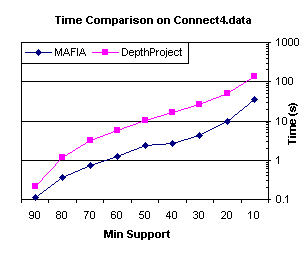
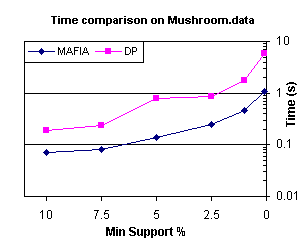
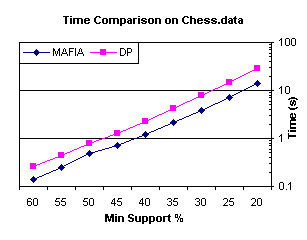
Figures 11 – 13 illustrate the results of comparing MAFIA to
our implementation of the DepthProject [1] method, the state-of-the-art method
for finding maximal patterns. The
x-axis is the user-specified minimum support, while the Y-axis uses a
logarithmic scale to show the running time.
In Figures 11 and 12, we see MAFIA is approximately four to
five times faster than DepthProject on both the Connect-4 and Mushroom datasets
for all support levels tested (down to 10% support in Connect-4 and 0.1% in
Mushroom). These were the most
striking performance improvements.
For Connect-4, the increased efficiency of itemset generation and support
counting in MAFIA versus DepthProject explains the improvement. Connect-4 contains an order of magnitude
more transactions than the other two datasets (67,557 transactions), amplifying
the MAFIA advantage in generation and counting.
Depth |
1 |
2 |
3 |
4 |
5 |
6 |
7 |
8 |
|
|
1.23 |
4.22 |
16.46 |
61.07 |
134.8 |
169.06 |
79.98 |
50.43 |
|
Mushroom |
1 |
12.64 |
51.81 |
73.15 |
72.92 |
56.81 |
41.29 |
26.78 |
|
Chess |
1.33 |
4.14 |
5.73 |
6.51 |
6.73 |
6.7 |
5.97 |
4.95 |
Table 1 – Reduction Factor of Nodes Considered due to PEP
pruning
In Figure 13, we see that MAFIA is only a factor of two
better than DepthProject on the dataset Chess. The extremely low number of transactions
in Chess (3196 transactions) and the small number of frequent 1-items at low
supports (only 54 at lowest tested support) muted the factors that MAFIA relies
on to improve over DepthProject.
Table 1 shows the reduction in itemsets using PEP for Chess was an order
of magnitude lower compared to the other two data sets for all depths.
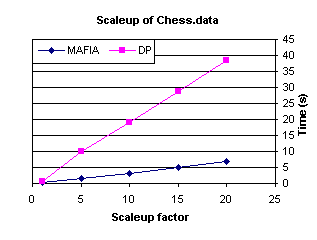
To test the counting conjecture, we ran an experiment that
vertically scaled the Chess dataset and fixed the support at 50%. This keeps the search space constant
while varying only the generation and counting efficiency differences between
MAFIA and DepthProject. The result
is shown in Figure 14. We notice
both algorithms scale linearly with the database size, but the scaleup factor
for MAFIA is much smaller than for DepthProject. Similar results were found for the other
datasets as well. Thus, we see
MAFIA scales very well vertically.
6.3 Effects Of Compression
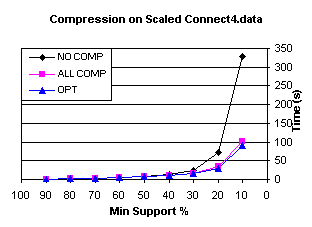
To isolate the effect of the compression schema on
performance, experiments with varying rebuilding_threshold values were
conducted. The most interesting
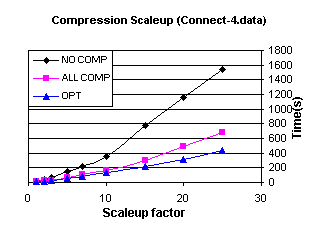
result is on a scaled version of Connect-4, displayed in Figure 15. The connect-4 dataset was scaled
vertically three times, so the total number of transactions is approximately
200,000. Three different values for
rebuilding_threshold were used: 0 (corresponding to no compression), 1
(compression immediately, and all subsequent operations performed on compressed
bitmaps), and an optimized value tied to minSup (the greater of (2*
minSup) or 25%). We see for higher
supports above 40% compression has a negligible effect over no compression, but
at the lowest supports compression can be quite beneficial, e.g. at 10% support
compression yields a savings factor of 3.6.

6.4 Raw Data Gathered During Experiments
Included in these tables are the number of maximal frequent
itemsets, the number of itemsets found by MAFIA, and the comparative running
times (in seconds) of MAFIA and DepthProject at various supports.
|
Connect-4 |
|
|
|
|
|
|
|
|
|
|
%
support |
90 |
80 |
70 |
60 |
50 |
40 |
30 |
20 |
10 |
|
MFISize |
222 |
673 |
1220 |
2103 |
3758 |
6213 |
11039 |
32571 |
130986 |
|
Itemsets
found |
222 |
673 |
1220 |
2103 |
3758 |
6213 |
11039 |
32571 |
130986 |
|
MAFIA |
0.11 |
0.36 |
0.72 |
1.28 |
2.34 |
2.72 |
4.19 |
9.45 |
35.12 |
|
DepthProject |
0.23 |
1.16 |
3.20 |
5.70 |
10.03 |
16.51 |
26.26 |
50.77 |
134.90 |
|
Mushroom |
|
|
|
|
|
|
|
%
support |
10 |
7.5 |
5 |
2.5 |
1 |
0.1 |
|
MFISize |
547 |
909 |
1442 |
3036 |
6768 |
27712 |
|
Itemsets
found |
629 |
1046 |
1789 |
3969 |
8946 |
36873 |
|
MAFIA |
0.07 |
0.08 |
0.14 |
0.25 |
0.46 |
1.08 |
|
DepthProject |
0.18 |
0.23 |
0.80 |
0.87 |
1.77 |
5.92 |
|
Chess |
|
|
|
|
|
|
|
|
|
|
%
support |
60 |
55 |
50 |
45 |
40 |
35 |
30 |
25 |
20 |
|
MFISize |
3323 |
6262 |
11463 |
20628 |
38050 |
71166 |
134624 |
260092 |
509335 |
|
Itemsets
Found |
3330 |
6318 |
11693 |
21280 |
39813 |
75838 |
146655 |
290774 |
588858 |
|
MAFIA |
0.14 |
0.25 |
0.48 |
0.70 |
1.22 |
2.20 |
3.75 |
6.98 |
13.8 |
|
DepthProject |
0.25 |
0.45 |
0.76 |
1.29 |
2.26 |
4.12 |
7.88 |
14.72 |
28.66 |
7
Conclusions
In this paper we presented MAFIA, an algorithm for finding
maximal frequent itemsets, which uses a depth-first traversal of the search
space. Our experimental results
demonstrated MAFIA consistently outperformed DepthProject, which represents the
state-of-the-art in finding maximal frequent itemsets in data with large
itemsets, by a factor of 3 to 4.
The breakdown of the algorithmic components showed parent-equivalence
pruning and dynamic reordering were quite beneficial in reducing the search
space while relative compression/projection of the vertical bitmaps dramatically
cuts the cost of counting supports of itemsets and increases the vertical
scalability of MAFIA.
For future work, we propose exploring application of the
depth-first search with vertical bitmap representation to find the set of
frequent closed itemsets (FCI).
Also, modifications of the algorithm to handle disk-resident data and to
use more advanced compression techniques for the bitmaps will be
pursued.
8
Acknowledgements
We would like to thank Charu Aggarwal for discussing
DepthProject and giving us advise on its implementation. We also thank Jayant R. Haritsa for his insightful comments on
the MAFIA algorithm and Jiawei Han for helping in our understanding of CLOSET
and providing us the executable of the FP-Tree algorithm.
References:
[1] R. Agarwal,
C.Aggarwal, and V. V. V. Prasad. A
Tree Projection Algorithm for Generation of Frequent Itemsets. In Journal of Parallel and
Distributed Computing (special issue on high performance data mining), (to
appear), 2000.
[2] R. Agrawal, T.
Imielinski, and R. Srikant. Mining
association rules between sets of items in large databases. SIGMOD, May 1993.
[3] R. Agrawal, R. Srikant:
Fast Algorithms for Mining Association Rules, Proc. of the 20th Int'l
Conference on Very Large Databases, Santiago, Chile, Sept. 1994.
[4] R.
Agrawal, H. Mannila, R. Srikant, H. Toivonen and A. I. Verkamo, Fast Discovery
of Association Rules, Advances in Knowledge Discovery and Data Mining,
Chapter 12, AAAI/MIT Press, 1995.
[5] R. J.
Bayardo. Efficiently mining long patterns from databases. In Proc. 1998
ACM-SIGMOD Int. Conf. Management of Data (SIGMOD ‘98), pages 85-93, Seattle,
Washington, June 1998
[6] R. J.
Bayardo Jr. and R. Agrawal. Mining
the Most Interesting Rules. In
Proc. of the 5th ACM SIGKDD Int'l Conf. on Knowledge Discovery and Data
Mining, 145-154, August 1999.
[7] Sergey
Brin, Rajeev Motwani, Jeffrey D. Ullman, and Shalom Tsur. Dynamic itemset counting and implication
rules for market basket data.
SIGMOD Record (ACM Special Interest Group on Management of Data),
26(2):255, 1997.
[8] B. Dunkel
and N. Soparkar. Data Organization and access for efficient data mining. In
Proc. Of 15th Intl. Conf. On Data Engineering (ICDE),
1999.
[9] T. Fukuda,
Y. Morimoto, S. Morishita, and T. Tokuyama. Data mining using two-dimensional
optimized association rules: Scheme, algorithms, and visualization. In Proc. 1996 ACM-SIGMOD Int. Conf.
Management of Data, pages 13--23, Montreal, Canada, June 1996.
[10] G. Gardarin, P.
Pucheral, and F. Wu. Bitmap based algorithms for mining association rules.
Technical report 1998-18, University of Versailles, 1998.
[11] Dimitrios Gunopulos,
Heikki Mannila, Sanjeev Saluja: Discovering All Most Specific Sentences by
Randomized Algorithms. ICDT 1997:
215-229
[12] Jiawei Han, Jian Pei, Yiwen
Yin: Mining Frequent Patterns without Candidate Generation. SIGMOD Conference
2000: 1-12.
[13] Marcel Holsheimer, Martin L.
Kersten, Heikki Mannila, Hannu Toivonen: A Perspective on Databases and Data
Mining. KDD 1995: 150-155.
[14] W. Lee and S. J.
Stolfo. Data mining approaches for intrusion detection. In Proceedings of the
7th USENIX Security Symposium, 1998.
[15]
D.I. Lin and Z.
M. Kedem. Pincer search: A new
algorithm for discovering the maximum frequent sets. In Proc. of the 6th
Int'l Conference on Extending Database Technology (EDBT), Valencia, Spain,
1998.
[16] B. Mobasher, N. Jain, E.H.
Han, and J. Srivastava. Web mining: Pattern discovery from world wide web
transactions. Technical Report TR-96050, Department of Computer Science,
University of Minnesota, Minneapolis, 1996
[17] N. Pasquier, Y.
Bastide, R. Taouil, and L. Lakhal.
Discovering frequent closed itemsets for association rules. In Proc. 7th Int. Conf.
Database Theory (ICDT ‘99), pages 398-416, Jerusalem, Israel, January
1999.
[18] J. Pei, J. Han, and R.
Mao. CLOSET: An efficient algorithm
for mining frequent closed itemsets, In Proc. ACM SIGMOD Workshop on Research
Issues in Data Mining and Knowledge Discovery, Dallas, TX, May, 2000.
[19] Rastogi R., and Shim K. Mining Optimized Association Rules with
Categorical and Numeric Attributes.
In Proceedings of the International Conference on Data
Engineering, Orlando, Florida, February 1998.
[20] Rigoutsos, I., and
Floratos, A. Combinatorial pattern
discovery in biological sequences: The Teiresias algorithm.
Bioinformatics 14, 1 (1998), 55-67.
[21] Rymon, R. 1992. Search through Systematic Set
Enumeration. In Proc. Of Third
Int’l Conf. On Principles of Knowledge Representation and Reasoning, 539
–550.
[22] A. Savasere, E.
Omiecinski, and S. Navathe. An
efficient algorithm for mining association rules in large databases. In 21st VLDB Conference, 1995.
[23] Pradeep Shenoy, Jayant R.
Haritsa, S. Sudarshan, Gaurav Bhalotia, Mayank Bawa, Devavrat Shah:
Turbo-charging Vertical Mining of Large Databases. SIGMOD Conference 2000:
22-33
[24] Geoffrey I.
Webb. OPUS: An efficient admissible
algorithm for unordered search.
Journal of Artificial Intelligence Research, 3:45--83, 1996.
[25] L. Yip, K.K. Loo, Ben
Kao, David Cheung, C.K. Cheng, Lgen.
A Lattice-Based Candidate Set Generation Algorithm for I/O Efficient
Association Rule Mining, in the Third Pacific-Asia Conference on
Knowledge Discovery and Data Mining (PAKDD '99), Beijing,
1999.
[26] Mohammed J. Zaki,
Scalable Algorithms for Association Mining, in IEEE Transactions on
Knowledge and Data Engineering, Vol. 12, No. 3, pp 372-390, May/June
2000.
[27] M. J. Zaki and C. Hsiao.
CHARM: An efficient algorithm for
closed association rule mining. In Technical Report