This problem several parts. You will write your solutions in the appropriate files and submit the files separately on CMS. To get you started, we are providing a zip file ps3.zip containing several files. You can edit the necessary files, and submit your solution using CMS when you have finished. Remember that non-compiles and warnings will receive an automatic zero.
You will compile multiple structures at once using the Compilation Manager (CM). We provided a file sources.cm that contains a list of all files that need to be compiled. Use the compilation manager by typing CM.make(); at the command prompt. This command will automatically compile all of the programs that have changed since the last time CM was invoked.
[Download the zip file ps3.zip]
A multivariate polynomial is a polynomial with multiple variables. For instance, P(x,y) = x2y+ 3xy3 - 2y + 1 is a polynomial with two variables. Since the actual names of variables are not relevant, we can use canonical names: x1 for the first variable, x2 for the second, and so on. For instance, the polynomial P becomes: P(x1,x2) = x12x2 + 3x1x23 - 2x2 + 1. A polynomial is a sum of terms, where each term is the product between an non-zero integer coefficient and some non-negative, integer powers of the coefficients. That is, each term is of the form c1 x1p1... xnpn. In the example above, x12x2, 3x1x23, -2x2, and 1 are the four terms of polynomial P.
Polynomilas will be implemented as follows. Each term c*x1p1*...*xnpn is implemented using a record that contains the coefficient c and powers p1, ..., pn: {coeff=c, powers=[p1, .., pn]}. Terms with coefficients equal to zero are omitted. A polynomial is a record that holds the number of variables and a sorted list of terms. Polynomial zero has no terms.
type term = {coeff:int, powers:int list}

type poly = {nvars:int, terms:term list}
For instance, the above polynomial P is represented as:
{ nvars=2,

  terms=[{coeff=1,  powers=[2,1]}, {coeff=3, powers=[1,3]},

         {coeff=~2, powers=[0,1]}, {coeff=1, powers=[0,0]}] }
The list of powers in each term must have length equal to the number of
variables in the polynomial. This is also the case for terms where some, or all
the powers are zero. For instance, {coeff=~2, powers=[0,1]} or
{coeff=1, powers=[0,0]}. The list of terms is sorted by the
lexicographic ordering of the powers in each term, in decreasing order.
In the example polynomial P, term x12x2 must
occur before term 3x1x23 (because power of x1
decreases), and -2x2 must occur before term 1 (because power of x1
is the same, but the power of x2 decreases). The provided function
comparePowers yields the lexicographic ordering of two lists of
powers. Finally, no duplicate terms are allowed in a polynomial, i.e., 2xy + 4x
+ 3xy should be 5xy + 4x.
Work to be done:
poly.sig. The existing
specs may be missing, incomplete, or even incorrect. Examine each function
and decide what needs to be properly specified. You should not add
new exceptions to the interface. In case of errors, the functions will raise
Fail. repOK function that checks if a polynomial
satisfies the representation invariant. If it does, then the same polynomial
is returned, otherwise Fail is raised. Document your repOk
function with the representation invariant that this function checks.val repOK : poly -> poly zero builds a polynomial with value zero; its argument
represents the number of variables. Function singleton builds a
polynomial representing a single term. Given a coefficient c and a list [p1,...,pn],
singleton builds the polynomial c *x1p1*...
*xnpn.val zero : int -> poly val singleton : int * int list -> poly
val eval : int list * poly -> intval plus : poly * poly -> poly
val times : poly * poly -> poly
"a^2b + 3ab^3 -
	2b + 1"
val toString : poly -> string To do: Submit your solutions in the
poly.sig and
poly.sml files.
A trie is a tree structure whose edges are labeled with the elements of the alphabet. Each node can have up to N children, where N is the size of the alphabet. Nodes correspond to strings of elements of the alphabet. More precisely, each node corresponds to the sequence of elements traversed on the path from the root to that node. The map binds a string s to a value v by storing the value v in the node of s. The advantage of this scheme is that if efficiently represents common string prefixes, and lookups or inserts are achieved using quick searches starting from the root.
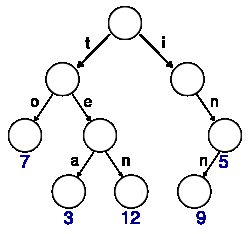
Suppose we want to build a map from strings of ASCII characters to integer codes. In this case, edges are labeled with ASCII characters, and integer codes are stored in (some of) the nodes. Here is an example:
The above trie describes the map {"to"->7, "tea"->3,
"ten"->12, "in"->5, "inn"->9}. The values (shown in blue) are stored in
the nodes. Note that nodes might not have values. For instance the node that
corresponds to string "te" doesn't have a value. Hence, "te"
is not in the map.
Your task is to do the following:
TRIE. The existing specifications may be incomplete, incorrect, or
nonexistent. type 'a trie = (* your implementation here *)
empty value,
representing an empty trie. Then implement the functions put,
get, size, and tabulate. The
put function adds a new mapping to a trie. If the key already exists
in the trie, its binding is updated.
The function get returns the binding of a string in the trie.
If the string does not exist in the trie, then an exception NotFound
must be raised. val empty: 'a trie val put: 'a trie * string * 'a -> 'a trie val get: 'a trie * string -> 'a
Note: the course
staff will use these functions to generate the inputs for testing other functions.
Therefore, be careful to implement them correctly.
size returns the size
(i.e., number of bindings) of
a trie; tabulate n f creates a new trie with n bindings,
where binding k is f(k), for k between 0 and n-1; and fold f v t.
performs folding over trie t, starting with initial accumulator value v,
applying function f at each step. Computing the size of the trie must be an
O(1) operation. Fold must visit key-value bindings using a
preorder
traversal of the trie.val size: 'a trie -> int val tabulate: int -> (int -> string * 'a) -> 'a trie val fold: (string * 'a * 'b -> 'b) -> 'b -> 'a trie -> 'b
sort: string list -> string list that sorts a list
of strings using a trie. The returned list must be sorted in ascending lexicographical
order. The algorithm must have O(n) complexity, where n is the sum of the lengths of all
strings. Consider the following six possible specifications for a function f
of type int*int -> int :
Returns: f(a, b) = a*b Returns: f(a, b) >= 0 Returns: f(a, b) = max(a, b). Checks: a, b >= 0 Returns: f(a, b) >= b Returns: f(a, b) = a*a
Returns: f(a, b) >= 0. Requires: a is even Draw a diagram that describes the refinement relation among these specifications. The diagram should contain the names A through G. If specification 1 is a refinement of specification 2, draw a line between the two corresponding letters, and make sure that the name of specification 2 is higher in the diagram than that of spec 1. For example, the diagram should contain at least the following arc:
     B
     |
     E
When there is a line between 1 and 2, and between 2 and 3, the line between 1 and 3 can be omitted in the diagram. (This kind of diagram is known as a Hasse diagram, after its inventor).
To do: turn in the solution in the fileswritten.txt.
The following problem will count for 5 bonus points (but the total max is still 100). Consider the following four higher-order functions.
fun peel f x = (f (x div 10) (x mod 10))
fun sub f x y = (f (Int.abs(y*y-x)))
fun swap f x y = (f y x)
fun dummy x = x
We can think of these four functions as basic building blocks, and construct
new functions with them, without using any operators, literals, constants,
keywords, functions, etc. For instance, we can define "val magic =
peel(sub dummy)". The problem asks you to write three magic expressions
magic1, magic2, and magic3 that will
yield the values indicated below. For each answer, provide a high-level
explanation (i.e., not the step-by-step evaluation) why they produce the desired
results:
magic1 42 = 14
magic2 4 = 5
magic3 312 = 62
Turn in the solution in the file hofun.sml.